
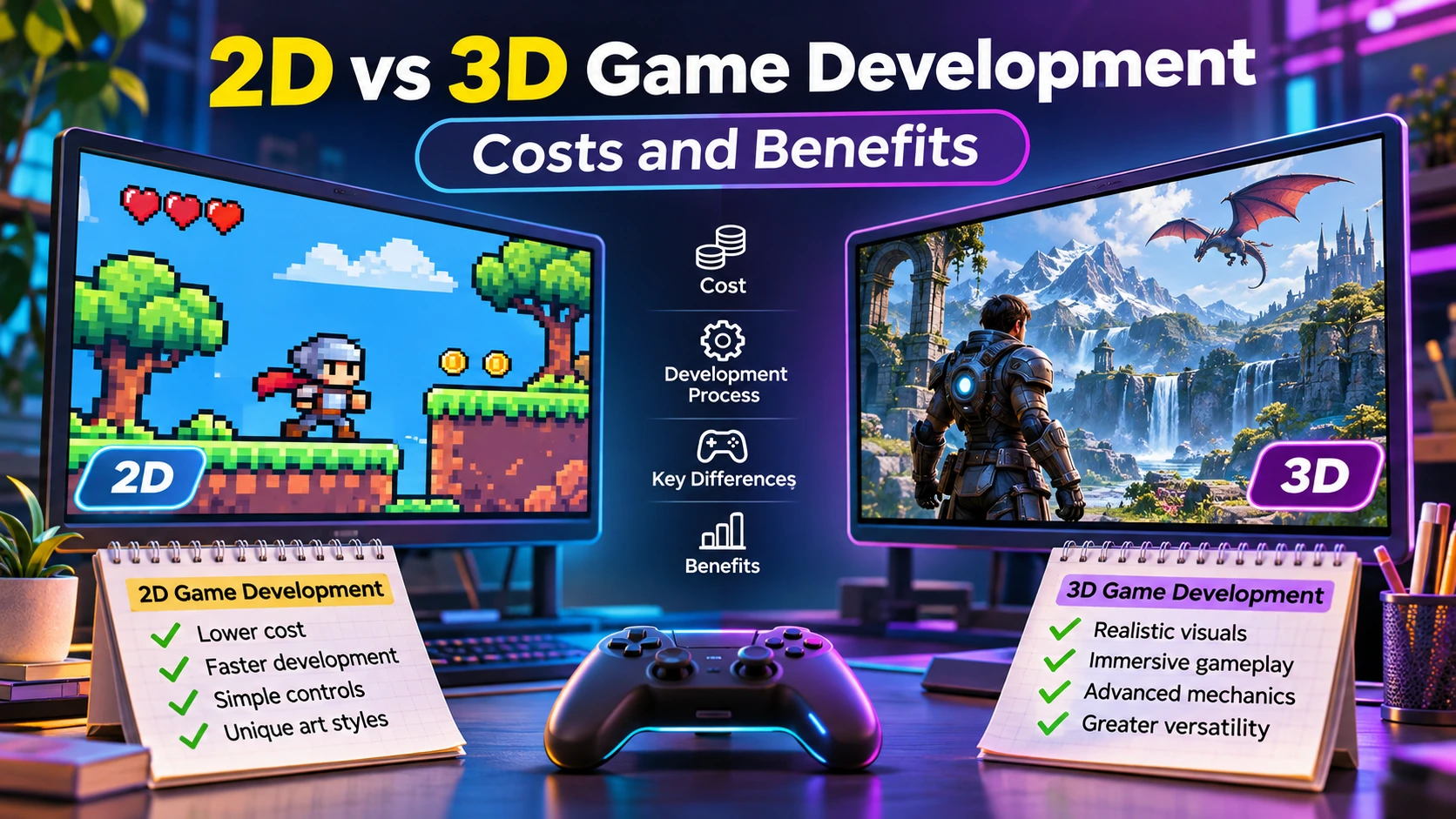
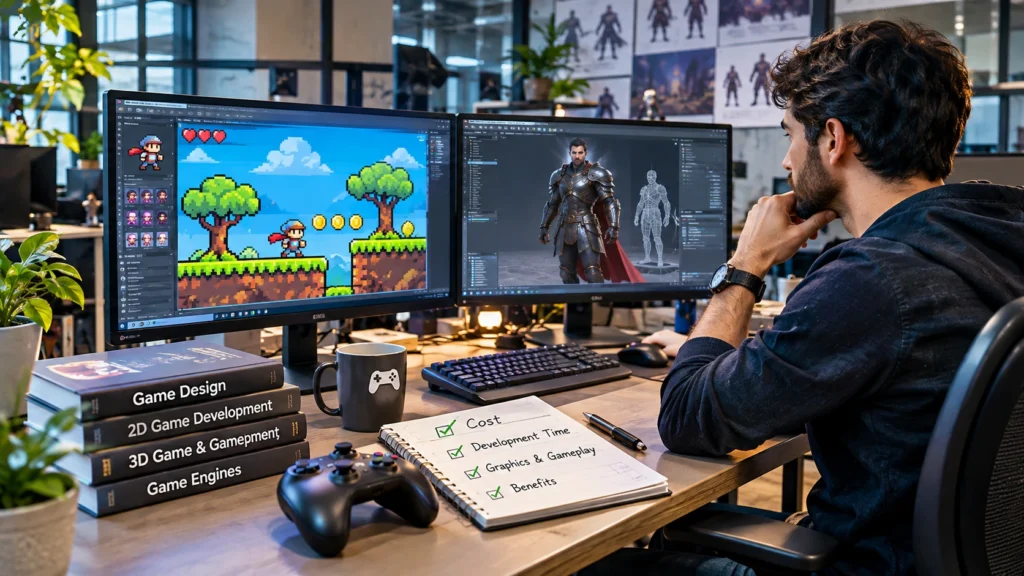
The gaming industry continues to evolve as technology, player expectations, and development tools become more advanced. From simple mobile games to visually impressive open-world adventures, developers have more opportunities than ever to create engaging gaming experiences. However, one important decision remains at the heart of every game project: choosing between 2D and 3D game development.
Both approaches have unique advantages, limitations, and development costs. While 3D games are often associated with realistic graphics, immersive environments, and advanced gameplay mechanics, 2D games remain popular because of their accessibility, distinctive visual styles, and relatively straightforward development requirements.
Understanding the differences between 2D and 3D game development can help businesses, independent developers, and gaming entrepreneurs make informed decisions before investing in a new project.
In this guide, we explore the main differences between these two approaches, their benefits, development processes, estimated costs, and the factors that determine which option is best for a particular gaming project.
The Popularity of 2D and 3D Gaming Today
Two-dimensional and three-dimensional games are among the most established formats in the gaming industry. Although 2D games have been around since the early days of video gaming, 3D technology became increasingly popular during the 1990s as hardware and graphics capabilities improved.
Today, both formats have developed into sophisticated gaming experiences.
2D games use two-dimensional graphics, typically displaying characters and environments through height and width. Classic platformers, puzzle games, and many mobile games use this approach. Despite their relatively simple visual structure, modern 2D games can feature detailed artwork, smooth animations, creative storytelling, and challenging gameplay.
3D games introduce depth into the gaming environment, allowing developers to create objects, characters, and landscapes with three-dimensional proportions. Players can often explore environments from different camera angles and interact with objects in more complex ways.
Popular examples include action-adventure games, racing simulators, sports games, and open-world experiences.
Neither format is automatically better than the other. The right choice depends on the target audience, gameplay requirements, available budget, and overall creative vision.
Main Differences Between 2D and 3D Game Development
Understanding the technical and visual differences between these formats is essential before starting a game development project.
1. Graphics and Visual Design
The most noticeable difference between 2D and 3D games is how visual elements are created and displayed.
2D games generally use sprites, illustrations, backgrounds, and animation frames. Their visual elements are arranged along two primary dimensions: height and width.
3D games use models with height, width, and depth. Developers create three-dimensional characters, objects, environments, lighting effects, and textures to produce a more spatially immersive experience.
2. Gameplay and Movement
Movement mechanics can vary significantly between the two formats.
In many 2D games, characters move horizontally, vertically, or along predetermined paths. Platform games, for example, commonly involve jumping, running, climbing, and avoiding obstacles.
However, modern 2D games can also include complex movement systems, multiple layers, and sophisticated physics.
In 3D games, characters can move through environments in several directions. They may walk around objects, explore large environments, interact with three-dimensional objects, and navigate complex spaces.
This flexibility makes 3D particularly suitable for open-world adventures, realistic simulations, and immersive action games.
3. Development Tools and Technology
Both 2D and 3D game development rely on specialized software, programming languages, and game engines.
Commonly used game development engines include:
- Unity: Supports both 2D and 3D game development.
- Unreal Engine: Particularly popular for advanced 3D graphics and immersive gaming experiences.
- Godot: An open-source engine supporting both 2D and 3D projects.
- GameMaker: Commonly used for 2D game development.
The choice of technology depends on the project’s complexity, performance requirements, developer experience, and intended platforms.
4. Development Complexity
2D games are generally easier to develop when they involve straightforward mechanics, simple environments, and limited animation requirements.
However, advanced 2D projects can still require considerable programming, artistic work, and testing.
3D development often involves additional production stages, including modeling, texturing, rigging, lighting, animation, and environmental design.
Consequently, complex 3D projects usually require larger development teams, more specialized skills, and additional production time.
Key Gameplay Differences Between 2D and 3D Games
The selected game format influences several aspects of the player’s experience.
- Controls: Many 2D games use relatively simple control systems, making them accessible to beginners. However, 3D games may require additional controls for camera movement, character navigation, and interaction with the environment.
- Storytelling: Both formats can support engaging stories. 2D games often communicate their narratives through dialogue, illustrations, and carefully designed levels, while 3D games can use cinematic sequences, environmental storytelling, and interactive worlds.
- Environment: 2D games typically present environments through flat backgrounds and layered visual elements. In contrast, 3D games allow developers to construct detailed environments with depth, lighting, and spatial interactions.
- Character Movement: Many 2D games use side-scrolling or top-down movement. Three-dimensional games can support more flexible navigation, including movement in multiple directions and interaction with complex environments.
- Camera Perspective: 2D games often use fixed or scrolling camera views. Three-dimensional games can offer first-person, third-person, isometric, and other camera perspectives.
These differences influence how developers design levels, create challenges, and deliver an enjoyable gaming experience.
The demand for professional 3D game development services continues to grow as businesses explore more immersive gaming experiences. Nevertheless, 2D games remain relevant because of their distinctive artistic styles, accessible gameplay, and established audiences.
Benefits of 2D and 3D Game Development
Both development approaches offer valuable advantages. The best option depends on what developers want to achieve and the experience they intend to deliver.
Advantages of 2D Game Development
2D games continue to attract players across mobile devices, computers, and gaming consoles.
Some of their main benefits include:
- Lower development costs: Simple 2D projects generally require fewer specialized resources than comparable 3D projects.
- Faster production: Basic 2D games can often be developed within shorter production timelines.
- Simpler controls: Many 2D games have straightforward control systems that are easy for new players to understand.
- Distinctive artistic styles: Developers can experiment with pixel art, hand-drawn illustrations, cartoon graphics, and other creative visual approaches.
- Accessibility: Lightweight 2D games can run on a wider range of devices, depending on their technical requirements.
- Easier prototyping: Developers can often test gameplay ideas and mechanics without building complex three-dimensional environments.
These advantages make 2D development particularly suitable for puzzle games, casual mobile games, platformers, and independent gaming projects.
Advantages of 3D Game Development
3D technology offers opportunities to create detailed and immersive gaming experiences.
Its main benefits include:
- Realistic visuals: Three-dimensional models, lighting, textures, and animations can create convincing visual environments.
- Immersive gameplay: Players can explore detailed environments and interact with objects in three-dimensional space.
- Flexible camera perspectives: Developers can introduce first-person, third-person, and other camera systems.
- Complex gameplay possibilities: 3D environments support advanced navigation, physics, combat systems, and interactive mechanics.
- Versatile game genres: Racing, simulation, sports, action-adventure, and open-world games can benefit from three-dimensional environments.
- Greater environmental depth: Developers can build detailed worlds with interactive objects, realistic landscapes, and complex level designs.
Although 3D games often require greater investment, they can offer development opportunities that are difficult to achieve with traditional 2D graphics.
How Much Does 2D and 3D Game Development Cost?
Development cost is one of the most important considerations when planning a gaming project.
There is no universal price for creating a 2D or 3D game. The final budget depends on the game’s complexity, features, visual quality, development team, technology, and intended platforms.
Generally, a simple 2D game costs less to develop than a similarly scoped 3D game. However, a highly polished 2D game with extensive content can still require a substantial investment.
Typical Development Cost Considerations
The following factors influence the overall development budget:
1. Game Design and Planning
The initial stage involves defining the game concept, target audience, gameplay mechanics, story, and overall design direction. Proper planning helps reduce unnecessary development expenses later.
2. Programming
Developers write the code responsible for character movement, gameplay mechanics, user interfaces, scoring systems, artificial intelligence, and other interactive features.
3. Graphics and Animation
2D games require illustrations, sprites, backgrounds, and animations. Three-dimensional projects may additionally require modeling, texturing, rigging, and advanced animation.
4. Testing and Quality Assurance
Testing helps identify bugs, performance problems, control issues, and compatibility problems before release.
5. Audio Production
Sound effects, background music, voiceovers, and other audio elements contribute to the overall gaming experience.
6. Platform Compatibility
Developing for Android, iOS, Windows, consoles, or multiple platforms can affect the project budget. Each platform may introduce additional technical requirements and testing responsibilities.
Estimated Cost Differences
The following figures are broad planning estimates rather than fixed industry prices. Actual quotations can vary considerably depending on the development team, project scope, and market.
| Game Type | Indicative Development Budget |
|---|---|
| Simple 2D mobile game | $3,000–$15,000 |
| Mid-level 2D game | $15,000–$60,000 |
| Complex 2D game | $60,000–$150,000+ |
| Simple 3D game | $15,000–$50,000 |
| Mid-level 3D game | $50,000–$200,000 |
| Advanced 3D game | $200,000–$1 million+ |
These ranges are illustrative, not guaranteed market quotations. A simple prototype may cost considerably less, while a large commercial game with extensive content, multiplayer functionality, and advanced graphics may require a much larger budget.
Why Is There Such a Big Difference in Development Costs?
Several factors explain why two games with similar concepts can have very different development budgets.
- Game complexity: Advanced gameplay mechanics and interactive features require additional development work.
- Graphics quality: Realistic 3D graphics generally require more specialized artistic and technical resources.
- Number of levels: Games with more levels, environments, and challenges require additional design and testing.
- Development team: Hiring experienced programmers, designers, animators, and sound specialists influences costs.
- Game engine and software: Licensing fees, third-party tools, and development software may contribute to the budget.
- Platform requirements: Supporting multiple devices and operating systems can increase development and testing expenses.
- Multiplayer functionality: Online multiplayer systems, servers, matchmaking, and security features can significantly increase complexity.
- Maintenance and updates: Bug fixes, new content, performance improvements, and ongoing support should also be included in the long-term budget.
Before starting development, businesses should establish a realistic budget that includes both initial production and ongoing maintenance.
For additional information about development approaches and services, you can visit Kevuru Games.
Which Is Better: 2D or 3D Game Development?
There is no single answer because both formats serve different purposes.
Choosing between them requires an understanding of the intended gaming experience, target audience, and available resources.
Choose 2D game development if:
- You want to create a casual or puzzle game.
- Your project focuses on simple and engaging gameplay.
- You have a limited development budget.
- You want to develop a lightweight mobile game.
- Your artistic direction suits pixel art, illustrations, or cartoon-style graphics.
Choose 3D game development if:
- You want to create an immersive gaming environment.
- Your project requires realistic characters and environments.
- You are developing a racing, sports, or simulation game.
- Players need to explore complex three-dimensional spaces.
- Your game requires advanced camera systems and spatial interactions.
It is also worth considering a combination of both approaches. Some games use 2D characters in three-dimensional environments, while others combine 3D models with a fixed or isometric camera perspective.
These hybrid approaches allow developers to balance visual creativity, gameplay requirements, and production costs.
Final Thoughts
Both 2D and 3D game development continue to play important roles in the modern gaming industry. While 3D games offer immersive environments, detailed graphics, and advanced gameplay possibilities, 2D games remain attractive because of their accessibility, creative freedom, and potentially lower development costs.
The right choice should be based on the project’s objectives rather than the assumption that newer technology always produces a better game.
Before investing in development, consider your target audience, gameplay mechanics, technical requirements, production timeline, and available budget. A well-designed 2D game can be just as engaging and successful as a sophisticated 3D experience when it delivers genuine value to players.
Frequently Asked Questions (FAQs)
1. What is the main difference between 2D and 3D game development?
The main difference is the visual dimension. 2D games use height and width to display characters and environments, whereas 3D games introduce depth, allowing developers to create three-dimensional objects and interactive environments.
2. Is 2D game development cheaper than 3D game development?
Generally, yes. Simple 2D games usually require fewer resources, less complex graphics production, and shorter development timelines. However, the final cost depends on the game’s features, content, and overall complexity.
3. How much does it cost to develop a 2D game?
A simple 2D mobile game may cost approximately $3,000–$15,000, while more advanced projects can cost $60,000 or more. These are indicative estimates, and actual prices depend on the development requirements.
4. How much does it cost to develop a 3D game?
A simple 3D game may cost approximately $15,000–$50,000. Mid-level and advanced projects can require significantly larger budgets depending on graphics quality, gameplay features, and development time.
5. Which game engine is best for 2D and 3D development?
Unity and Godot support both 2D and 3D game development. Unreal Engine is particularly popular for advanced 3D projects, while GameMaker is commonly used for 2D games. The best engine depends on the project’s requirements and the development team’s experience.
6. Are 2D games still popular?
Yes. 2D games remain popular across mobile, PC, and console platforms. Puzzle games, platformers, indie titles, and casual games continue to demonstrate the appeal of two-dimensional gameplay.
7. How long does it take to develop a 2D or 3D game?
A simple game may take a few weeks or months, while more complex projects can require a year or longer. Development time depends on the number of features, graphics requirements, team size, and testing process.
8. Can a game combine 2D and 3D graphics?
Yes. Developers can combine 2D characters, sprites, and illustrations with three-dimensional environments and objects. These hybrid approaches provide additional creative possibilities and can help achieve a distinctive visual style.