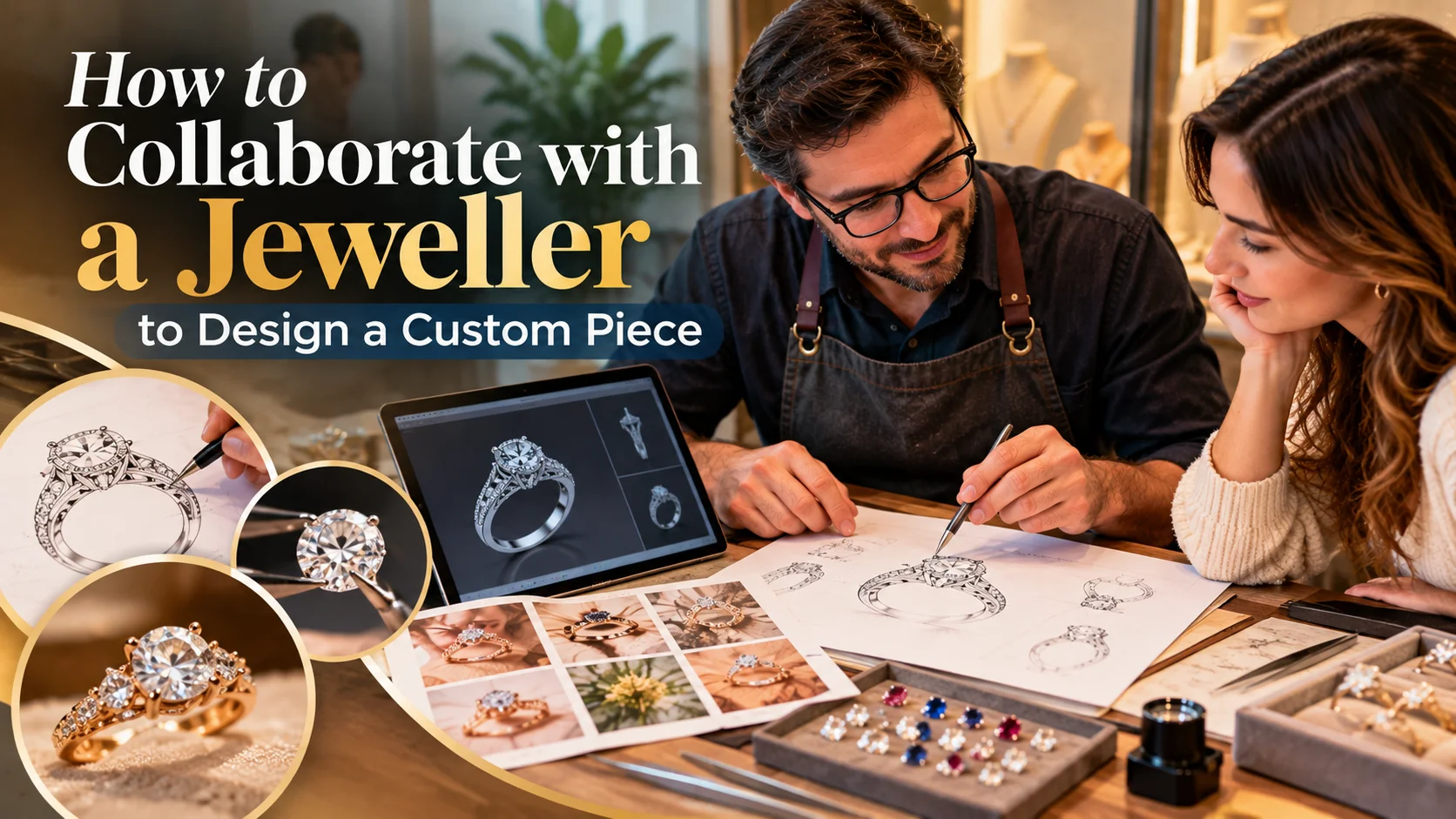
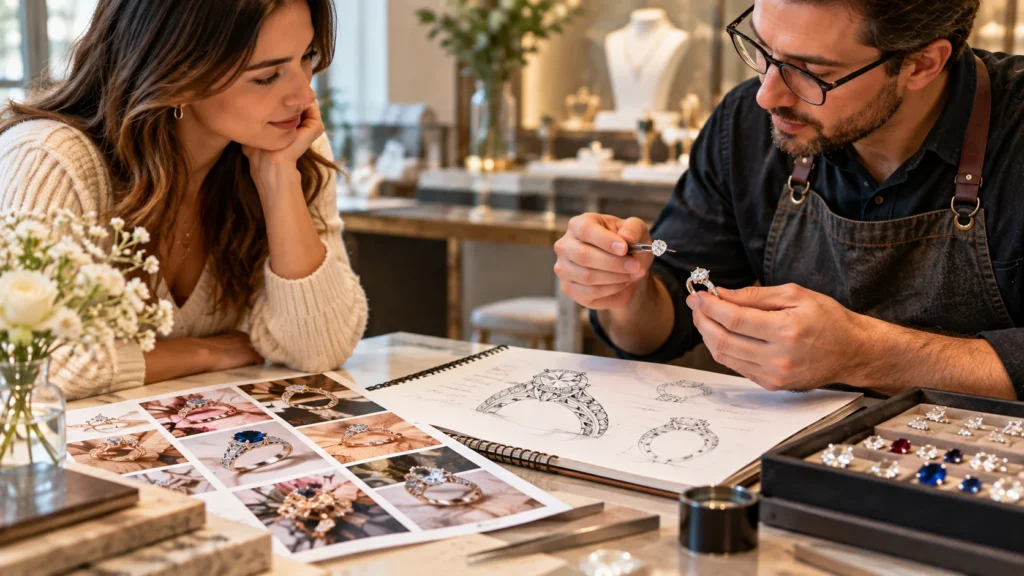
Sketches or a Pinterest board can show a jeweller the style and details you’re drawn to, like the shape of a ring or some interesting metalwork on a pair of earrings. If you pin a red ring, explain whether it is the colour, the design or both that caught your eye. But remember, you aren’t just showing a jeweller your board and saying, “Make this for me”. You’re showing them your board and saying, “This is what I like, what do you think?”
Bring the image into the consultation and talk through it with the jeweller. Give them a chance to look closely at what caught your eye. They may point out details you hadn’t consciously noticed, and you can then prioritise which elements matter to you. Rather than asking for a copy, explain what you want to keep and what you would change. That gives the conversation somewhere useful to go, with room for your own ideas as well as the jeweller’s suggestions.
Start with homework, not just inspiration
Prepare before you schedule a consultation. Collect pictures for inspo, and see if the artist’s style suits you, but it’s also really important to visualise where and how you will wear the jewel. Is it supposed to complement an existing piece or will you wear it daily?
Your budget is another non-negotiable piece of information, and shouldn’t be the one that’s kept secret until the end because, well, there’s no point in that. Knowing what you have in mind allows the jeweller to share your options – could the design use different metals or stones, or would scaling it down bring it within budget? These are the kind of constructive suggestions that wouldn’t sound pushy if the available budget was somewhere near the intended budget to begin with.
The consultation is a translation exercise
A talented jeweller doesn’t just make a sale. They translate an emotional brief – “something that reminds me of her” or “a ring we can look at for the next 20 years” – into a series of decisions about metal, stone, and setting. From there, sketches will be drafted on paper or directly on a computer screen.
If you are looking in Hatton Garden, use the consultation to judge the individual workshop rather than relying on the address. Ask to see previous commissions with something in common with your idea. Talk about how the jeweller would approach the design and how much time they would need. A clear conversation about your particular piece is more useful than assumptions about reputation or speed.
This is also the phase to discuss bespoke jewellery for your occasion and how the occasion should influence the design. An engagement ring is a different beast to an anniversary ring that you’ll only wear on special occasions. A good jeweller will make you aware of all such considerations before you’re infatuated with a ring that can’t be easily resized or wouldn’t stand up to daily wear.
Metal and stone selection is a set of trade-offs
There is no one-size-fits-all “best” metal or stone. Ask how the proposed platinum, gold or palladium would suit the design and your daily routine. Compare the quoted price, weight, finish and care requirements for the actual options in front of you. If you have a known metal sensitivity, raise it before choosing an alloy. Do not assume a metal name alone tells you how comfortable the finished piece will feel.
Gemstones are the same. If you’re in the diamond market, you’ll be force-fed the 4 Cs – cut, colour, clarity, carat – but a good jeweller will also tell you how you can make trade-offs between those four. Ask to compare stones side by side rather than choosing from grades alone. Decide which differences you can see and which matter to you within your budget. For coloured stones, ask the jeweller to explain the information supplied about each stone, including its character and any stated origin.
Ethical sourcing is important to bring up if you care. Ask where the stones are from and whether they’re conflict-free. Ask what documentation supports the answer, and be clear about what remains unknown.
Watch the piece take shape
Once the design has been approved, you should be able to witness it progressing through a couple of different forms – rather than the workshop door simply shutting until it’s time to pick up the finished piece. Ask whether the process includes a CAD rendering that shows the design in three dimensions on a computer screen. If it does, request views from different angles so you can discuss the balance and proportion of the ring before approving it.
If a wax model or 3D-printed prototype is offered, ask what it can show you about size and fit. Do not treat it as a preview of the final metal’s weight or feel. Confirm which changes are still possible and what they would cost before approving production, so don’t be afraid to speak up if something is bothering you: a stone sticking out towards you with more clearance than you’d like, a shank too broad to grow with you.
Get the details in writing
Request a written estimate explaining what is included in the price, from materials and stones to labour. Ask how changes would be priced and when payment is due. Also, enquire about timing. Explain any occasion deadline, ask whether sourcing the stone or making the setting could affect it, and agree when you will receive progress updates.
The handover is more than a box and a smile
Once the piece is completed, ask the jeweller to explain any hallmark and accompanying documentation, and check the fit for yourself. Also, enquire about aftercare: resizing, re-polishing and checks on claw settings. Establish which services are included, which cost extra and how to arrange them, rather than assuming they all come with the commission.
The aim is a piece you want to keep wearing. Knowing what to request at each stage helps you make decisions you can feel comfortable with.