

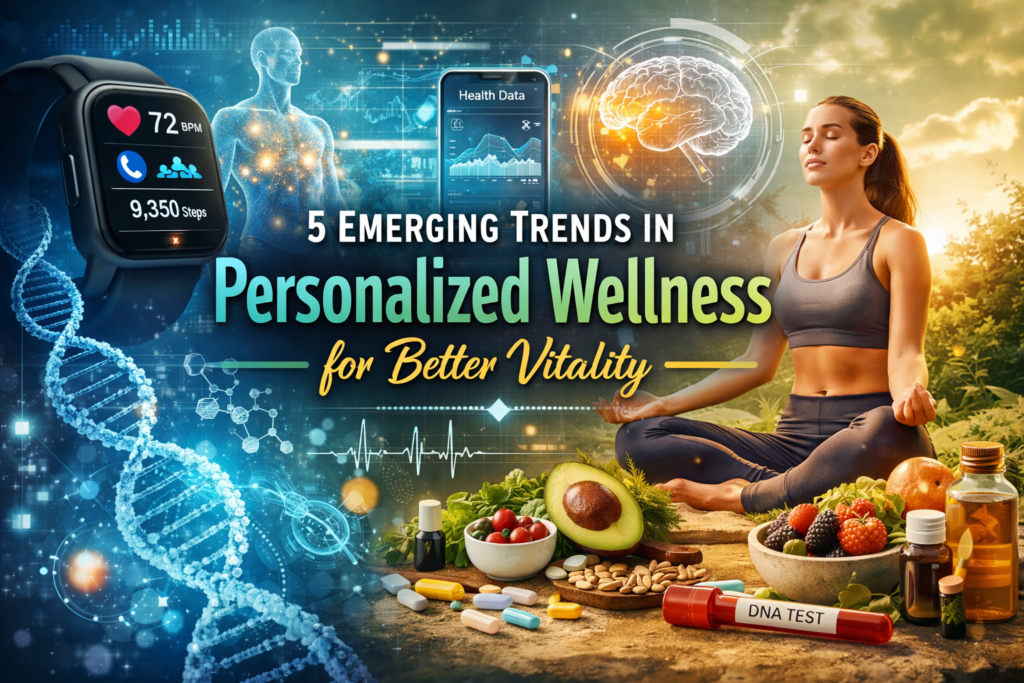
Many wellness programs continue to be developed based on disease symptoms. For example, when you feel tired, you may decide to take magnesium, or if you feel foggy, you add B12. The issue here is not taking supplements, but rather the approach. Responding to symptoms is not a successful long-term strategy. The five current trends that are changing personalized wellness are shifting towards proactive, more precise cellular-level solutions.
Trend 1: Peptide Bioregulators as Molecular Precision Tools
General multivitamins are being replaced by a more specialized type of treatment. Peptide bioregulators, which are short amino acid chains serving as signaling molecules, are increasingly being taken seriously since they do not merely deliver nutrients; they also guide cells. Studies that started with scientists such as Vladimir Khavinson indicated that certain peptide structures may function in connection with a specific organ, which can activate repair mechanisms in tissue that has started to lose its function or become inactive.
The difference is not a new fad. It is about precision. While a general dietary supplement may promote overall well-being, a peptide treatment plan will target a specific system, such as the thymus, pineal gland, or liver, and work toward the re-establishment of the signaling structure that these tissues utilize to monitor and uphold a state of equilibrium.
Trend 2: Epigenetic Testing as a Biological Roadmap
Chronological age tells you how long you’ve been alive. Biological age, on the other hand, is a clue to what extent your body has aged to date and could reflect your future health. Differences between your biological and chronological age can now be measured by epigenetic clocks. These molecular tools reveal how lifestyle choices affect gene function and are being adopted as rejuvenating therapeutics to improve health span.
What this unlocks is a personalized protocol built around real deficiencies rather than population averages. Instead of following a generic longevity stack, someone with a methylation profile showing accelerated cellular senescence in specific tissues can target exactly that. Companies like Rebel Peptides give researchers and biohackers access to materials they can actually trust, which matters as the global personalized medicine market was valued at approximately $538.93 billion in 2022 and is projected to grow at 7.20% annually through 2030. That growth reflects a genuine consumer shift toward individualized health strategies, not just marketing trends.
Trend 3: Cellular Rejuvenation Over Symptom Masking
There is a real, tangible difference between simply masking symptoms and proactively fixing the underlying issues causing you to feel bad. Rejuvenation programs work towards the latter, addressing cellular malfunction at the protein and mitochondrial levels rather than simply covering up exhaustion with stimulants or medication.
That’s why mitochondrial health is increasingly a priority area. When mitochondria become less effective, it blocks everything else: cellular energy, recovery time, mental focus. This often includes regimented supplement schedules along with peptide formulations that’s becoming the new standard for longevity optimization and regeneration, rather than merely symptomatic relief.
We’re not talking fringe science. The clinical marriage of nootropics, peptides and biochemical support is part of an evolution in biological thinking.
Trend 4: Wearables Closing the Feedback Loop
Knowing what to bring into your body is only part of the solution. Knowing if it’s helpful is the other half. Wearables were once about counting your steps, but now they’re measuring your heart rate variability, your skin temperature, your sleep architecture, and providing your recovery score in real time.
That data changes your behavior around your wellness protocols. Someone on a peptide cycle or a time-restricted eating window can now notice positive or negative changes, and in some cases the utter lack of changes, despite the hype, in days and weeks rather than having to wait a full 12 months for their annual blood work. Real-time feedback facilitates rapid iteration. If your disruption of circadian rhythm is seen in your recovery score, you change it. If anecdotally experimenting with a specific intervention correlates with a bump in your HRV, you keep doing it.
This virtuous feedback loop is what separates biohacking from pure guesswork. Wearables don’t obviate biomarker testing. But they make the period between tests less about grasping in the dark and more about shining the light of N=1 experimentation on yourself.
Trend 5: Purity and Sourcing Becoming Non-Negotiable
Peptides have spent decades floating in gray markets. Users were often taking products of unknown purity made using undisclosed practices. But as more biohackers and researchers seek to incorporate them into their work, the demand for verified research chemicals, a designation that requires extensive purity testing and reporting, has grown. Peptide suppliers can no longer operate in the shadows, free from accountability or oversight, if they want to serve this expanding market.
The right ones to use are those that come with a CoA: a certificate of analysis which details exactly what the compound is and at what purity it’s been synthesized. Practitioners now want to know precisely what they’re adding to their program or stack. And it’s not just a case of being sold the “wrong” compound; a peptide that is even 99 percent pure, but still contaminated with just 1 percent of some untested-for-by-product, could easily disrupt an entire protocol.
Where This is Heading
All these five trends are not isolated on their own. In fact, they are coming together. Epigenetic data plays a part in deciding which peptide regimens are appropriate. Wearables prove if these regimens are effective or not. Purity criteria guarantee that the compounds do not contaminate the environment. These trends are part of the shift from wellness as a self-help measure to wellness as a self-engineering practice; it is a methodical, quantifiable approach designed based on the biology of the person who is implementing the program.