

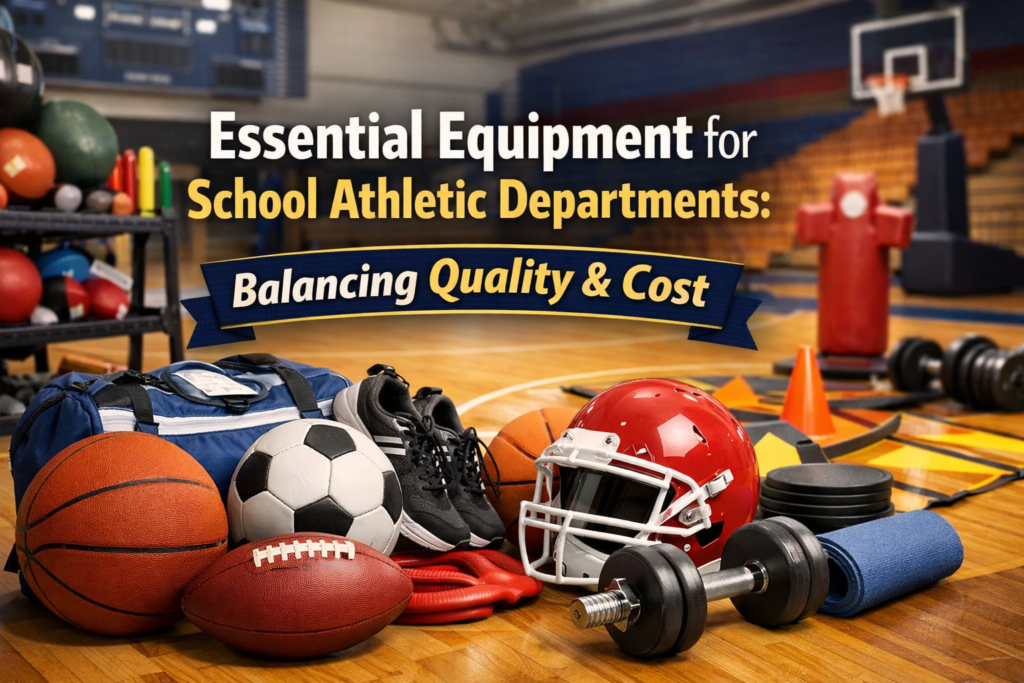
Buying equipment isn’t simply about getting the best-looking catalog or website offering the best price. To truly elevate your program, you need a partner that truly elevates your athletic department. Knowing your vendor and their products, capabilities, and reputation can mean the difference between rebuilding a decade from now and adding a new program instead.
Stop Comparing Sticker Prices
It’s natural to be inclined to purchase the least expensive option available. Athletic budgets are tight and a low unit price makes you look good when justifying your spending. The issue is that inexpensive equipment breaks sooner, and the costs of replacements rarely get related back to the initial purchase decision.
A smarter approach is to consider the cost per season; take the total purchase price and divide it by the number of seasons the product will last with regular daily use. A 30% more expensive kit that lasts six full seasons instead of two is actually the cheaper solution. These are the kind of sums that distinguish between reactive buying and actual procurement planning.
When it comes to bags, the fabric used to create the bag is paramount. The denier count, a unit of measurement for the linear mass density of fibers, is one of the most reliable measures of how long a bag or equipment carrier will last. The higher the denier, the more durable the bag. This counts against how often the zippers will be opened and closed, how roughly the bag will be thrown around, and how much the straps will be overstretched and overloaded, before the bag needs to be replaced.
Specialized vs. General Equipment – Where to Spend and Where to Scale Back
All athletic equipment does not carry the same risk profile. Helmets, pads, and protective gear literally support student life. These are non-negotiable purchases where quality standards, and those that are ASTM or ISO aligned, should carry higher weight than cost. There is no smart savings play in the protective gear category.
Non-specialized equipment comes with a different risk level. Sourcing items from companies like Bags in Bulk such as, towels, basic training aids, and carrying solutions are high-touch items that wear out often, but do not demand similar technical specifications as safety gear. This is where wholesale sourcing creates real budget leverage. Redirecting savings from the general equipment procuring back to the safety gear budget is one of the cleaner ways to keep a full program running without standards dilution where it counts most.
The NFHS equipment and supplies cost survey also revealed this uncomfortable pattern. Supplier consolidation and exclusive partner contracting are high on the list of emerging trends, yet these discussions are more about who should be cut than how savings should be recycled. That should change. Cutbacks are necessary, but savings are optional if they result in program losses net of supplier gains.
The Logistics Argument For Standardization
A benefit that often flies under the radar when discussing bulk ordering is that it simplifies the arrival-to-practice workflow. Your gear arrives, quickly followed by an 8 a.m. practice the next morning. Do you want to spend 4 hours organizing jerseys and shorts by number and size on day one, or would you rather grab gear from a well-organized storage room and get to coaching? Coaches and administrators talk about the hidden costs of managing small fragmented gear. This is one area where the costs show up.
If the ultimate goal in coaching is buying back time, using pre-order cycles of six months (‘What do we need in season?’) and one year (‘What will we lose this year?’) can help proactively prepare for your squad’s needs. Implementing a scouting report on loss replaces the inevitable guesswork year on year. It’s not just the storage room gear that disappears, either. Kids will lose or severely damage 20% of issued gear every season. We don’t like it, but it’s a predictable loss. The best strategy is to plan for it.
Building Program Identity Through Equipment Consistency
This aspect is more of a cultural one and may not be quantifiable in financial terms. However, the feeling of belonging and unity that is fostered when all athletes receive the same type of bag with school branding can have far more reaching positive effects. It sends a message to students, parents, and the community about the professionalism and unity of the institution and the athletic department as a whole. This can lead to stronger community support, more successful fundraising efforts, and the long-term success of athletic programs.
Making the Numbers Work
The aim is not to reduce spending to a minimum. Rather, it is to make the right allocations, safeguarding budget for areas in which quality cannot be compromised, and lowering costs for products and services that can be obtained more reasonably through wholesale purchasing. Wholesale sourcing combined with a low cost-per-use analysis helps athletic departments make purchasing decisions that are not reactive due to budget constraints.
Departments that follow this approach no longer fall behind. They maintain program quality while creating opportunities to increase spending in areas that truly impact performance.