
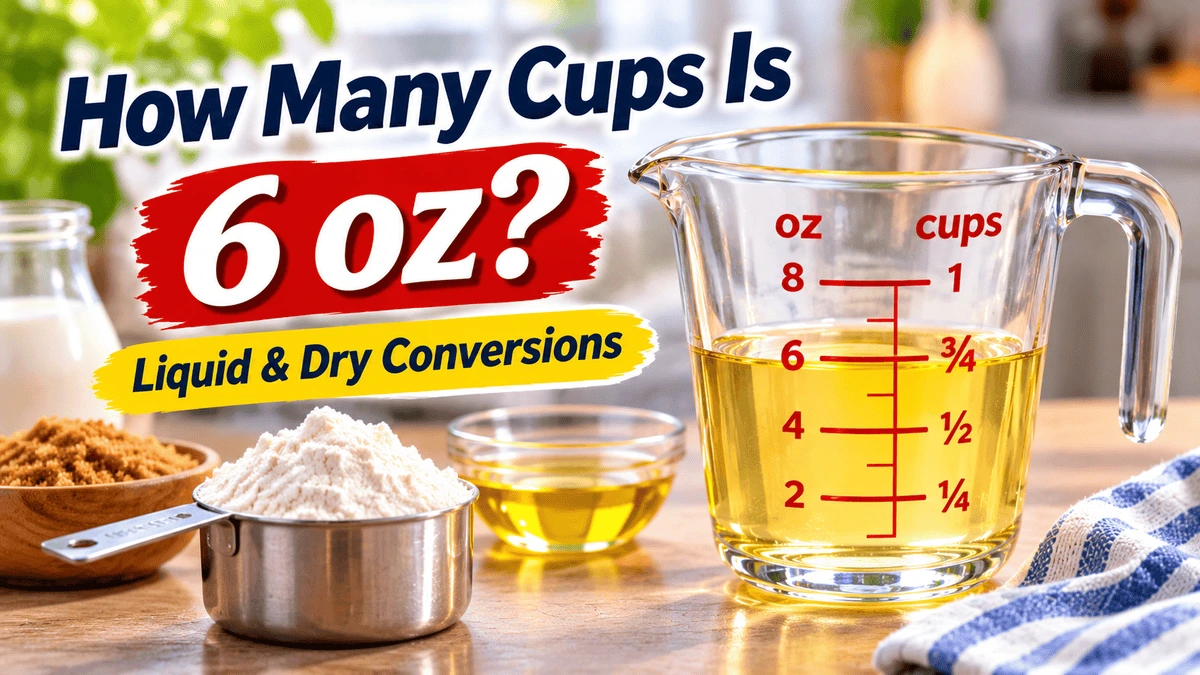
When following a recipe, knowing how to convert measurements correctly can make a big difference to the final result. If you are wondering how many cups is 6 oz, the answer depends on whether you are measuring liquid volume or ingredient weight.
Quick answer: 6 US fluid ounces equals ¾ US cup (0.75 cup). However, 6 ounces by weight does not always equal ¾ cup because different ingredients have different densities. For accurate cooking and baking, it is important to understand which type of ounce your recipe uses.
Understanding Ounces and Cups
Before converting ounces to cups, you need to understand the difference between weight and volume. These measurements are related, but they are not interchangeable for every ingredient.
What Is an Ounce?
An ounce (oz) is a unit commonly used in the United States to measure weight. In cooking, you may also see fluid ounces (fl oz), which measure liquid volume. Although both use the word ounce, they represent different types of measurement.
- Weight ounces: Used to measure the mass of ingredients such as flour, sugar, cheese, and butter.
- Fluid ounces: Used to measure the volume of liquids such as water, milk, juice, and cooking oil.
One ounce by weight is approximately 28.35 grams. One US fluid ounce is approximately 29.57 milliliters. These values are different because one measures weight and the other measures volume.
What Is a Cup?
A cup is a unit of volume used in many American recipes. One US customary cup equals 8 US fluid ounces, approximately 236.6 milliliters, or 16 US tablespoons.
Be aware that cup sizes can differ between countries and measurement systems. For example, a metric cup is commonly 250 milliliters. When following a recipe, check which measurement system it uses before converting quantities.
Why Convert Between Ounces and Cups?
Converting ounces to cups is useful when cooking, baking, preparing drinks, or adapting recipes from different countries. Understanding these conversions can help you measure ingredients correctly and avoid changing the proportions of a recipe unintentionally.
- Maintain recipe consistency: Accurate measurements help you achieve more predictable results, particularly when baking cakes, cookies, and bread.
- Use the measuring tools you have: If a recipe lists fluid ounces but you have a measuring cup, converting the volume makes preparation easier.
- Adapt international recipes: Recipes may use cups, milliliters, grams, or ounces. Understanding the differences helps you convert quantities more confidently.
- Reduce measuring mistakes: Knowing whether a recipe refers to weight or volume prevents confusion when working with different ingredients.
How Many Cups Is 6 oz? The Exact Answer
If your recipe specifies 6 US fluid ounces, the conversion is straightforward. Since one US customary cup contains 8 US fluid ounces, divide 6 by 8.
Cups = Fluid ounces ÷ 8

6 ÷ 8 = 0.75 cup
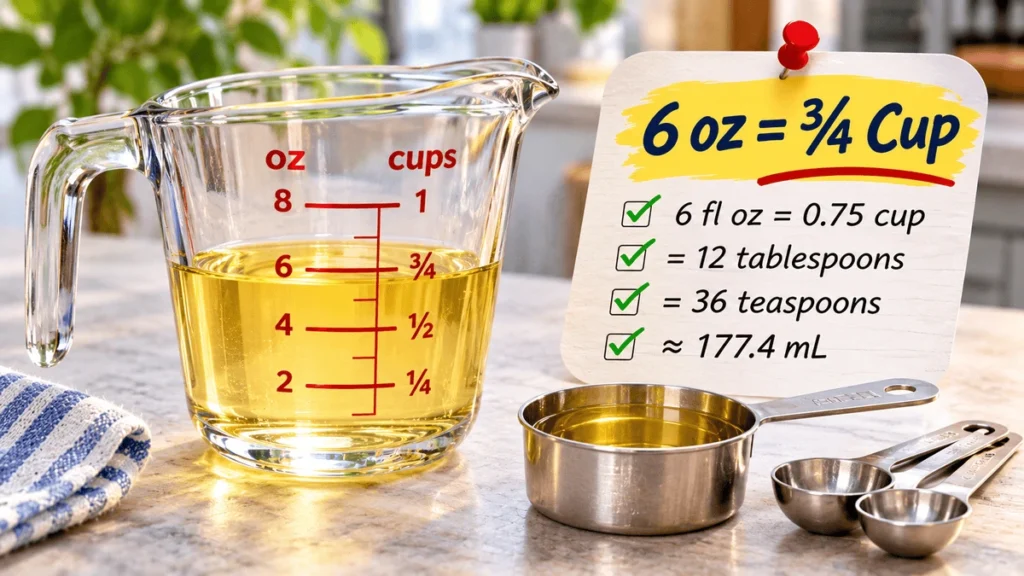
Therefore, 6 US fluid ounces equals ¾ US cup. This is also equivalent to 12 US tablespoons, 36 US teaspoons, or approximately 177.4 milliliters.
| Measurement | Equivalent to 6 US fl oz |
|---|---|
| US cups | ¾ cup (0.75 cup) |
| US tablespoons | 12 tablespoons |
| US teaspoons | 36 teaspoons |
| Milliliters | Approximately 177.4 mL |
| US fluid ounces | 6 fl oz |
Example: If a smoothie recipe calls for 6 fluid ounces of milk, measure ¾ of a US cup. The same volume conversion applies to water, juice, and other liquids, although their weights may differ slightly.
Fluid Ounces vs. Dry Ounces
The distinction between fluid ounces and weight ounces is essential when converting measurements for cooking and baking. The correct conversion depends on what your recipe is measuring.
Fluid Ounces: Measuring Liquid Volume
Fluid ounces measure how much space a liquid occupies. For US customary measurements, 8 fluid ounces equal 1 cup, so 6 fluid ounces equal ¾ cup.
Use a liquid measuring jug or cup with clear volume markings. Place it on a level surface and check the measurement at eye level for better accuracy.
Weight Ounces: Measuring Ingredients by Mass
Weight ounces measure the mass of an ingredient. Six ounces of flour, for example, will occupy a different volume from 6 ounces of sugar or butter. This happens because ingredients have different densities and packing characteristics.
For weight measurements, a kitchen scale is generally more reliable than converting directly to cups. If you must use cups, look for a weight-to-volume conversion specific to the ingredient and follow the recipe’s measuring method.
Converting Fluid Ounces to Cups
To convert US fluid ounces to US cups, divide the number of fluid ounces by 8. This formula works for liquids measured by volume.
Cups = Fluid ounces ÷ 8
Here are a few examples:
| US fluid ounces | US cups |
|---|---|
| 2 fl oz | ¼ cup |
| 4 fl oz | ½ cup |
| 6 fl oz | ¾ cup |
| 8 fl oz | 1 cup |
| 12 fl oz | 1½ cups |
| 16 fl oz | 2 cups |
| 24 fl oz | 3 cups |
| 32 fl oz | 4 cups |
These values use US customary cups and fluid ounces. If your recipe uses metric measurements or imperial fluid ounces, check the units before applying the formula.
Converting Dry Ounces to Cups
Converting ounces by weight to cups requires information about the particular ingredient. There is no single formula that converts all dry ingredients accurately because a cup of one ingredient can weigh considerably more or less than a cup of another.
For example, if a recipe uses an approximate conversion of 120 grams of all-purpose flour per US cup, 6 weight ounces of flour equals about 170.1 grams. The calculation is:
6 oz × 28.35 = approximately 170.1 g

170.1 g ÷ 120 g per cup ≈ 1.42 cups
Using that particular flour conversion, 6 ounces by weight is approximately 1.42 cups, not ¾ cup. The result may vary depending on the flour type and how it is measured, so use the weight specified by your recipe whenever possible.
For reliable baking results, weigh ingredients using a digital kitchen scale. If a scale is unavailable, use a trusted ingredient-specific conversion chart rather than applying the fluid-ounce formula to dry ingredients.
Common Measurement Conversions
These common US customary conversions are useful when adjusting recipe quantities or switching between measuring tools.
| Unit | Equivalent |
|---|---|
| 1 US cup | 8 US fluid ounces |
| 1 US cup | 16 US tablespoons |
| 1 US fluid ounce | 2 US tablespoons |
| 1 US tablespoon | 3 US teaspoons |
| 1 pound | 16 weight ounces |
| 1 weight ounce | Approximately 28.35 grams |
| 1 US fluid ounce | Approximately 29.57 milliliters |
| 1 US cup | Approximately 236.6 milliliters |
Remember that volume conversions and weight conversions are not the same. Use the appropriate unit for your ingredient and the measurement system specified by your recipe.
Tips for Accurate Measurements
Using the correct tools and techniques helps you measure ingredients consistently. Follow these practical tips when preparing meals, desserts, or baked goods.
- Choose the right measuring tool: Use a liquid measuring jug for liquids and dry measuring cups for dry ingredients when measuring by volume.
- Level dry ingredients: For ingredients such as flour, fill the measuring cup according to the recipe and level off the top with a straight edge. Avoid compressing the flour unless instructed.
- Follow the recipe’s packing instructions: Brown sugar may need to be firmly packed, while flour is usually measured without packing. Different ingredients require different techniques.
- Use a digital kitchen scale: Weighing ingredients in grams or ounces is particularly helpful for baking, where accurate proportions matter.
- Check the measurement system: Confirm whether your recipe uses US cups, metric cups, US fluid ounces, or imperial fluid ounces.
- Read liquid markings at eye level: Place your measuring jug on a level surface to reduce reading errors.
Tools for Converting Ounces to Cups
Several kitchen tools and resources can help you convert measurements and follow recipes accurately.
- Measuring cups and jugs: Useful for measuring liquids and ingredients by volume.
- Digital kitchen scales: Ideal for weighing ingredients in grams or ounces, especially for baking.
- Ingredient conversion charts: Helpful when a recipe lists weight but you need a volume estimate for a particular ingredient.
- Online conversion calculators: Useful for converting fluid ounces to cups or calculating ingredient-specific weight-to-volume estimates. Confirm the units and ingredient assumptions before relying on the result.
Frequently Asked Questions About 6 oz to Cups
How many cups is 6 oz of liquid?
Six US fluid ounces equals ¾ US cup, or 0.75 cup. This is approximately 177.4 milliliters.
Is 6 oz equal to ¾ cup?
Yes, when you mean 6 US fluid ounces. If you mean 6 ounces by weight, the equivalent in cups depends on the ingredient being measured.
How many tablespoons are in 6 fluid ounces?
Six US fluid ounces equals 12 US tablespoons because 1 US fluid ounce equals 2 US tablespoons.
How many milliliters are in 6 US fluid ounces?
Six US fluid ounces is approximately 177.4 milliliters. This conversion uses the US fluid ounce rather than the imperial fluid ounce.
How many cups is 6 oz of flour?
Six ounces by weight of all-purpose flour is approximately 1.4 US cups when using a conversion of about 120 grams per cup. The exact amount varies with the flour and measuring method, so weighing the flour is more accurate.
How many cups is 6 oz of water?
If the recipe means 6 US fluid ounces of water, the answer is ¾ US cup. If it means 6 ounces by weight of water, that weight is approximately 170.1 grams and occupies about 170 milliliters, which is slightly less than ¾ US cup.
Does 6 oz equal one cup?
No. One US customary cup contains 8 US fluid ounces, so 6 fluid ounces is three-quarters of a cup.
Conclusion
The answer to how many cups is 6 oz depends on the type of measurement. Six US fluid ounces equals ¾ US cup, 12 tablespoons, or approximately 177.4 milliliters. However, 6 ounces by weight can equal a different number of cups depending on the ingredient’s density.
For accurate cooking and baking, identify whether the recipe uses fluid ounces or weight ounces before converting. Use a measuring jug for liquids and a kitchen scale whenever possible for dry ingredients. Understanding this difference will help you follow recipes confidently and achieve more consistent results.