
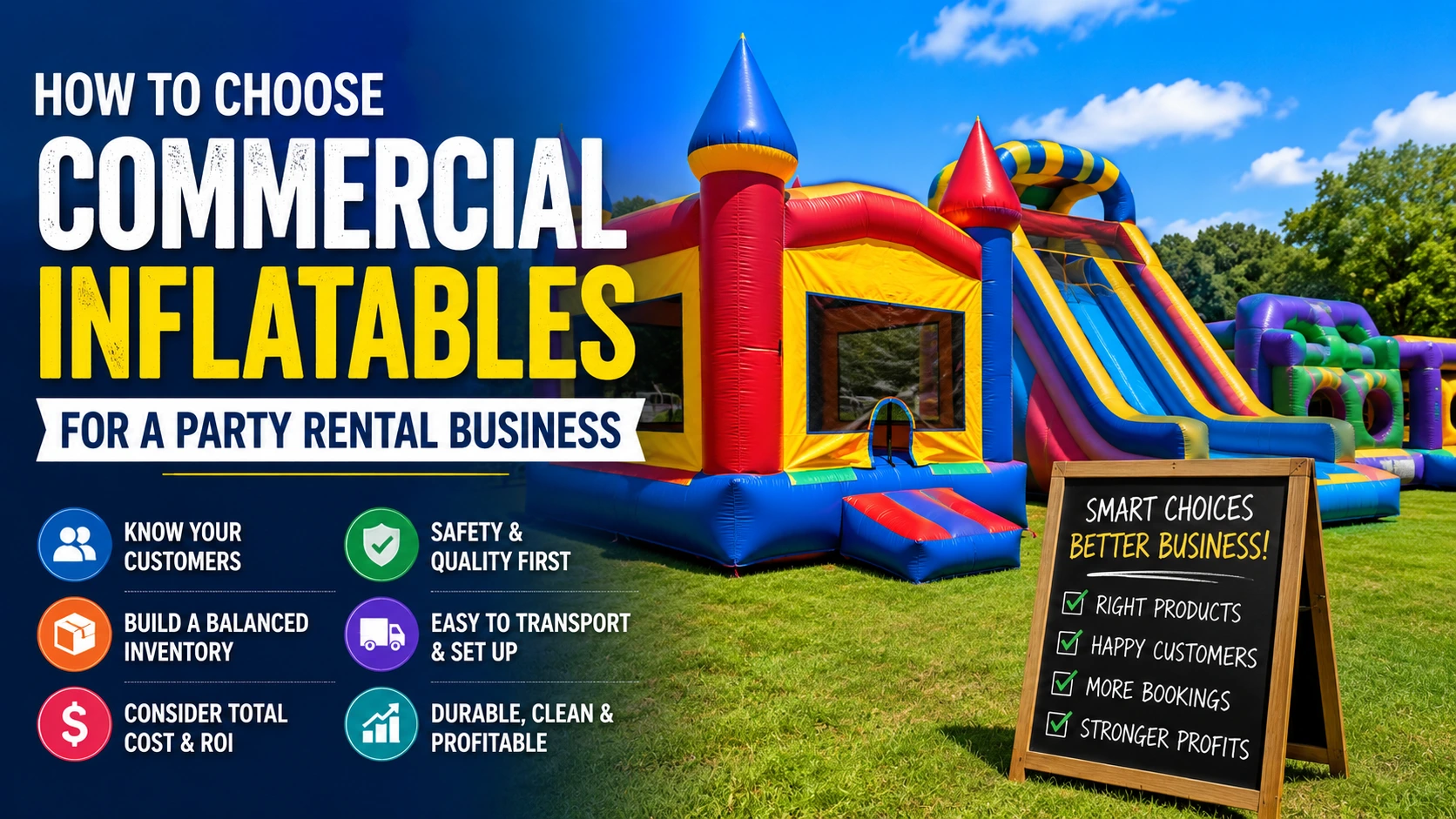
Starting or expanding a party rental business involves more than purchasing colorful equipment. Every inflatable added to the inventory affects transportation, setup time, staffing, storage, maintenance, customer demand, and potential rental income.
The right products can serve many types of events and remain useful for years. Poorly chosen equipment, however, may spend much of the season in storage or create unnecessary operating difficulties.
Before investing in commercial inflatables, rental business owners should evaluate their customers, service area, available resources, and long-term business goals. The following considerations can help operators build a practical and competitive rental inventory.
Understand the Customers You Want to Serve
The first step is identifying the types of customers and events the business expects to serve. A company focusing on backyard birthday parties will have different equipment needs from one serving schools, festivals, churches, corporate events, or community organizations.
Bounce houses and compact combination units are often practical for residential parties because they fit into smaller spaces and are relatively straightforward to transport. Larger water slides and obstacle courses may appeal more to schools, summer camps, festivals, and organizations planning high-attendance events.
The age of the expected users also matters. Products designed for younger children should offer age-appropriate activities, manageable heights, and clear visibility for supervision. Older children and teenagers may be more interested in tall slides, competitive obstacle courses, sports games, and interactive challenges.
Understanding the target customer makes it easier to purchase products that match real demand rather than relying only on appearance.
Build a Balanced Rental Inventory
A balanced inventory gives customers options while helping a rental company serve different events throughout the year. Instead of purchasing several products with nearly identical functions, operators can begin with a mix of dependable categories.
Common commercial inflatable categories include:
- Traditional bounce houses
- Bounce-and-slide combination units
- Dry slides
- Inflatable water slides
- Obstacle courses
- Interactive games
- Sports inflatables
- Inflatable parks and modular attractions
Combination units can be useful for birthday parties because they provide several activities in one product. Inflatable water slides may generate strong seasonal interest in warmer regions, while dry obstacle courses can be rented for schools, festivals, and indoor events during a broader part of the year.
Operators should also consider whether a product can be used in more than one way. A wet-and-dry unit, for example, may serve as a water attraction during summer and a dry attraction when water use is unsuitable. This flexibility can help increase the number of potential rental dates.
Measure Typical Event Spaces
Product dimensions should be evaluated carefully before purchase. The listed dimensions of an inflatable are not the same as the total operating area required at an event.
Additional space may be needed for:
- Safe entry and exit areas
- Blowers and inflation tubes
- Anchoring or ballast
- Electrical cables
- Attendant positions
- Access for setup and removal
- Clearance from fences, trees, buildings, and overhead hazards
Rental companies should review the properties they commonly serve. A large attraction may look impressive online but may not fit many residential yards in the local market. Likewise, a very small product may not be attractive enough for schools or community events.
Maintaining accurate product dimensions also helps staff confirm site suitability before accepting a booking.
Evaluate Commercial Construction
Equipment intended for repeated rentals should be manufactured for commercial use. Operators should examine the main material, stitching, high-wear areas, anchor points, entrances, climbing sections, and slide surfaces.
Areas that experience frequent contact or stress should have appropriate reinforcement. These commonly include:
- Entry steps
- Climbing lanes
- Slide platforms
- Wall connections
- Anchor points
- Inflation tubes
- Interior obstacles
Rental companies should request clear product specifications and detailed photographs instead of relying only on rendered images. Information about the supplied blower, repair materials, storage bag, operating instructions, and warranty should also be confirmed before ordering.
A commercial product may cost more initially than a residential model, but construction quality is especially important when equipment will be transported, installed, used, cleaned, and packed repeatedly.
Consider Transportation and Setup Requirements
A product is not practical simply because customers like it. The rental company must also be able to transport and install it efficiently.
Before purchasing, operators should confirm:
- Packed dimensions
- Packed weight
- Number of packages
- Recommended blower capacity
- Number and location of anchor points
- Number of staff normally needed for setup
- Vehicle and trailer requirements
- Storage space required between rentals
Large water slides and obstacle courses may require additional staff, larger vehicles, suitable moving equipment, and more setup time. These costs should be included when calculating rental prices.
Modular obstacle courses can be helpful for growing businesses because individual sections may be transported separately and arranged in different combinations. However, all connections and layouts should follow the manufacturer’s instructions.
Plan for Safe Operation
Safety should be considered at the purchasing stage, not only when the equipment arrives.
Commercial operators need appropriate instructions for installation, anchoring, supervision, inspection, cleaning, maintenance, emergency procedures, and weather monitoring. Staff should understand each product’s operating limits and follow the manufacturer’s guidance.
Before every rental, the equipment should be inspected for issues such as:
- Damage to fabric or seams
- Worn or damaged anchor points
- Obstructed inflation tubes
- Loose connections
- Unsafe entry or exit areas
- Blower or electrical problems
- Contamination, moisture, or debris
Local requirements can vary by state, city, venue, and type of event. Rental businesses should confirm any applicable licensing, inspection, insurance, electrical, amusement-device, and operating requirements in every market they serve.
Choose Designs with Broad Rental Appeal
Highly customized themes may be popular with certain customers, but they can also limit the number of suitable bookings. New rental businesses may benefit from starting with versatile colors and themes that work for birthdays, schools, churches, festivals, and corporate events.
Gender-neutral designs and familiar themes often appeal to a wider customer base. Operators can later add more specialized products after reviewing actual booking requests.
Appearance still matters. Customers frequently make decisions based on photographs, so an inflatable should look attractive from the angles most commonly used in rental listings. Clear, authentic photos are valuable for websites, social media pages, catalogs, and quotations.
Calculate the Full Cost of Ownership
The purchase price is only one part of the investment. Business owners should also account for:
- Shipping and import expenses
- Applicable taxes and fees
- Blowers and electrical accessories
- Transportation equipment
- Labor
- Insurance
- Cleaning and maintenance
- Repairs and replacement parts
- Warehousing
- Marketing and photography
A lower-priced inflatable is not necessarily the more economical option if it creates frequent repair needs or cannot be rented consistently. Similarly, an expensive specialty attraction may not produce a good return if demand is limited.
Operators can estimate performance by comparing the complete landed and operating cost with the expected rental price, realistic number of bookings, seasonal demand, and anticipated service life.
A Practical Example: Building a Starter Rental Inventory
Consider a new party rental company serving backyard birthdays, school events, and community gatherings. The owner has limited storage space, one delivery vehicle, and a small setup team. Purchasing the largest available attractions might attract attention, but it could also create transportation and staffing problems.
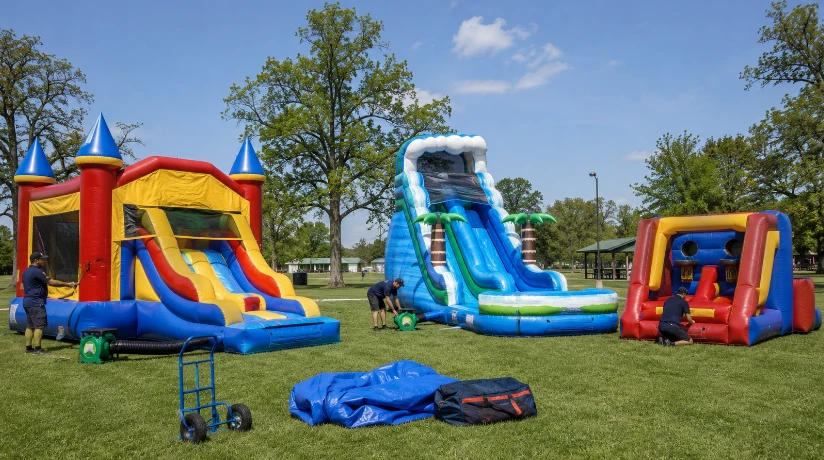
A more practical starting inventory could include a versatile bounce-and-slide combination, a medium-sized inflatable water slide, and an interactive game. The combination unit could serve birthday parties, the water slide could support higher-value summer bookings, and the interactive game could be added to school or corporate events.
Before ordering, the owner would need to compare the dimensions and packed weight of each product, blower requirements, anchor points, available electrical supply, and the number of staff needed for setup. The complete landed cost, including transportation and accessories, should also be reviewed rather than considering only the advertised purchase price.
This approach gives the business three products with different functions instead of several inflatables that compete for the same type of booking. It also allows the owner to test demand across residential parties, seasonal events, and larger group activities.
As booking history develops, the operator can use real customer inquiries and revenue records to determine whether the next investment should be a larger slide, an obstacle course, another combination unit, or a specialized attraction.
Work with a Supplier That Provides Clear Information
Reliable communication is important when purchasing equipment for commercial use. A supplier should be able to explain dimensions, materials, accessories, customization options, production schedules, packaging, and shipping arrangements.
Rental operators researching different types of commercial equipment can explore the selection available from EastJump, including bounce houses, water slides, obstacle courses, games, and larger inflatable attractions.
Regardless of which supplier is selected, buyers should request written specifications and confirm every important detail before production or shipment.
For customized equipment, colors, dimensions, artwork, branding, entrances, and activity layouts should be reviewed carefully. Keeping approvals and specifications in writing can help prevent misunderstandings.
Make Decisions Based on the Business, Not Only the Product
The most impressive inflatable is not always the best investment. A strong rental inventory should match local customers, available event spaces, transportation capacity, staffing, storage, seasonal conditions, and safety responsibilities.
For a new company, a smaller collection of versatile and frequently requested products may be more valuable than a large inventory of specialized attractions. As booking history grows, operators can use real customer inquiries and revenue data to guide future purchases.
By evaluating both customer appeal and operating requirements, a party rental business can choose commercial inflatables that are easier to manage, suitable for more events, and better aligned with long-term growth.