


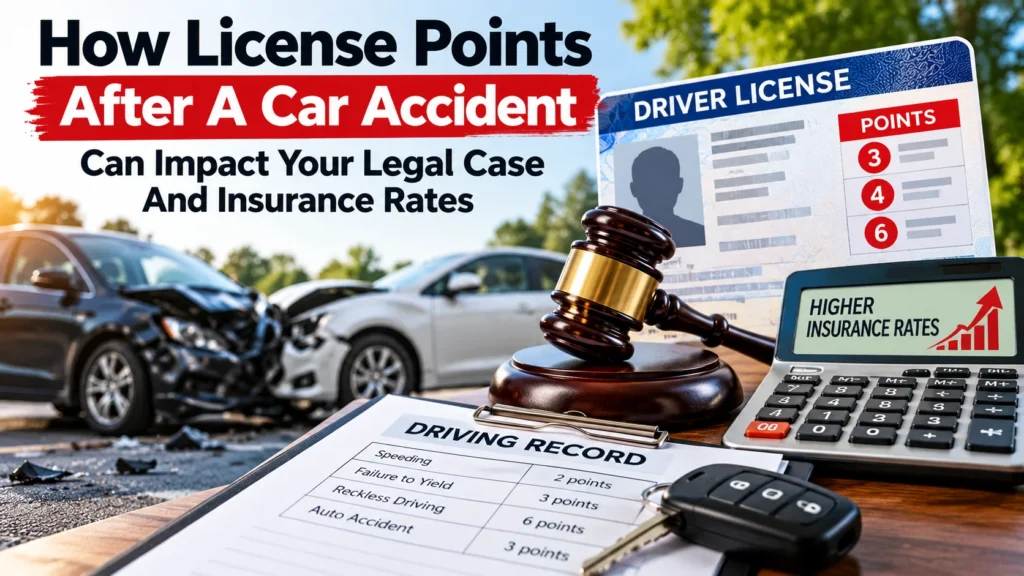

A car accident can create problems that extend well beyond vehicle repairs, medical expenses, and time away from work. Drivers may also face traffic citations, license points, higher insurance premiums, or even a suspended license. Understanding how license points after a car accident can affect your legal case and insurance rates can help you make informed decisions after a collision.
When a police officer believes a driver has violated a traffic law, the driver may receive a citation. Depending on the state and the outcome of the case, a qualifying violation may result in points being added to the driver’s motor vehicle record. Insurers may consider this information when assessing risk, while attorneys may examine relevant traffic violations when investigating fault in a personal injury claim.
However, receiving a ticket does not automatically establish legal liability for every aspect of a crash, and license points do not affect every insurance policy in the same way. The consequences depend on state law, the specific violation, the available evidence, and the insurer’s rating rules.
Why Do License Points Matter After a Car Accident?
Many U.S. states use a driver point system to identify motorists who repeatedly violate traffic laws. Points may be assigned for offenses such as speeding, failing to yield, running a red light, or reckless driving. The number of points depends on the jurisdiction and the specific violation.
Accumulating too many points within a defined period can trigger consequences such as a warning, a required driver improvement course, a license suspension, or other administrative action. These consequences are not identical in every state. Some jurisdictions also consider the seriousness of an offense independently of the driver’s total points.
Following a collision, it is important to distinguish between the accident itself, a traffic citation, a court finding, and the points that may subsequently appear on a driving record. Each can have different legal and insurance implications.
What Is the Difference Between License Points and a Traffic Citation?
A traffic citation is a notice alleging that a driver violated a traffic law. It may require the driver to pay a fine, respond to the charge, or appear in court. The driver may have options to contest the allegation, depending on the offense and local procedures.
License points are a separate administrative consequence under a state’s driving-record system. A citation does not necessarily mean points have already been added. The outcome may depend on whether the driver is convicted, pleads guilty, or receives another disposition recognized by the applicable law.
For example, a speeding citation following a collision could result in points if the violation is established under the state’s rules. A driver who successfully contests the charge may avoid the points associated with that citation. Nevertheless, the accident and any other independently established violations may still affect insurance or civil claims.
How Long Do License Points Stay on a Driving Record?
The length of time license points remain active varies by state and by the type of offense. In some jurisdictions, points count toward suspension thresholds for a limited period. The underlying conviction or traffic incident may remain visible on a driving record for longer than the period during which points count toward a threshold.
It is therefore important not to assume that points disappear everywhere after two or three years. States maintain different record-retention rules, and insurance companies may use their own legally permitted lookback periods when reviewing driving history.
Drivers can check their official motor vehicle records and consult their state motor vehicle agency to determine how a particular violation is recorded, how long points remain active, and whether any corrective options are available.
How Can License Points Affect a Car Accident Legal Case?
In a car accident lawsuit, one of the central questions is whether a driver’s conduct caused or contributed to the collision and the resulting injuries. Evidence of a traffic violation may help establish what happened, but the legal effect depends on the applicable rules of evidence and negligence law.
A car accident lawyer at Stewart Law Offices, a firm that emphasizes legal representation for injured people, may investigate citations, police reports, witness statements, photographs, video footage, and other evidence when evaluating a claim. Information about license points after accident can provide additional context about an alleged traffic violation and its possible consequences.
However, the existence of license points does not automatically prove that a driver caused a particular crash. A citation may be disputed, and a traffic proceeding may address different issues from a civil lawsuit. The court handling an injury claim must apply the relevant legal standards to the evidence presented.
Can a Traffic Citation Help Establish Negligence?
Negligence generally involves a failure to exercise the level of care required by law that causes harm to another person. When a driver violates a traffic rule, the alleged violation may be relevant to determining whether the driver acted negligently.
For example, evidence that a driver failed to yield at an intersection may help explain how a collision occurred. A police report, witness testimony, traffic camera footage, and vehicle damage may help investigators determine whether the driver violated a legal duty and whether that conduct contributed to the injuries.
The significance of the violation depends on state law. Some jurisdictions may treat certain statutory violations as evidence of negligence, while others apply different standards or recognize specific defenses. A citation alone should not be treated as conclusive proof of liability in every case.
Do License Points Affect Your Ability to Recover Compensation?
License points do not automatically prevent an accident victim from recovering compensation. The important issues usually include who caused the collision, the injuries sustained, the financial losses involved, and the rules governing shared fault.
If a driver seeking compensation has a relevant traffic violation, the opposing party may investigate whether that conduct contributed to the crash. However, unrelated points from an earlier incident do not automatically establish fault in a new accident. Their admissibility and relevance depend on the circumstances and applicable evidence rules.
Because negligence and comparative-fault rules vary across jurisdictions, drivers involved in a serious collision should consider obtaining advice from a qualified attorney in the state where the accident occurred.
How Do License Points Affect Car Insurance Rates?
Insurance companies evaluate risk when setting auto insurance premiums. Depending on state regulations and company policies, insurers may review driving records, traffic convictions, previous claims, accident history, and other permitted rating factors.
When a driver receives points for a moving violation after an accident, the underlying violation may influence the insurer’s assessment of future risk. However, points themselves do not produce an identical premium increase for every driver. The effect depends on the violation, the insurer, the driver’s previous record, the policy, and the rules in the relevant state.
For official information about how a state administers driving points and penalties, drivers can review the New York State driver point system. The rules described there apply to New York and should not be assumed to apply in other states.
Why Can Insurance Premiums Increase After an Accident?
Several factors can contribute to an increase in car insurance premiums after a collision. A chargeable accident, a moving violation, or a combination of the two may affect how an insurer evaluates a policy at renewal, where permitted by law.
- Higher perceived risk: A serious traffic violation may indicate a greater likelihood of future claims under an insurer’s rating model.
- Loss of discounts: A driver may lose a safe-driving discount if the policy’s eligibility conditions are no longer met.
- Accident-related surcharges: An insurer may apply a surcharge for an at-fault accident or qualifying violation, subject to state rules and policy terms.
- Changes at renewal: Premiums may change when a policy renews because of driving history, claims experience, or other permitted rating factors.
- Coverage availability: A serious or repeated violation may make some coverage options more expensive or harder to obtain. Nonrenewal or cancellation is governed by applicable law and policy requirements.
A premium increase is not guaranteed simply because points appear on a driving record. Some insurers focus on the underlying conviction or at-fault accident rather than the point total itself. Others may apply different rules based on the driver’s history and the severity of the incident.
How Can Drivers Reduce the Financial Impact?
Drivers can take several practical steps to understand their insurance options after a collision. First, review the policy to understand how accidents and moving violations may affect premiums. Next, ask the insurer which specific event or violation influenced any rate change and when it will be reviewed again.
It may also be useful to compare quotes from other insurers, ask whether an approved defensive-driving course qualifies for a discount, and check whether a safe-driver program is available. Discounts and eligibility requirements vary, and completing a course does not guarantee that points or an insurance surcharge will be removed.
When Can License Points Lead to a Suspended License?
Every state establishes its own rules for suspending or restricting driving privileges. In some states, accumulating a specified number of points within a defined period can trigger administrative action. Other violations may lead to suspension independently of the driver’s point total.
There is no single nationwide threshold, such as twelve points in one year, that applies to all U.S. drivers. The relevant threshold, time period, notice requirements, and opportunities to challenge a suspension depend on state law and the circumstances of the offense.
For drivers who are concerned about serious traffic violations, the consequences may extend beyond a temporary suspension. Losing driving privileges can interfere with commuting, employment, family responsibilities, and access to essential services.
Drivers in Florida researching whether they need SR-22 for having a lot of points should verify the requirements with the Florida Department of Highway Safety and Motor Vehicles or another appropriate official source. An SR-22 is generally a certificate of financial responsibility filed by an insurer when required; it is not itself a type of insurance policy. The filing requirement depends on the applicable circumstances and cannot be determined from a point total alone.
What Happens if You Drive With a Suspended License?
Driving while a license is suspended or revoked can lead to additional legal and financial consequences. Depending on the jurisdiction and the reason for the suspension, penalties may include fines, further restrictions, extended suspension periods, or criminal charges. Jail time is possible in some circumstances but is not an automatic consequence in every case.
A suspension may also complicate insurance arrangements. Some insurers may decline to offer certain policies or may charge higher premiums, depending on the driver’s record and the applicable rules. Drivers should confirm that their license has been legally reinstated before returning to the road.
Brent Stewart, a car accident attorney at Stewart Law Offices, is quoted in the original discussion regarding the broader consequences of a suspended license. Drivers should seek current, jurisdiction-specific legal advice before relying on general statements about criminal penalties or insurance consequences.
Can You Remove or Reduce License Points?
Some states allow eligible drivers to complete an approved defensive-driving or driver improvement course to receive a point reduction, prevent certain points from being assessed, or satisfy a requirement imposed by the licensing authority. Other states may provide different options.
Drivers should verify the course requirements, eligibility conditions, deadlines, and effect on their records before enrolling. A course may not remove the underlying conviction, erase an accident from an insurance database, or prevent an insurer from considering the incident when setting premiums.
If a citation is inaccurate or disputed, drivers should review the official instructions for contesting it. Meeting court deadlines and responding to notices can help prevent additional consequences that may arise from failing to address a citation.
Why Is E-Discovery Important in Car Accident Cases?
Electronic discovery, commonly called e-discovery, involves identifying, collecting, preserving, and reviewing electronically stored information that may be relevant to a legal dispute. In a car accident case, this information can help attorneys and investigators reconstruct events, assess competing accounts, and understand the circumstances surrounding a collision.
Potential digital evidence may include dashcam recordings, traffic camera footage, GPS information, vehicle event data, photographs, text messages, electronic communications, and relevant digital records. Whether a particular item can be obtained or used in court depends on issues such as relevance, authenticity, privacy protections, and applicable legal procedures.
The National Institute of Justice has discussed the use of evidence-based practices and data to reduce traffic fatalities. Its article on evidence-based practices using data to drive down traffic fatalities provides context for understanding how traffic data can support safety analysis.
Digital evidence can be useful when the parties disagree about speeding, braking, right-of-way, or the sequence of events before a crash. However, e-discovery does not automatically reveal every aspect of an accident, and not all digital records will be available in every case.
How Should Drivers Preserve Accident Evidence?
Drivers involved in a collision should preserve relevant documents and information where it is safe and lawful to do so. Useful records may include the police report, photographs of the scene and vehicle damage, witness contact information, medical documentation, repair estimates, insurance correspondence, and citation paperwork.
Drivers should avoid deleting potentially relevant communications or altering digital files when a legal dispute is reasonably anticipated. If a vehicle or device may contain important evidence, an attorney can explain how to preserve it appropriately and whether formal preservation requests are necessary.
Accurate records are generally more useful than assumptions about what an insurer or court will discover. Drivers should provide truthful information when legally required and consult a qualified attorney if they are uncertain about their obligations.
What Should You Do After an Accident That May Add License Points?
If a collision results in a traffic citation or a possible license suspension, taking organized steps can help protect your driving privileges and clarify your legal position.
- Prioritize safety: Check for injuries, contact emergency services when needed, and follow applicable accident-reporting requirements.
- Document the incident: Preserve photographs, witness details, the police report, and relevant vehicle and medical records.
- Review the citation: Read the alleged violation, response deadline, and instructions for paying or contesting the ticket.
- Check your driving record: Contact the appropriate state motor vehicle agency to confirm whether points or other actions have been recorded.
- Contact your insurer: Review your policy and follow the applicable requirements for reporting the accident.
- Understand your legal options: Consider consulting a local traffic attorney or car accident lawyer if the crash involves serious injuries, disputed fault, or a potential license suspension.
- Meet official deadlines: Respond to court notices, licensing correspondence, and insurance requests within the applicable time limits.
Taking these steps does not guarantee a particular legal or insurance outcome. It can, however, help drivers understand the issues involved, avoid preventable administrative problems, and make better-informed decisions.
Frequently Asked Questions About License Points After a Car Accident
Do license points transfer between states?
Not automatically in every situation. States may exchange driver and conviction information through interstate agreements and other reporting systems. Whether an out-of-state violation results in points on a driver’s home-state record depends on the states involved, the offense, and applicable rules.
Can I hide a car accident from my insurance company?
Drivers should follow their policy’s accident-reporting requirements and provide truthful information when required. Insurers may learn about accidents through claims, police reports, driving records, and other permitted sources. Failing to comply with policy obligations or providing false information can create coverage or legal problems, depending on the circumstances and applicable law.
Will license points affect my job?
They can affect employment when driving is an essential job responsibility, such as delivering goods, transporting passengers, or operating a company vehicle. Employers may review driving records where legally permitted, and certain roles have specific licensing or safety requirements. The effect depends on the position, employer policies, and applicable employment laws.
Do license points automatically increase car insurance rates?
No. Insurance companies use different rating methods, and state regulations limit how certain information can be used. A qualifying moving violation or at-fault accident may increase premiums, but the effect depends on the insurer, the policy, the driver’s history, and local rules.
Can a traffic ticket prove that I caused an accident?
A traffic citation may be relevant evidence, but it does not automatically establish civil liability in every case. The effect of the citation depends on the outcome of the traffic proceeding, the applicable evidence rules, and the facts of the collision.
Can a defensive-driving course remove license points?
Some states allow eligible drivers to complete approved courses to reduce points or satisfy certain administrative requirements. Eligibility and the effect on the driving record vary. Completing a course does not necessarily erase an accident or prevent an insurer from considering the underlying incident.
How can I find out whether my license is at risk of suspension?
Check your official driving record and suspension rules with the motor vehicle agency in your state. Review any notices you receive and respond by the stated deadlines. If you have accumulated points or received a serious traffic citation, a qualified local attorney can help explain the options available under state law.
Final Thoughts
License points after a car accident can affect driving privileges, insurance costs, and the evaluation of a related legal claim. However, the consequences depend on the state, the specific traffic violation, the outcome of any citation, and the driver’s circumstances.
Understanding the difference between a citation, a conviction, license points, and civil liability can help drivers avoid common misconceptions. By preserving relevant evidence, checking official records, meeting deadlines, and obtaining qualified legal advice when necessary, drivers can better understand their options after a collision.
Disclaimer: This article is for general informational purposes only and does not constitute legal, insurance, or financial advice. Laws and procedures vary by jurisdiction. Consult the relevant state agency, your insurer, or a qualified attorney for guidance about your specific situation.