

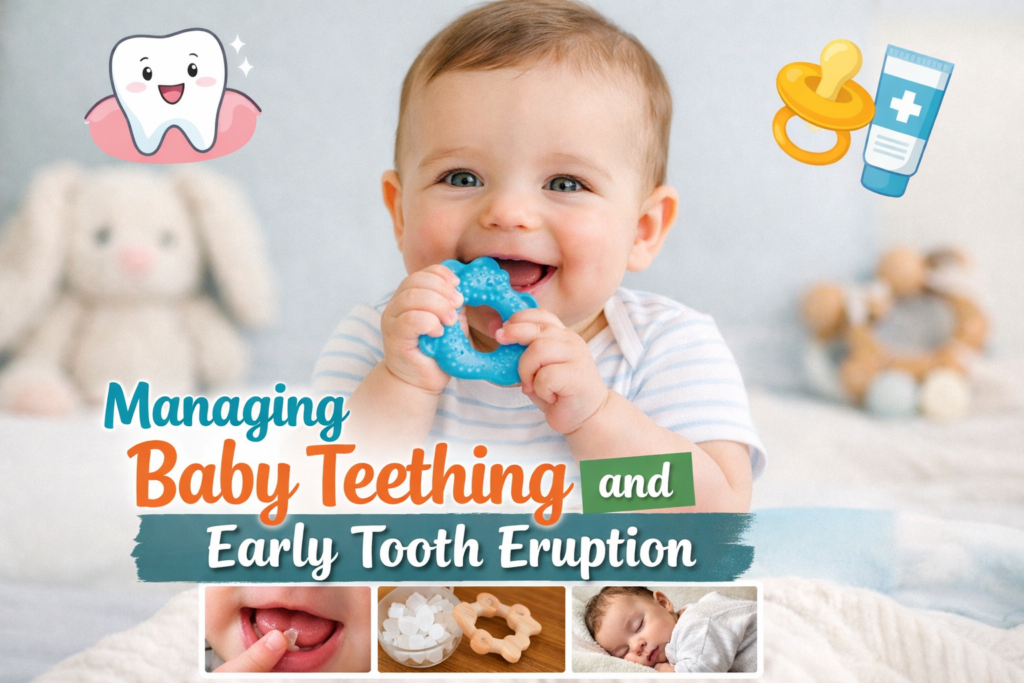
While teething symptoms are varied and can be bothersome, the ultimate reason you want them to feel better is to help them get the rest they (and you) need to thrive. To make confident decisions in that context, get the facts about your baby’s dental future.
Separating Normal From Concerning
The typical teething process includes drooling, fussiness, and some inflammation of the gum. Redness and irritation are normal when there’s a tooth breaking through. Increased saliva frequently causes a rash to form around the mouth and on the chin. A very low-grade fever may also occur as the tooth comes in, but not everyone agrees with this.
What isn’t caused by teething: a high fever, runny nose, or diarrhea. Parents who attribute these symptoms to teething may delay seeking the right treatment for genuine, although coincidental, infections. For any real fever (above 38.5°C or 101.3°F) or overly loose stools, consider calling your pediatrician or GP rather than using a teething ring.
The surprise for many parents isn’t the eruption itself but rather a little blue bump that pops up right in front of a new tooth. Often called an eruption cyst (or eruption hematoma if it’s filled with bloody fluid), this small pimple is not normally a cause for alarm. Unlike with pimples, it’s best to leave these alone because they often disappear once the tooth is out. If the bump stays around more than a few weeks or seems to cause your baby significant discomfort, you might want to consult your dentist.
How to Actually Soothe Inflamed Gums
Cold helps. But the temperature matters. A chilled (not frozen) teething ring applied to inflamed gingival tissue reduces discomfort without the risk of thermal injury that a frozen object can cause on delicate infant tissue. Solid rubber rings are the appropriate choice, liquid-filled versions carry a contamination risk if they’re punctured or compromised.
Gum massage with a clean finger is also effective for many infants. The counterpressure seems to help.
What to avoid: topical gels containing benzocaine. These are still sold over the counter but health authorities have flagged them as unsafe for infants. Benzocaine can cause methemoglobinemia, a condition that interferes with how blood carries oxygen. The risk isn’t theoretical. Don’t use them.
For genuine pain beyond comfort measures, acetaminophen or ibuprofen at the correct weight-based dose is appropriate, but dose guidance should come from your child’s doctor, not the packaging alone.
Start Cleaning the Moment the First Tooth Appears
This is the point many parents push back by months. The change from no teeth to one tooth is the ideal opportunity to start with a soft-bristled brush. Not a cloth, not “just wiping”, a legitimate, small-headed, infant toothbrush with a smear of fluoride toothpaste, the size of a grain of rice.
Fluoride toothpaste at this juncture is definitely not a choice. Fluoride varnish, similarly, is advised by a children dentist hobart as soon as the first tooth emerges. These early applications notably improve the resistance of newly erupted enamel against decay.
Early Childhood Caries (ECC), generally known as “bottle rot”, is not an amazing exception. Tooth decay is the most ordinary continuous childhood illness, five times more common than asthma, and four times more common than childhood obesity (American Academy of Pediatric Dentistry). ECC is largely preventable, but it can swiftly emerge on erupting teeth in the perfect conditions.
The two most dangerous conditions: a baby is put to bed drinking milk or juice from a bottle, and put off cleaning. Sugars from milk and juice accumulate around erupting teeth while your baby is asleep. This is when the salivary flow and natural protection are at their minimum. This advancing decay can become so significant to demand general anesthesia.
Invest a few minutes every month by using the “Lift the Lip” method, pull back your baby’s upper lip and interpret the gum line of front teeth. White spots or brown coloring are early indicators of ECC. Treat them in their early stages and the remedies are moderate. By the following normal check-up, it’s mostly too late.
Build the Professional Relationship Early
The initial dental appointment must occur by age one, and preferably six months after the first tooth has erupted. It’s not a simple formality, it’s a time for a professional to assess the eruption sequence, recognize early crowding or spacing, and begin monitoring that helps capture orthodontic issues before they become “expensive” problems to correct.
For this, you need local context. A dentist who has followed a child’s specific eruption over time can recognize subtle deviations that a first-time parent, or even a general dentist who sees the child only occasionally, might not. And little habits like sucking a thumb at this age can determine how a child’s permanent teeth align: malocclusion is not overnight and the related causes are identified early, change outcomes.
Teething is the Starting Line
The pain goes away. The teeth remain. However, effective management during the eruption phase will determine everything that follows, from the strength of the enamel, to overall bite architecture. Viewing it as a short-term discomfort overlooks the opportunity to form the habits and partnerships that will safeguard your child’s smile in the future.