

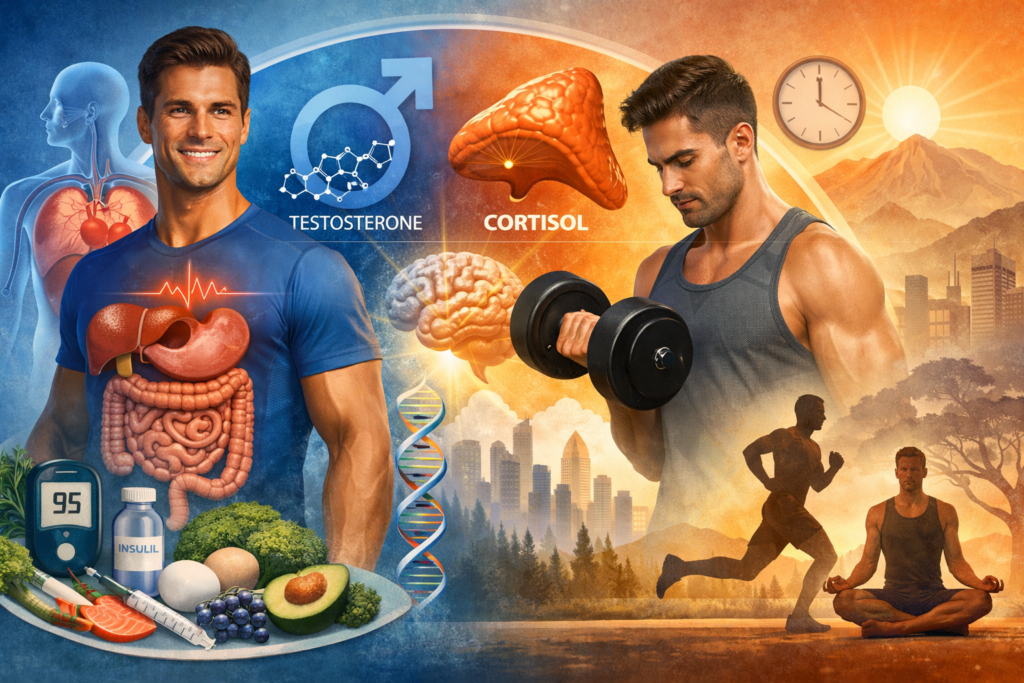
If you are maintaining a healthy diet, working out regularly, and yet seem to have no energy left, the issue is likely not related to your lifestyle. It’s about your biology. More precisely, it’s about how your metabolic function interacts with your hormonal environment. These two systems are interdependent and when one is disrupted, the other one is affected too.
Why Insulin Resistance Comes for Testosterone Next
Insulin resistance is commonly associated with a blood sugar problem, with too much glucose in the blood, but the relationship between insulin and the body’s androgen levels is more important. When cells become resistant to insulin, the body responds by elevating insulin levels higher and higher. Elevated insulin tells the enzyme that converts testosterone (and crucially for women, DHEA) into estradiol to do its work. As testosterone levels fall because more are being converted to estradiol, the number of androgen receptors drops.
This creates a hormonal cascade. Estrogen is a potent antagonist of the thyroid receptor and creates hypothyroidism, while promoting fat gain. Essentially, insulin resistance doesn’t result in more sugar in the blood but less glucose entering muscle cells where it can do its job. Too many people lack the muscle to store fuel, which creates a host of other problems in the mitochondria, where the body generates energy.
Andropause isn’t Just Aging – it’s a Metabolic Shift
Men used to start losing testosterone in their 50s. Now it’s their 30s. Western men’s testes are failing, and men are largely unaware and undiagnosed. Rather than addressing the root causes of andropause, like the feminizing effects of herbicides on male endocrine systems, or the insulin dis-regulation caused by processed food on a man’s ability to produce testosterone, doctors are quick to pull out the prescription pad. 94% of male HRT prescriptions are written in a way that drugs the testes to shut down further testosterone production.
Why Generic Weight Loss Advice Fails Men With Hormonal Imbalances
The calories-in, calories-out model isn’t exactly wrong. But it’s incomplete for any man whose testosterone-to-estrogen ratio is out of whack. When estrogen is too high relative to testosterone, an imbalance that’s often seen in men with visceral fat and poor insulin sensitivity, the fat-loss engine we expect caloric restriction to prime is locked. The body resists losing fat.
What we actually hear all the time is that men in this state are losing muscle with no corresponding drop in the number on the scale. High-intensity output further elevates cortisol. Without the hormones necessary for a full recovery, progress becomes minimal.
While the links between these compounds and frequently unspoken-of epidemics of low testosterone and insulin resistance continue to be studied, we can say that phthalates and bisphenols act as endocrine disruptors. They tinker with our body’s ability to produce and metabolize the hormones we need for recovery and use during exercise and daily life. They’re a large part of the hiding half of modern illness and suffering.
A Mens Hormone Clinic that approaches male symptoms looking first and foremost at the blood can help you determine where the weakest link in the chain actually is. Low free testosterone? Cool. But what’s trigging that? Low SHBG? Almost certainly, the bottom of the cascade. Low thyroid or low cortisol awakening response overexposing you to cortisol during what should be low-output times? You’d never know without the test. And that’s what the morning test makes sure of.
The Two Non-Negotiable Levers: Sleep and Resistance Training
Before thinking that any pharmacological protocol will be relevant, two lifestyle interventions do more for hormonal health than anything else you can get without a prescription.
Restorative sleep is where the magic occurs. Growth hormone and testosterone are released in a pulsatile pattern directly connected with the circadian rhythm, peaking in deep sleep stages. If you have consistently bad sleep, you’re not just worn out, you’re actually breaking the hormonal cascade, blocking mitochondrial repair, and raising cortisol the next day. Seven to nine hours of quality sleep is not a wellness suggestion. It’s an endocrine demand.
Resistance training is the most powerful metabolic message you can send. Heavy compound movements enhance insulin sensitivity, boost testosterone production, and trend body composition towards lean mass. That trend reinforces hormonal health, more muscle makes for better glucose management, lower visceral fat, and a more advantageous hormonal environment going forward.
Neither will work particularly well if the underlying hormonal architecture is so dysfunctional that it stops adaptation in its tracks. And that’s the kind of problem you run into when you start with a fitness program and hope the biology will catch up.
A Biomedical Approach Should Come First
Men who think they are following all the rules and are still failing are not simply deficient in willpower. They are abiding by a rulebook that was never properly screened before going to print. Blood chemistry, including free testosterone, SHBG, cortisol, insulin, and metabolic panel, gives you a look at what your body is actually capable of responding to before you make your next move.
Sure, general wellness advice could have a little relevance. But it would have to be absorbed by a body that has the hormonal mastery to act on it. That order of operations is far more important than any man is ever advertised.