
A puffer jacket is designed to provide warmth without adding excessive weight, making it a popular choice for cold-weather wardrobes. But because these jackets contain insulation and often use lightweight outer fabrics, cleaning them requires more care than washing an ordinary coat. Knowing how to handle puffer jacket dry cleaning, washing, drying, and storage can help protect the jacket’s shape, insulation, and performance.
The most important rule is simple: always check the garment’s care label before cleaning it. Puffer jackets can contain down, synthetic insulation, waterproof coatings, delicate fabrics, or combinations of materials that require different care methods. Some down jackets can be safely machine washed and tumble dried on low heat, while others may have specific professional-cleaning instructions. :contentReference[oaicite:2]{index=2}
In this guide, we’ll explain the dos and don’ts of cleaning a puffer jacket, when dry cleaning may be appropriate, how to wash and dry down-filled jackets, and when using a professional laundry service can make sense.
Why Puffer Jackets Need Special Cleaning Care
A puffer jacket gets its warmth from insulation trapped inside stitched or baffled sections. That insulation may be natural down or a synthetic alternative. Cleaning the jacket incorrectly can affect the insulation’s loft, the outer fabric, or water-resistant finishes.
Down is particularly sensitive to moisture during the drying process. When wet, down can clump together, temporarily reducing its ability to trap warm air. Thorough drying helps restore the loft and overall performance of the garment. REI recommends low-heat drying and using clean tennis or dryer balls to help break up clumps. :contentReference[oaicite:3]{index=3}
Puffer Jacket Cleaning: Dos and Don’ts
Do: Read the Care Label First
Before putting a puffer jacket into a washing machine or taking it to a dry cleaner, read the manufacturer’s care instructions. The label may specify machine washing, hand washing, professional cleaning, tumble drying, air drying, or restrictions on particular cleaning products.
This step is especially important because the correct method depends on the jacket’s insulation, shell fabric, coatings, trims, and construction.
Do: Identify Whether the Jacket Uses Down or Synthetic Insulation
Down and synthetic insulation do not necessarily have identical care requirements. Down-filled jackets often require careful washing and thorough low-temperature drying to restore their loft. Synthetic insulation can also have specific washing and drying requirements depending on the manufacturer.
If you’re unsure what type of insulation your jacket contains, check the product label or manufacturer’s website before cleaning it.
Do: Empty and Prepare the Jacket
- Empty all pockets.
- Remove detachable accessories if the care label permits.
- Close zippers and fasteners where appropriate.
- Check the jacket for loose stitching, holes, or damaged seams.
- Remove obvious surface dirt before washing.
Do: Use a Suitable Cleaner
For down garments, a cleaner specifically formulated for down can be appropriate when the manufacturer’s instructions allow machine washing. Some specialist down cleaners are designed to clean the insulation without compromising its loft. :contentReference[oaicite:4]{index=4}
Use the amount recommended by the product manufacturer. Excess detergent can be difficult to rinse completely from insulated garments.
What You Should Not Do When Washing a Puffer Jacket
Don’t Use Bleach Unless the Care Label Specifically Allows It
Bleach can damage fabrics, coatings, and insulation. For this reason, it should not be used on a puffer jacket unless the garment manufacturer specifically says it is safe.
Don’t Automatically Use Fabric Softener
Fabric softener is generally not recommended for down garments. Patagonia’s care guidance specifically advises against fabric softener for down products. :contentReference[oaicite:5]{index=5}
Don’t Assume Hot Water Is Better
Hot water is not necessary for most puffer-jacket cleaning and can be unsuitable for certain fabrics and insulation. When machine washing is permitted, follow the temperature stated on the care label. Many down-jacket care instructions recommend cold water. :contentReference[oaicite:6]{index=6}
Don’t Ignore Damaged Seams
If a puffer jacket has a tear, open seam, or damaged baffle, cleaning it without repairing the problem first may allow insulation to escape. Inspect the jacket before washing and consider professional repair when necessary.
How to Wash a Puffer Jacket at Home
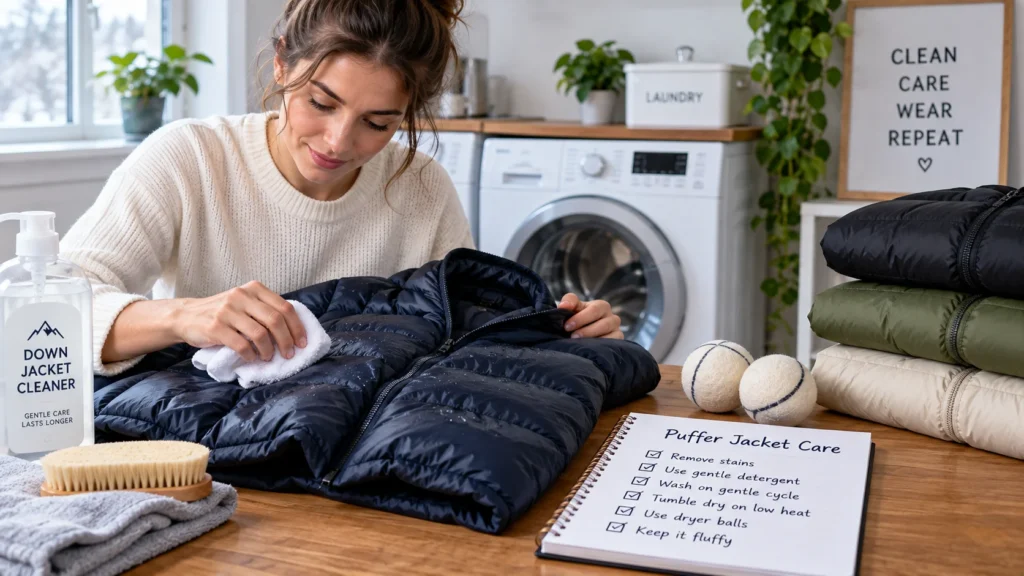
If the care label allows machine washing, a careful process can help reduce the risk of damaging the jacket.
- Read the care label carefully.
- Empty the pockets and close suitable zippers.
- Use a clean washing machine.
- Choose a gentle cycle and the temperature specified by the manufacturer.
- Use a suitable down or technical-garment cleaner when recommended.
- Run an additional rinse if necessary to remove cleaning residue.
- Remove the jacket carefully after washing.
- Dry it using the method specified by the manufacturer.
For many down garments, manufacturers and outdoor-care specialists recommend a front-loading washing machine because the gentler action can reduce the risk of snagging or stressing the garment. :contentReference[oaicite:7]{index=7}
How to Dry a Puffer Jacket Safely
Drying is one of the most important parts of cleaning a puffer jacket. Washing can leave down insulation clumped together, so the jacket needs enough time to dry completely and regain its loft.
Use Low Heat When the Care Label Allows Tumble Drying
For many down jackets, low-heat tumble drying is recommended. High heat can damage some fabrics, coatings, and insulation, so do not use a high-temperature setting unless the manufacturer specifically permits it. Patagonia and REI both recommend low or no heat for suitable down garments. :contentReference[oaicite:8]{index=8}
Use Clean Dryer Balls or Tennis Balls for Down
When permitted by the care instructions, adding clean dryer balls or tennis balls to the dryer can help break up wet down clumps and restore loft. The balls are useful during the drying stage, not as a substitute for proper washing. :contentReference[oaicite:9]{index=9}
Be Patient
Down jackets can take considerably longer to dry than ordinary clothing. REI notes that complete drying can take one to three hours depending on the garment and dryer, with additional cycles sometimes necessary. :contentReference[oaicite:10]{index=10}
Check the jacket periodically and gently redistribute any remaining clumps. Do not assume that a jacket is completely dry simply because the outer fabric feels dry.
Can You Air Dry a Puffer Jacket?
Air drying can be possible for some puffer jackets, but the correct method depends on the care label. For down garments where tumble drying is not available, Patagonia recommends laying the jacket flat on a towel in a warm, dry location away from direct sunlight and periodically breaking up clumps. :contentReference[oaicite:11]{index=11}
The key is to ensure the insulation becomes completely dry before the jacket is stored. Damp down that remains trapped inside the jacket can develop unpleasant odours and create conditions that encourage mildew.
Can You Dry Clean a Puffer Jacket?
It depends on the jacket. Dry cleaning should not automatically be considered the safest cleaning method for every puffer jacket.
Some manufacturers specifically advise against conventional dry cleaning for down products because solvents may affect the natural oils and loft of down. Patagonia, for example, advises against dry cleaning its down products, while REI also notes that the correct cleaning method depends on the garment’s instructions. :contentReference[oaicite:12]{index=12}
At the same time, some specialised insulated garments may have their own professional-cleaning requirements. Certain technical garments can also use unusual materials or treatments that require specialised processes.
Therefore, the safest approach is to follow the manufacturer’s care label rather than assuming that “dry clean” is always better than washing.
When Professional Puffer Jacket Cleaning Makes Sense
Professional cleaning can be useful when a jacket has difficult stains, delicate construction, specialist materials, significant odours, or care instructions that you do not feel comfortable handling at home.
Before handing over a puffer jacket, tell the cleaner what type of insulation it contains and show them the manufacturer’s care label. A professional cleaner should be able to determine whether their process is suitable for the garment.
Never assume that a standard dry-cleaning process is appropriate simply because the garment is expensive or delicate. The cleaning method should match the jacket’s construction and care requirements.
Puffer Jacket Cleaning Mistakes to Avoid
- Ignoring the care label: The manufacturer’s instructions should always come first.
- Using excessive detergent: Residue can be difficult to remove and may affect loft.
- Using bleach: It can damage fabrics and insulation.
- Using fabric softener: It is generally unsuitable for down garments.
- Using excessive heat: High temperatures can damage some materials.
- Stopping the drying cycle too early: Down needs to be completely dry.
- Storing the jacket while damp: Moisture can lead to odours and mildew.
- Assuming every puffer jacket can be dry cleaned: Some manufacturers specifically advise against it.
- Using dirty tennis balls: If using balls during drying, choose clean ones to avoid transferring dirt to the jacket.
How Often Should You Clean a Puffer Jacket?
A puffer jacket usually does not need to be washed after every wear. Frequent unnecessary washing can place additional stress on fabrics, finishes, stitching, and insulation.
Instead, clean the jacket when it becomes visibly dirty, develops noticeable odours, or when accumulated body oils and dirt begin affecting its appearance or performance. REI similarly recommends cleaning a down jacket when it looks or smells dirty rather than washing it after every use. :contentReference[oaicite:13]{index=13}
How to Remove Small Stains From a Puffer Jacket
For a small isolated stain, a full wash may not always be necessary. First check the care instructions, then gently spot-clean the affected area using a method appropriate for the fabric.
Avoid aggressive scrubbing because lightweight outer fabrics can be delicate. If a stain is difficult to remove or the jacket has a specialist coating, professional cleaning may be a better option.
How to Store a Puffer Jacket After Cleaning
Once your puffer jacket is completely clean and dry, store it in a cool, dry environment. For down jackets, long-term storage on a suitable hanger is generally preferable to keeping the garment tightly compressed in a small storage bag. REI recommends storing down jackets on a hanger to help preserve loft. :contentReference[oaicite:14]{index=14}
Before storage, make sure the jacket is completely dry. Never put a damp insulated jacket into long-term storage.
Professional Laundry Services for Puffer Jackets
If you prefer not to clean an expensive or delicate puffer jacket yourself, a professional laundry provider may be convenient. Hello Laundry currently offers laundry and dry-cleaning services with collection and delivery in locations it serves in the UK. :contentReference[oaicite:15]{index=15}
When arranging professional cleaning, provide the cleaner with the garment’s care instructions and ask which cleaning process they recommend for its particular insulation and fabric. This is especially important for down-filled and technical jackets.
You can learn more about the available dry cleaning services and determine whether the service is suitable for your particular garment.
A Note About Puffer Jackets and Technical Fabrics
Some modern puffer jackets combine insulation with water-resistant or waterproof outer fabrics. These garments may have durable water-repellent finishes or specialised membranes that require additional care.
For example, certain technical outerwear manufacturers recommend specific washing and drying methods to preserve water repellency. This is another reason why the garment’s individual care instructions are more reliable than a generic cleaning rule. :contentReference[oaicite:16]{index=16}
Frequently Asked Questions About Puffer Jacket Dry Cleaning
Can puffer jackets be dry cleaned?
Some puffer jackets may be suitable for professional cleaning, but dry cleaning is not automatically appropriate for every jacket. Always follow the manufacturer’s care label. Some down-jacket manufacturers specifically advise against conventional dry cleaning. :contentReference[oaicite:17]{index=17}
How should I wash a down puffer jacket?
If the care label permits machine washing, use the recommended temperature and a suitable cleaner for down. A front-loading machine is commonly recommended for down garments. Follow the manufacturer’s instructions rather than relying on a generic washing setting. :contentReference[oaicite:18]{index=18}
Can I put a puffer jacket in the dryer?
Many down puffer jackets can be tumble dried on a low-heat setting, but you should always check the care label first. Low heat and complete drying are important for suitable down garments. :contentReference[oaicite:19]{index=19}
Can I use tennis balls when drying a puffer jacket?
For suitable down jackets, clean tennis balls or dryer balls can help break up clumps during drying and restore loft. Use them only when compatible with the garment’s care instructions. :contentReference[oaicite:20]{index=20}
Can I hang a puffer jacket to dry?
It depends on the jacket and its care instructions. Some down-care guidance recommends laying a wet jacket flat when air drying, while other jackets may permit different methods. Follow the manufacturer’s instructions and ensure the insulation dries completely before storage. :contentReference[oaicite:21]{index=21}
How long does a puffer jacket take to dry?
Drying time varies depending on the jacket, insulation, dryer, temperature, and moisture level. Down jackets can take significantly longer than ordinary clothing, and additional low-heat cycles may be necessary. REI notes that some down jackets can take one to three hours to dry fully. :contentReference[oaicite:22]{index=22}
How often should I wash my puffer jacket?
There is no universal schedule. Clean the jacket when it becomes visibly dirty, develops an odour, or when accumulated dirt and body oils affect its condition. Avoid unnecessary washing and always follow the manufacturer’s recommendations. :contentReference[oaicite:23]{index=23}
Final Thoughts on Puffer Jacket Dry Cleaning and Care
Cleaning a puffer jacket does not have to be complicated, but it does require the right approach. The most important step is to check the care label before choosing between machine washing, air drying, tumble drying, or professional cleaning.
For suitable down jackets, gentle cleaning followed by thorough low-temperature drying can help restore the insulation’s loft. Clean dryer balls or tennis balls can assist during drying, while excessive heat, bleach, fabric softener, and improper cleaning methods should generally be avoided. :contentReference[oaicite:24]{index=24}
If your puffer jacket has specialist materials, difficult stains, delicate construction, or confusing care instructions, consider asking a professional cleaner for advice before proceeding. A suitable professional laundry or dry-cleaning provider can help determine the appropriate process for the garment rather than automatically applying a standard dry-cleaning treatment.
With the right care, you can keep your puffer jacket clean, comfortable, and ready for cold weather while reducing the risk of unnecessary damage to its insulation and outer fabric.