

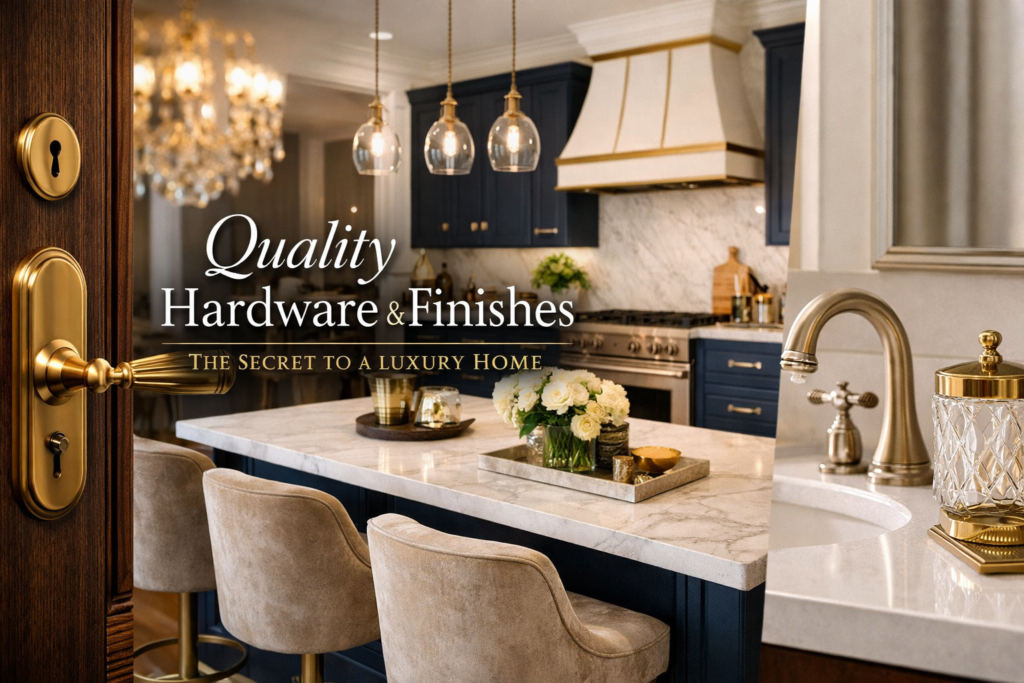
The case for investing in what you touch every day.
Quality hardware is a quiet support actor in your daily life. It is sustainable because you never have to replace it. It wears in, not out, and becomes a part of the rhythm of your house. Cheaper hardware is the opposite. It’s the pebble in your shoe, always slightly off, constantly fighting against the operation it was built for. It’s less expensive for a reason, but worse, that reason becomes a little tax on your peace of mind every day.
Why Weight and Material Density Matter More Than Appearance
The gap between two cabinet pulls of different prices can often be unnoticeable visually as they are pretty similar when you see them in a product image. But when you hold them in your hand, you can immediately see the distinction.
Most hardware brands offer products with very similar, almost identical designs. The real difference comes down to cost and quality. Higher-quality materials are more expensive because they perform better. Brass costs more than zinc because it’s heavier, feels better in your hand, and is far more durable over decades of use. Plating something in three microns of real gold costs more than dipping it in corn syrup and yellow dye, which is pretty self-explanatory.
That ‘invisible’ hammer-to-the-head feeling when you grab a hold of something well-made contributes heavily to the overall feel of a room.
The ROI Argument Most Homeowners Miss
Renovating an entire kitchen is a massive job. However, replacing cabinetry hardware is a simple task. People say it’s one of the only home improvement projects where you can actually achieve a custom aesthetic without the custom cost.
When you swap pulls, knobs, and hinges on your current cabinetry, it truly makes a difference in how high-end custom, or store-bought standard, your kitchen appears. It’s really just a matter of a few screws and a couple of hours of your time.
One of the most common topics listing agents are asked by sellers is, “What can we do to get the house ready to sell?” Buyers have priorities. When it’s a seller’s market, smart sellers listen and act on those priorities. A study by the National Association of Realtors confirmed that the two interior projects most likely to add value for resale are kitchen upgrades and a complete kitchen renovation (83% and 76%, respectively). Buyers notice. They open drawers and cabinets in kitchens. They notice the hardware. It’s often an unconscious reaction, but they do.
Sourcing Pieces That Function As Design, Not Just Hardware
Have you heard of “cabinetry jewelry”? Well, it’s a thing. Knobs and pulls are present in every good wide-angle photograph of a kitchen or bathroom. They’re the center of the places we literally spend the most time.
When you’re at this level of hardware you want something that at least tries to be more than just what it is obliged to functionally be. Companies like Lovech operate in the ‘object, not mechanism’ realm. You can see it in the quality of the finish by hand and in the ergonomics of the grip. You can often just tell by looking at it as a part of a larger room design that more consideration has gone into its form.
Texture and finish-wise, knurled has become a new thing. It supposedly adds grip and a precision-engineered vibe that you seem to find in many higher-end products. PVD coating has also crept in, says it’s got far greater resistance to corrosion and scratching compared to standard plating. An oldy-worldy one for those that like to be able to feel their hardware age are ‘living finishes’; unlacquered metals such as copper or bronze that patina and darken in the metal show the scratches, dings, nicks, flakes, and dents of your lives in real time.
Creating Visual Continuity Across A Space
One of the easiest finish selection concepts to grab onto is simply keeping metal tones consistent across a room. We say easiest because sometimes it’s the hardest point for our clients to relinquish. But if you can limit yourself to two, at most three, separate metal tones per space, the room will feel designed rather than assembled.
This rule applies across every finish point in a room: cabinet hardware, lighting fixtures, plumbing fittings, switch plates. A matte black faucet paired with matte black cabinet pulls and some matte, black-friendly light fixtures = a tight design. That same matte black pull, though, is paired with brushed nickel light fixtures and polished chrome faucet and switch plates? Three people made this room.
This idea – called ‘integrated finishes’ by some – is the invisible line between a good-intention renovation and something that actually looks different. The individual pieces are fine. It’s the fact that they can’t shake hands with each other that’s the problem.
Where The Details Land
Minimalist insides raise the stakes considerably. If there is less visual clutter in a room, each of the remaining pieces exerts more influence. In this sense, a beautifully crafted pull on a flat-front cabinet door is not a small thing – it is practically the only thing. This must be sustained. The truly luxurious homes are not always those with the highest budgets. They are the ones where someone has made conscious choices about the tangible things that people come into contact with. Hardware is where this becomes apparent – or it isn’t.