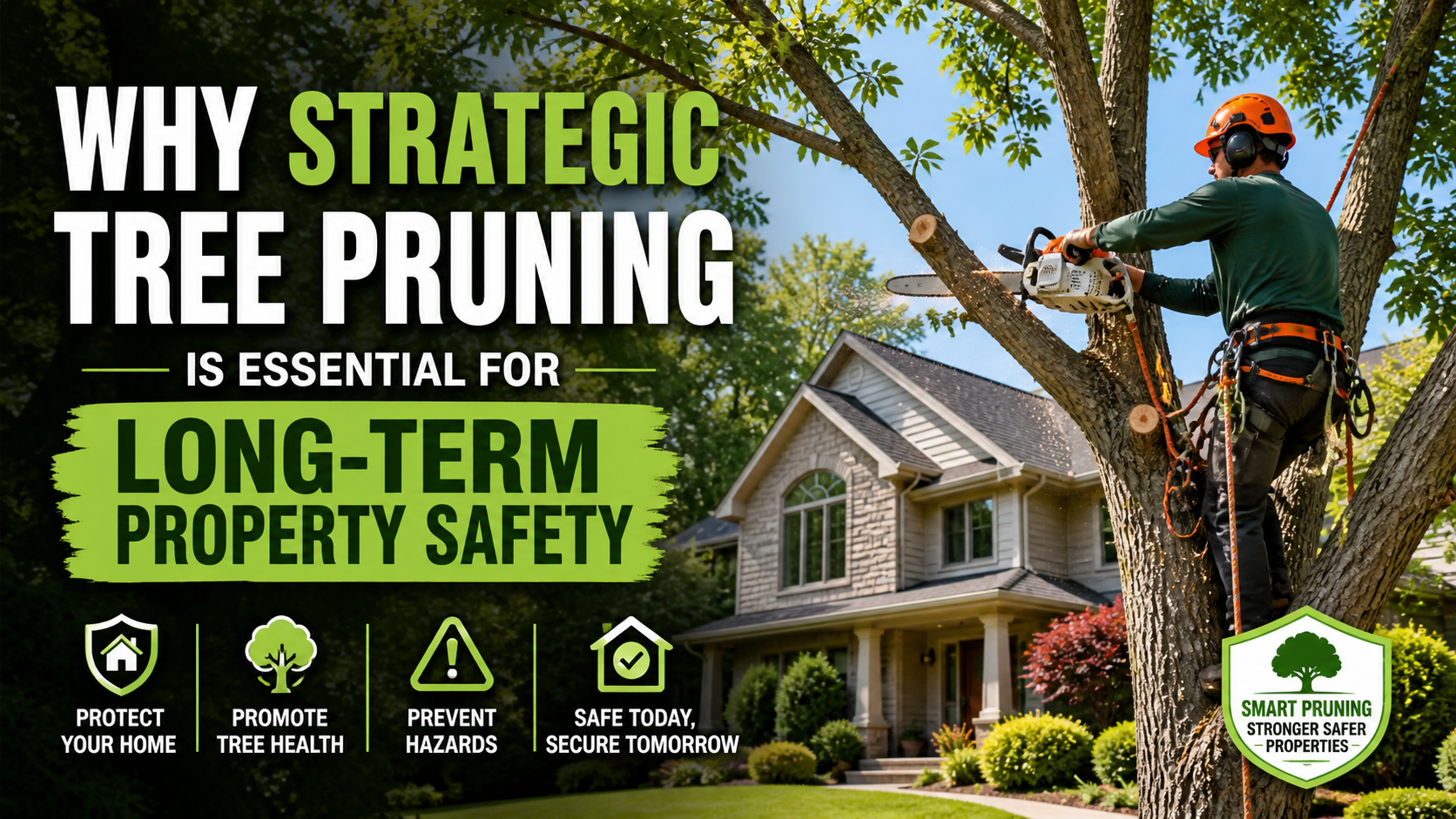
When a branch comes down in a storm, the response is usually the same, emergency calls, insurance reports, and someone with a chainsaw cleaning up what’s left. The problem isn’t the storm. It’s that the tree wasn’t managed before the storm arrived. Strategic pruning done months or years in advance is what separates a property that weathers severe weather from one that doesn’t.
The Real Risk is Structural, Not Aesthetic
While behind-the-woodshed pruning helps to reduce the load at the ends of branches, opening up the interior of the canopy improves air circulation and removes deadwood. This makes it easier for air to pass through the tree during a storm and less likely that a large, heavy, dead branch will split from the tree.
And that old wives’ tale about not thinning a tree because it gives the wind easier passage so it’s less likely to be knocked over? It’s actually true. A solid wall of foliage takes the hit. A tree with well-spaced branching and good exposure to prevailing winds, from the time it’s a sapling, develops stress wood in the appropriate locations to help it better withstand nature’s fury.
How Proper Pruning Cuts Actually Protect Trees
There is a common misconception that extensive cutting weakens trees. When performed properly, the opposite is true. A professional pruning cut made right outside the branch collar, which is the raised tissue at the bottom of a branch, stimulates the growth of callus tissue, the natural tree-sealing mechanism. This callus blocks off the wound and prevents pathogens from entering.
If the cuts are made incorrectly and go too close to the trunk or through the collar, then this sealing process is interrupted, and the exposed wood serves as a direct path for internal decay and structural hollowing. A tree that seems healthy on the outside might be completely hollow based on a few years of poor cutting work.
This is why the technical standard is important. For professional arborists working in Australia, tree lopping brisbane work conducted to AS 4373-2007 means that cuts are delivered in a way that sets the tree up to age with strong structure rather than hastening it towards decline, something especially important for the big-canopy species common in the subtropics.
Deadwood Doesn’t Wait For Storms
Deadwooding does reduce the overall mass in the canopy, which may allow a breeze to pass through rather than hitting sail-like surfaces and increasing the resistance to snapping or uprooting during a storm. It may provide the tree with the energy and resources needed to fight off diseases and pests, hold more water in its leaves, and bend rather than break if winds become high.
Prevention Versus Reaction
The difference in cost between proactive pruning and emergency removal is not only substantial, but also in terms of what it can achieve. A structurally compromised tree that could have been fixed five years ago by doing some targeted work on the crown might be at the point where it will have to be removed.
Minor structural works, taking out a co-dominant stem when the tree is a sapling, reducing a lateral of excessive weight, lifting a crown to prevent contact with a building, are all works that save the tree. Emergency response works virtually never do. They’re responses to a situation that has already occurred, and usually involve the removal of a tree that didn’t have to die.
A proactive frame of mind also means that you are engaging with local council rules before problems arise. Many works on significant trees, or, in certain scenarios, nearly all trees, require permits. In some cases, the tree is the subject of a protection order. Knowing that before there’s a problem presents a property owner with some decisions on what to do that reactive situations do not.
Building a Maintenance Schedule
Regular, systematic inspections are the single most effective strategy for maintaining tree risk at acceptable levels. The type and frequency of inspection will depend on the tree, its structure, its environment, and the past of management of the tree. Some species are notoriously prone to problems and may require more frequent and more thorough inspections.
The basic question an inspection needs to answer is “Does a tree have a structural defect that is likely to cause it to fail, and is that tree likely to hit a target?” which can be answered by identifying the characteristics of both defective trees and targets which contribute to tree, target impacts.