
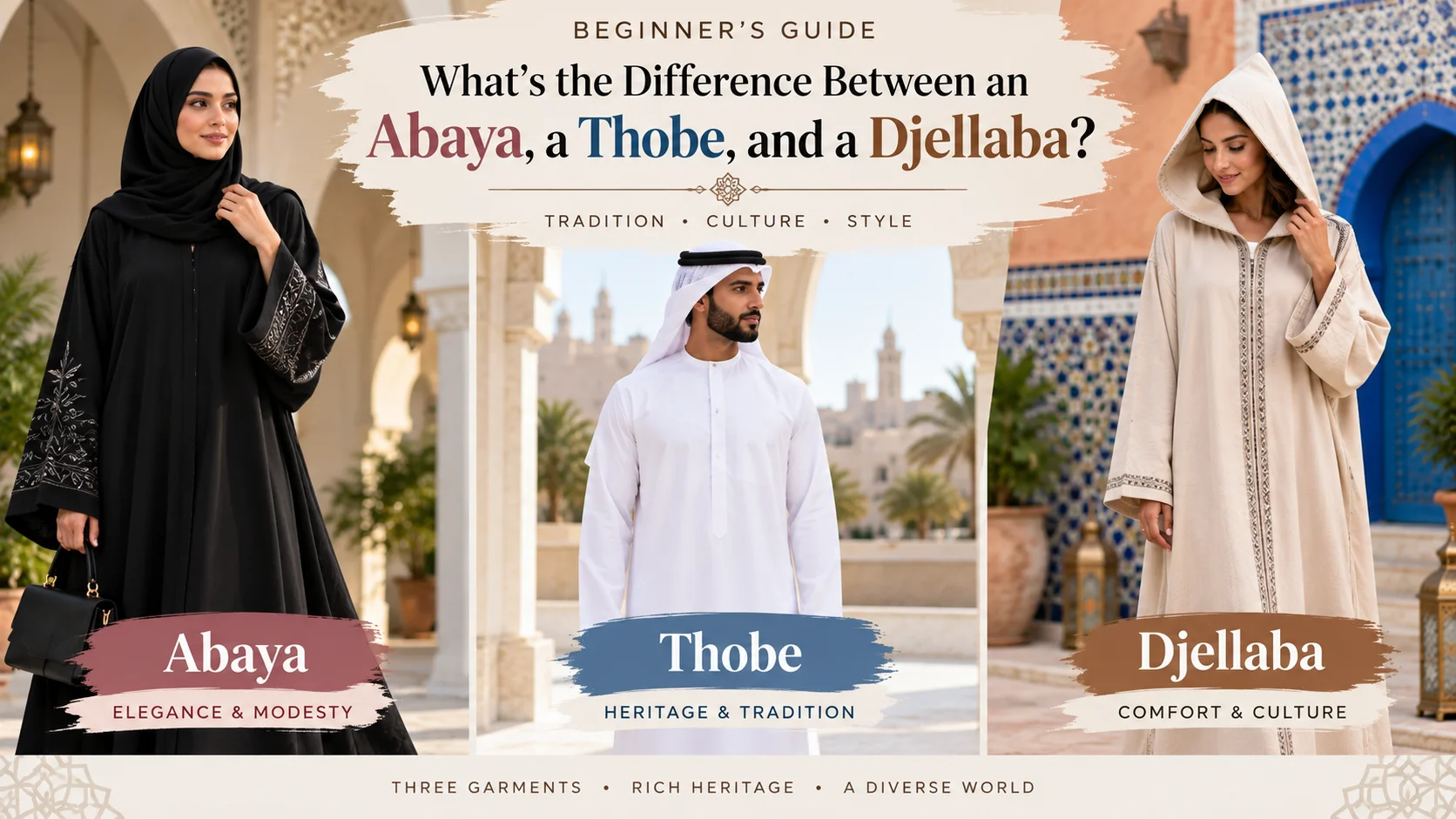
Traditional clothing can tell us a great deal about a region’s history, culture, climate and social traditions. If you are new to Islamic and Arab clothing, three names you may come across are the abaya, thobe and djellaba. Although these garments can all have loose, modest silhouettes, they are not interchangeable terms.
In this beginner’s guide, we’ll explain the difference between an abaya, thobe and djellaba, including their typical designs, regional associations, who wears them, how they are styled and why the terminology can sometimes be confusing.
Abaya vs Thobe vs Djellaba: What’s the Difference?
The easiest way to understand these garments is to look at their typical form and cultural context rather than treating them as three versions of exactly the same clothing item.
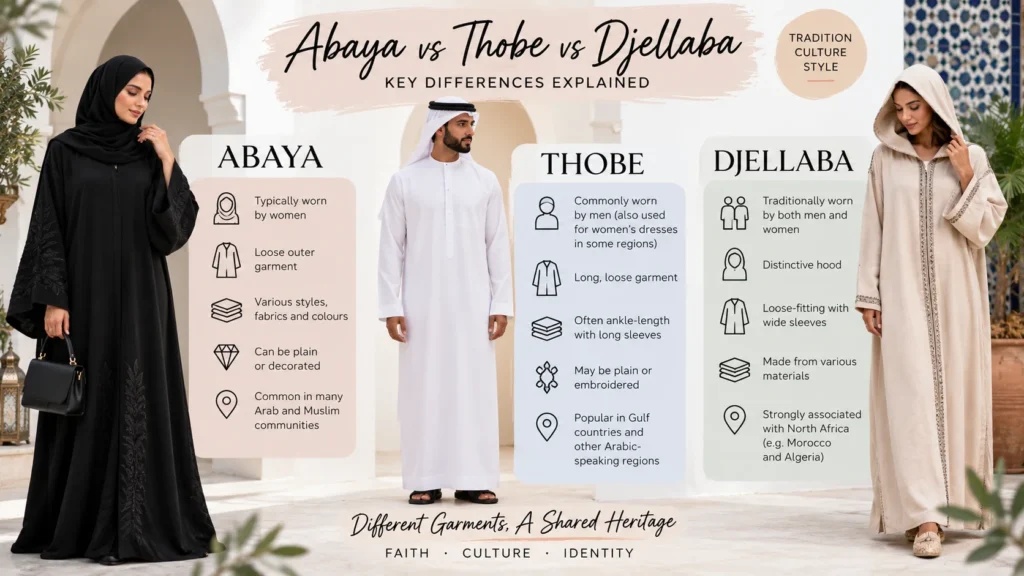
- Abaya: A loose outer garment or cloak associated particularly with women’s modest dress in many contemporary Arab and Muslim communities, although historical abayas have also been worn by men.
- Thobe: A broad Arabic clothing term that can refer to a long robe or dress. In many Gulf countries, the term commonly refers to a long men’s garment, while in other regions, including Palestine, a traditional women’s embroidered dress is also called a thobe.
- Djellaba: A distinctive hooded robe strongly associated with North Africa, particularly Morocco and Algeria, and traditionally worn in different forms by both men and women.
These definitions are useful starting points, but regional terminology matters. Clothing names can have different meanings from one country or community to another.
What Is an Abaya?
An abaya is a loose outer garment traditionally associated with Arab dress. In contemporary fashion, the word most often brings to mind a long, flowing garment worn by women over other clothing as part of a modest outfit.
Modern abayas are available in many silhouettes, fabrics, colors and levels of decoration. Depending on the region and occasion, an abaya may be plain and understated or decorated with embroidery, contrasting fabrics, embellishments or contemporary tailoring.
What Does an Abaya Look Like?
The classic contemporary abaya generally has a long, loose silhouette that provides substantial coverage. Some styles are open at the front and worn over another outfit, while others are designed as closed or pull-on garments.
- Usually long and loose-fitting
- Often worn as an outer layer
- Available in many colors and fabrics
- May feature embroidery or decorative details
- Can range from traditional to highly contemporary designs
Is the Abaya Only for Women?
Not historically. The term abaya has been used for different garments across Arab regions and historical periods. The Metropolitan Museum of Art, for example, describes historical Syrian abayas as unisex cloaks and documents their use by different social groups. In contemporary popular usage, however, the word is especially associated with women’s outerwear and modest fashion.
This distinction is important because traditional clothing terminology does not always fit neatly into modern categories of men’s and women’s fashion.
What Is a Thobe?
A thobe, also spelled thawb or thoub in different transliteration systems, is a long garment whose meaning varies according to regional usage. In the Gulf, the word commonly refers to the long robe traditionally worn by men.
A typical Gulf men’s thobe is long, loose and usually has long sleeves. White is particularly familiar in Gulf dress, especially in warm weather, although thobes are also made in other colors and fabrics depending on the season, country and occasion.
What Does a Men’s Thobe Look Like?
- Usually a long, ankle-length garment
- Generally loose and comfortable
- Usually has long sleeves
- Often worn with traditional headwear or other regional clothing
- May be plain or decorated depending on the country and occasion
The Thobe Is Not Always a Men’s Garment
One of the most important points to understand is that thobe is a regional term rather than a universal label for men’s clothing. In Palestine, for example, the traditional women’s thobe is a long dress historically decorated with embroidery known as tatreez.
Traditional Palestinian thobes can communicate information about regional identity, community and personal history through their embroidery, colors and patterns. This is very different from the way the word thobe is commonly understood in Gulf men’s fashion.
What Is a Djellaba?
The djellaba, also spelled jellaba or jelaba in some contexts, is a traditional robe strongly associated with North Africa, particularly Morocco and Algeria. One of its most recognizable characteristics is its hood.
Traditional djellabas can be made from different fabrics depending on the season and intended use. Heavier materials can provide warmth in cooler weather, while lighter fabrics are suitable for warmer conditions.
What Does a Djellaba Look Like?
- Usually loose and full-length
- Characteristically designed with a hood
- Often has wide or roomy sleeves
- Made in different fabrics for different seasons
- Worn in different styles by both men and women
Museum collections provide historical examples of Moroccan and Algerian djellabas, including garments made from wool and silk. The Metropolitan Museum of Art also describes the Moroccan jellaba as a hooded robe traditionally worn as part of men’s dress.
Abaya vs Thobe vs Djellaba: Side-by-Side Comparison
| Feature | Abaya | Thobe | Djellaba |
|---|---|---|---|
| Typical form | Long, loose outer garment | Long robe or dress | Loose hooded robe |
| Common modern association | Women’s modest outerwear | Men’s long robe in Gulf countries; women’s traditional dress in some regions | North African traditional clothing |
| Hood | Usually no | Usually no | Yes, traditionally characteristic |
| Gender | Varies historically; commonly associated with women today | Depends on region and meaning | Traditionally worn by men and women in different contexts |
| Regional associations | Arabian Peninsula and wider Arab world | Gulf and other Arabic-speaking regions | Morocco, Algeria and North Africa |
| Common purpose | Modest outerwear and everyday or occasion wear | Everyday, formal or traditional dress depending on region | Everyday, practical and traditional clothing |
Key Difference Between an Abaya and a Thobe
The main difference between an abaya and a thobe is not simply gender. It is also how the terms are used in different regions.
In contemporary Gulf fashion, an abaya is commonly understood as a woman’s outer garment, while a thobe usually refers to a man’s long robe. However, the word thobe has a much broader history and is also used for traditional women’s dresses in places such as Palestine.
So, if you see the word “thobe” online, look at the regional context before assuming it refers to men’s clothing.
Abaya vs Djellaba: What’s the Difference?
The easiest visual distinction between an abaya and a djellaba is often the hood. A traditional djellaba is characteristically hooded, while a typical contemporary abaya does not have a hood.
The garments also have strong regional associations. The abaya is widely associated with Arab modest dress, particularly in the Arabian Peninsula, while the djellaba is strongly connected with North African clothing traditions.
Modern designers can reinterpret both garments, so contemporary fashion pieces may not always follow traditional construction exactly.
Thobe vs Djellaba: What’s the Difference?
A traditional Gulf thobe and a North African djellaba can both be long and loose-fitting, but they have different characteristic designs and regional histories.
- Thobe: Often a long robe with long sleeves, especially in Gulf men’s fashion.
- Djellaba: Recognized particularly by its hood and association with North African dress.
There can be considerable variation within each category, so the garment’s country of origin, construction and cultural context are useful clues when identifying it.
Are These Garments Religious or Cultural?
These garments can have both cultural and religious significance, but it is useful not to treat them as identical religious uniforms. Clothing traditions develop through a combination of faith, local customs, climate, history, social expectations and personal preference.
For many people, wearing traditional clothing can also express regional identity, family heritage, community connection or cultural pride. The same garment may therefore have different meanings for different people.
How Are Abayas Styled Today?
Modern abaya fashion has expanded considerably beyond simple traditional silhouettes. Contemporary designs can include open-front styles, structured shoulders, flowing sleeves, embroidery, pleating, textured fabrics and minimalist tailoring.
Some people choose understated abayas for everyday wear, while embellished designs may be selected for weddings, religious celebrations or other special occasions.
If you are looking for contemporary abaya styles, the Modesque collection is one place to explore modern modest-fashion options.
How Are Thobes Styled?
Men’s thobes are often worn as part of a wider regional outfit. Depending on the country, a thobe may be paired with traditional headwear, sandals, formal footwear or other accessories.
For formal occasions, fabrics and finishing details can become more elaborate. Everyday thobes may use practical fabrics designed for comfort and the local climate.
How Are Djellabas Styled?
Djellabas can be worn as practical everyday clothing as well as traditional or occasion wear. Their roomy construction and hood make them particularly distinctive among North African garments.
Depending on the wearer and occasion, a djellaba may be relatively simple or decorated with embroidery, trims or other details. Materials can also change with the season.
Why Do These Garments Look Similar?
It is understandable that abayas, thobes and djellabas can be confused. All three can feature long, loose silhouettes and substantial coverage. They also developed within regions where clothing needed to balance comfort, practicality, climate and cultural expectations.
However, similarities in appearance do not mean that the garments have the same cultural identity. Details such as the hood, cut, fabric, embroidery, terminology and regional history can help distinguish them.
Common Mistakes When Identifying Islamic Clothing
- Assuming every long robe is a thobe: Long robes exist in many clothing traditions.
- Assuming every abaya is black: Black is strongly associated with many contemporary abayas, but abayas are available in many colors.
- Assuming thobe always means men’s clothing: Regional usage includes traditional women’s thobes.
- Ignoring the hood: A hood is one of the most recognizable features of the traditional djellaba.
- Assuming modern fashion follows historical rules: Contemporary designers often reinterpret traditional garments.
- Using one country’s definition everywhere: Clothing terminology can change significantly between regions.
Which Garment Should You Choose?
There is no single garment that is universally right for everyone. The appropriate choice depends on your cultural context, personal style, occasion, climate and the level of coverage or functionality you prefer.
- Choose an abaya if you are looking for a contemporary long outer garment associated with modest fashion.
- Choose a thobe when the style and terminology fit the regional tradition you are interested in, particularly Gulf men’s clothing or traditional women’s thobes in regions where that term is used.
- Choose a djellaba if you are interested in the distinctive hooded robes associated with North African dress.
Frequently Asked Questions
What is the main difference between an abaya, thobe and djellaba?
An abaya is commonly understood today as a long modest outer garment, especially in women’s fashion. A thobe is a broad regional term for a long garment and commonly refers to men’s robes in Gulf countries, while also referring to women’s traditional dresses in some regions. A djellaba is a distinctive hooded robe associated particularly with North Africa.
Is an abaya only worn by Muslim women?
The abaya is strongly associated with Muslim women’s modest fashion today, but historical forms of the garment were not exclusively women’s clothing. Usage and meaning vary by region and period.
Is a thobe only for men?
No. In many Gulf contexts, thobe commonly refers to men’s clothing, but the term is also used for traditional women’s dresses in other parts of the Arab world. The Palestinian thobe is a well-known example.
What is the difference between a djellaba and an abaya?
A traditional djellaba is particularly recognizable by its hood and its North African associations. An abaya is generally a long outer garment associated with Arab modest dress and is usually not hooded.
Is a djellaba worn by men or women?
Djellabas have been worn by both men and women, with styles and construction varying by region, period and occasion.
Where does the djellaba come from?
The djellaba is strongly associated with North Africa, particularly Morocco and Algeria. Historical museum collections contain examples from Morocco and Algeria.
Can an abaya be colorful?
Yes. Although black is a familiar color for contemporary abayas, modern abayas are available in many colors, fabrics and designs. The appropriate style can depend on regional customs, occasion and personal preference.
Final Thoughts
The difference between an abaya, thobe and djellaba becomes easier to understand once you look beyond their similar loose silhouettes. The abaya is widely associated with contemporary modest outerwear, the thobe has different meanings across Arabic-speaking regions, and the djellaba is especially recognizable as a hooded North African robe.
Most importantly, these clothing terms should be understood within their regional and historical contexts. Traditional clothing is more than a particular shape or fabric—it can reflect heritage, identity, climate, craftsmanship and changing fashion traditions.