
Every girl deserves the opportunity to grow up healthy, safe, educated, and confident. Yet, for millions of girls around the world, childhood can come with challenges that affect their education, health, safety, independence, and future opportunities. These difficulties are often connected to poverty, gender discrimination, social expectations, limited resources, and unequal access to essential services.
Understanding the challenges faced by a girl child is an important step toward creating a society where girls can reach their full potential. From unequal access to education to child marriage and safety concerns, these issues can influence a girl’s life long before she becomes an adult. In particular, girl child education in India remains an important area of focus because education can significantly expand a girl’s choices and opportunities.
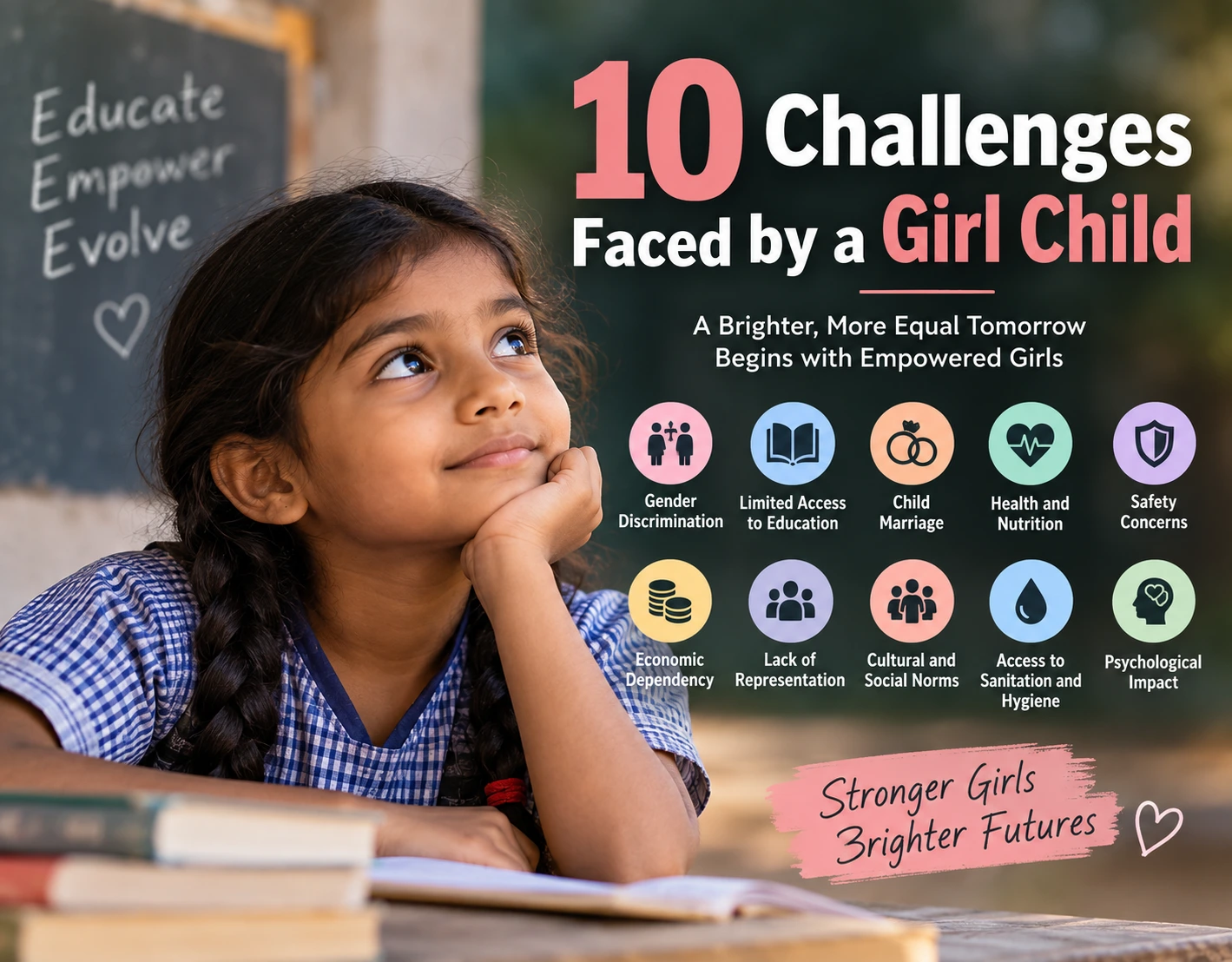
10 Major Challenges Faced by a Girl Child
The challenges experienced by girls can vary depending on where they live and their family’s social and economic circumstances. However, several issues are common across different communities. Here are ten major challenges that can affect girls during childhood and adolescence.
1. Gender-Based Discrimination
Gender discrimination is one of the most significant challenges faced by a girl child. In some families and communities, girls may receive fewer opportunities or resources simply because they are female. This can begin at a very young age and influence decisions about education, healthcare, nutrition, freedom, and household responsibilities.
When boys are consistently given greater importance, girls may grow up believing that their needs and ambitions are less valuable. Challenging these attitudes starts with treating boys and girls equally and ensuring that both have access to the same opportunities.
2. Limited Access to Education
Education can transform a girl’s future, but not every girl has the same opportunity to attend and complete school. Poverty, household responsibilities, cultural expectations, transportation difficulties, inadequate school facilities, and concerns about safety can all create barriers to education.
Girl child education in India has made important progress, but access and completion can still be affected by social and economic circumstances. When a girl misses out on education, she may have fewer opportunities to develop skills, pursue employment, and make informed decisions about her future.
3. Child Marriage
Child marriage can take away important years of childhood and education. When girls are married at an early age, they may be expected to leave school, take on household responsibilities, and enter adulthood before they are prepared for it.
Early marriage can also affect a girl’s economic independence and future choices. In addition, pregnancy during adolescence can create serious health and social challenges. Preventing child marriage requires education, community awareness, legal protections, and support for families facing economic hardship.
4. Health and Nutrition
Good health and adequate nutrition are essential during childhood because the body and brain undergo rapid development. However, girls in disadvantaged households may sometimes have limited access to nutritious food, healthcare, or timely medical attention.
Unequal treatment within households can make these problems worse when boys are given priority for food or healthcare. Ensuring that girls receive appropriate nutrition, preventive healthcare, vaccinations, and medical support is essential for their healthy development.
5. Safety and Protection Concerns
Safety is another major concern for girls. Harassment, abuse, exploitation, violence, and unsafe environments can affect how freely girls travel, attend school, participate in activities, and interact with their communities.
Safety concerns can also place additional restrictions on girls’ education and independence. Creating safe homes, schools, transportation systems, and public spaces can help girls participate more fully in education and community life.
6. Economic Dependency and Poverty
Poverty can affect almost every aspect of a girl’s childhood. Families with limited financial resources may struggle to afford school supplies, transportation, healthcare, nutritious food, or other necessities. In some situations, girls may also be expected to leave school to help with household work or childcare.
Limited education can later make it harder for women to access stable employment and earn an independent income. This can contribute to a cycle in which financial dependency continues from one generation to another. Providing girls with quality education and opportunities to develop useful skills can help break this cycle.
7. Lack of Representation and Role Models
Girls benefit from seeing women succeed in different areas of life. However, women can still be underrepresented in some leadership positions, professional fields, politics, business, science, technology, and other areas.
When girls rarely see people like themselves represented in positions of responsibility, they may have fewer visible examples of what is possible. Encouraging girls to explore different careers and providing access to positive role models can help broaden their understanding of their potential.
8. Cultural and Social Expectations
Social and cultural expectations can strongly influence a girl’s choices. In some communities, girls may be expected to focus primarily on household responsibilities rather than education, employment, leadership, or personal goals.
Traditional expectations are not necessarily harmful in themselves, but problems can arise when social norms prevent girls from making choices about their education and future. Giving girls room to develop their interests, express their opinions, and pursue their goals is an important part of supporting their development.
9. Limited Access to Sanitation and Hygiene
Access to clean water, toilets, and appropriate hygiene facilities is particularly important for girls as they grow older. Poor sanitation facilities at home or school can make it difficult for girls to manage their personal hygiene comfortably and privately.
Menstrual hygiene is another important consideration. A lack of suitable facilities, products, privacy, or accurate information can contribute to discomfort and missed school days. Improving sanitation and hygiene facilities can therefore support both health and continued education.
10. Psychological and Emotional Challenges
The challenges faced by a girl child can have emotional consequences as well. Experiencing discrimination, pressure, harassment, poverty, family conflict, or restrictions can affect a girl’s confidence and sense of self-worth.
Girls need supportive environments where they can talk about their concerns without fear of judgment. Parents, teachers, caregivers, and communities can play an important role by listening to girls, encouraging their interests, and helping them develop healthy confidence and resilience.
How Can We Support Girl Children?
Addressing the challenges faced by a girl child requires more than focusing on one issue. Families, schools, communities, governments, and organizations all have a role to play.
- Promote equal opportunities: Girls and boys should have equal access to education, nutrition, healthcare, and opportunities to develop their talents.
- Support education: Families and communities can help girls remain in school and continue their education for as long as possible.
- Create safe environments: Homes, schools, transportation, and public spaces should provide appropriate protection for children.
- Challenge harmful stereotypes: Girls should be encouraged to explore subjects, careers, sports, and activities without unnecessary gender-based restrictions.
- Improve health and hygiene: Access to healthcare, nutritious food, clean water, sanitation, and menstrual hygiene support is essential.
- Listen to girls: Children should have safe opportunities to express their concerns, needs, interests, and aspirations.
Why Is Girl Child Education Important?
Education gives girls knowledge and skills that can influence many parts of their lives. It can improve access to future employment opportunities, increase awareness of rights and responsibilities, and help girls make informed decisions as they grow into adulthood.
Education can also have benefits beyond the individual. Educated girls can contribute to their families, workplaces, and communities in many different ways. This is why improving girl child education in India is an important part of creating more equal opportunities for future generations.
Frequently Asked Questions About Challenges Faced by a Girl Child
What are the main challenges faced by a girl child?
Common challenges include gender discrimination, limited access to education, child marriage, health and nutrition problems, safety concerns, poverty, limited representation, restrictive social expectations, inadequate sanitation, and psychological or emotional pressure.
Why is education important for a girl child?
Education can help girls develop knowledge, skills, confidence, and greater access to future opportunities. It can also help them make informed decisions and participate more actively in their families, workplaces, and communities.
How does child marriage affect girls?
Child marriage can interrupt education, reduce future economic opportunities, increase household responsibilities, and limit a girl’s ability to make independent decisions about her future. Early pregnancy can also create additional health risks.
How can parents support girls during childhood?
Parents can support girls by providing equal access to education, healthcare, nutrition, and opportunities. Listening to their concerns, encouraging their interests, protecting them from abuse, and allowing them to participate in age-appropriate decisions can also help build confidence.
What can schools do to support girl child education?
Schools can provide a safe and inclusive learning environment, encourage girls to participate in all subjects and activities, maintain appropriate sanitation facilities, address bullying and harassment, and provide support when students face barriers to attendance or learning.
How can society reduce gender discrimination against girls?
Reducing gender discrimination requires changes at family, community, institutional, and policy levels. Promoting equal opportunities, challenging harmful stereotypes, supporting girls’ education, and ensuring children are treated with dignity and respect are important steps.
Conclusion
The challenges faced by a girl child can affect her education, health, safety, confidence, and future opportunities. While these challenges can be complex, meaningful progress is possible when families, schools, communities, organizations, and governments work together.
Supporting girls begins with something simple but powerful: giving them the same chance to learn, grow, stay healthy, express themselves, and pursue their goals. By investing in girls today, society can help create a future in which every child has a fair opportunity to thrive.