

It is no secret that getting young children moving sets the stage for a lifetime of healthy habits. According to Healthdirect Australia, regular physical activity develops crucial coordination and teamwork skills while noticeably improving a child’s concentration. In Australia, parents are increasingly looking for engaging ways to channel that boundless preschooler energy into structured environments. With 76 percent of children currently participating in organised out-of-school sports, finding the right fit is a common parental goal. Increasingly, families are turning to the basketball court to help their kids grow physically and emotionally.
The Physical Foundation: Motor Skills and Modified Equipment
Australian physical education resources identify age five, often referred to as Early Stage 1, as the optimal window to introduce Fundamental Movement Skills. At this specific age, a young child’s physical movement patterns are not yet deeply entrenched. This creates a perfect opportunity to teach correct form. Fundamental Movement Skills such as running, jumping, catching, and throwing form the building blocks for more complex physical activities later in life. However, introducing a sport using standard adult equipment can be overwhelming and counterproductive for small hands.
Experts have consistently highlighted the importance of using age-appropriate equipment like smaller balls to help early learners comfortably develop their hand-eye coordination. This simple modification allows young players to maintain their confidence without the frustration that so often causes children to quit sports prematurely.
To support this, Basketball Australia officially introduced smaller Size 4 basketballs tailored specifically for the prep-to-grade-2 demographic in 2019. By scaling down the size of the ball, sports science research shows that children experience higher passing success rates and greater overall enjoyment. This is exactly why finding highly tailored basketball training for 5 year olds is so beneficial. Such programmes focus entirely on early development using modified gear, allowing children to build foundational motor skills without the intense pressure of competitive scoring.
Building Confidence Through Tailored Coaching
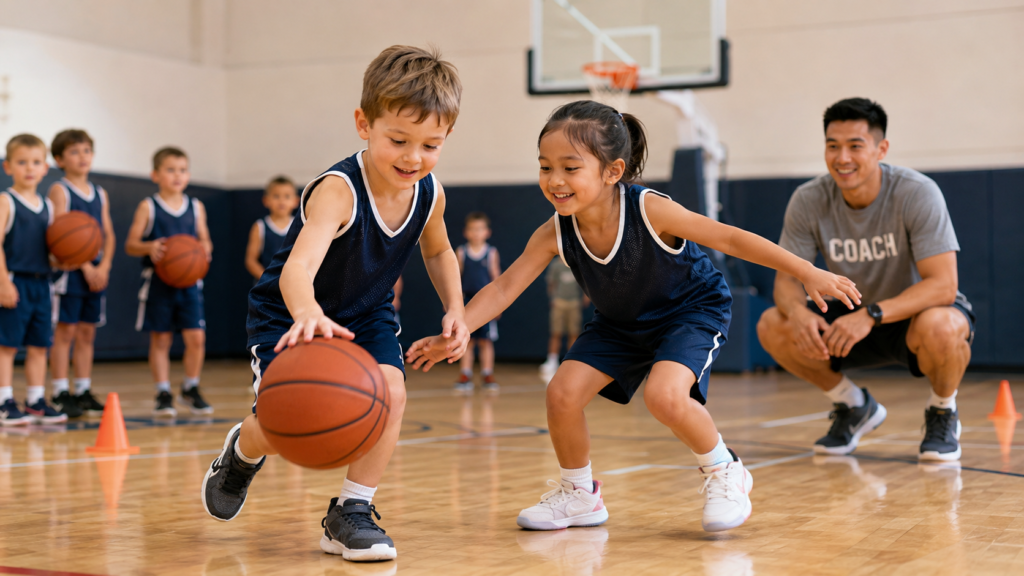
Skill acquisition at a young age requires immense patience and a uniquely child-friendly approach. Local early childhood coaching frameworks utilise imaginative tactical cues to make learning both memorable and fun. For instance, coaches might teach early learners to “pat the dog” while dribbling. This vivid imagery encourages proper downward finger pushing rather than incorrectly slapping the ball with flat palms. When children master these small, manageable steps, their self-esteem naturally rises.
Furthermore, introductory youth basketball frameworks frequently implement modified, smaller-sided game structures like three-on-three or four-on-four formats. These strategic adjustments purposely maximise individual ball-handling time. When a child spends more time actively holding and moving with the ball, their motor skill acquisition accelerates rapidly. Rather than standing on the sidelines waiting for a turn, every participant remains engaged in the action. This structure gives children a safe, encouraging space to take healthy risks, make quick decisions, and experience tangible personal growth on the court.
The Broad Social Benefits for Young Players
The advantages of stepping onto the basketball court extend far beyond physical fitness. Team sports foster social dynamics that are critical for early childhood development, especially as kids transition into full-time schooling. When children participate in introductory group programmes, they learn how to share, take turns, and communicate clearly with their peers. These early interactions often translate to better classroom behaviour and improved academic readiness.
Some of the key developmental benefits of early basketball participation include:
- Enhanced Spatial Awareness: Navigating the boundaries of the court helps kids better understand their physical presence in relation to others.
- Improved Socialisation: Interacting closely with teammates builds popularity with peers and encourages highly inclusive behaviour.
- Resilience and Emotional Regulation: Learning to handle dropped passes or missed shots in a supportive setting teaches kids how to process minor setbacks without a meltdown.
- Active Listening and Focus: Following multi-step instructions from coaches trains young minds to concentrate on specific tasks in distracting environments.
A Thriving, Inclusive Sporting Culture
Recent AusPlay data gathered by the Australian Sports Commission reveals that basketball currently ranks as one of the top five most played organised sports among Australian children aged 5 to 14. Its high accessibility, flexible formats, and overarching emphasis on fun make it a standout choice for modern families.
The sport has also seen incredible growth in inclusivity. Basketball participation among Australian girls and women has surged by 25 percent since 2022. Initiatives like She Hoops, championed by Australian basketball icon Lauren Jackson AO, have been instrumental in driving this current boom in female participation. Additionally, national introductory frameworks like Aussie Hoops continue to build strong foundational skills for primary school-aged children everywhere.
For parents, the main takeaway is quite simple. Getting kids involved in sports early is less about creating future professional athletes and more about instilling a pure joy in movement. It establishes a positive relationship with exercise that combats the increasingly sedentary nature of modern entertainment. By starting with modified, supportive basketball routines, children gain the physical capabilities and the mental resilience needed to thrive for years to come.