

Seamless steel tubes are used in many industries because they have no weld seam and offer strong performance. Two main production methods exist: hot-rolled and cold-drawn. Understanding the differences helps you pick the right tube for your project. This article explains both processes and compares them in simple terms.
What Are Seamless Steel Tubes?
Seamless steel tubes are hollow pipes made from solid steel billets without any welding. Manufacturers heat the steel and form it into tubes. These tubes are popular in oil and gas, construction, machinery, and automotive applications because of their strength and reliability.
The two most common ways to produce them are hot-rolled and cold-drawn processes. Each method creates tubes with different characteristics in size, finish, strength, and cost.
The Hot-Rolled Seamless Tube Process
Hot-rolled seamless tubes are produced at very high temperatures. Manufacturers heat steel billets to around 1100–1300°C. Then they pierce the billet to create a rough tube and roll it to the final size while it is still hot.
This high-temperature process makes the steel easier to shape. After rolling, the tubes are cooled naturally. Hot-rolled tubes can be made in larger diameters and thicker walls. The process is faster and more suitable for mass production.
The Cold-Drawn Seamless Tube Process
Cold-drawn tubes start with a hot-rolled tube as the base material, called a hollow. Workers then pull this hollow through a die at room temperature to reduce its diameter and wall thickness. Sometimes they repeat the drawing process several times.
This method is done at normal temperatures, which is why it is called “cold.” The steel is often annealed (heated and cooled slowly) between drawing steps to restore its properties. Cold drawing gives much tighter control over the final dimensions.
Main Differences in Manufacturing
The biggest difference is the temperature. Hot rolling happens at high heat, while cold drawing occurs at room temperature.
Hot-rolled tubes require fewer steps and can be produced quickly in large quantities. Cold-drawn tubes need more processing steps, including multiple drawings and possible heat treatments, so production takes longer.
Because of these process differences, hot-rolled tubes usually have larger sizes, while cold-drawn tubes are available in smaller diameters and thinner walls.
Surface Finish and Appearance
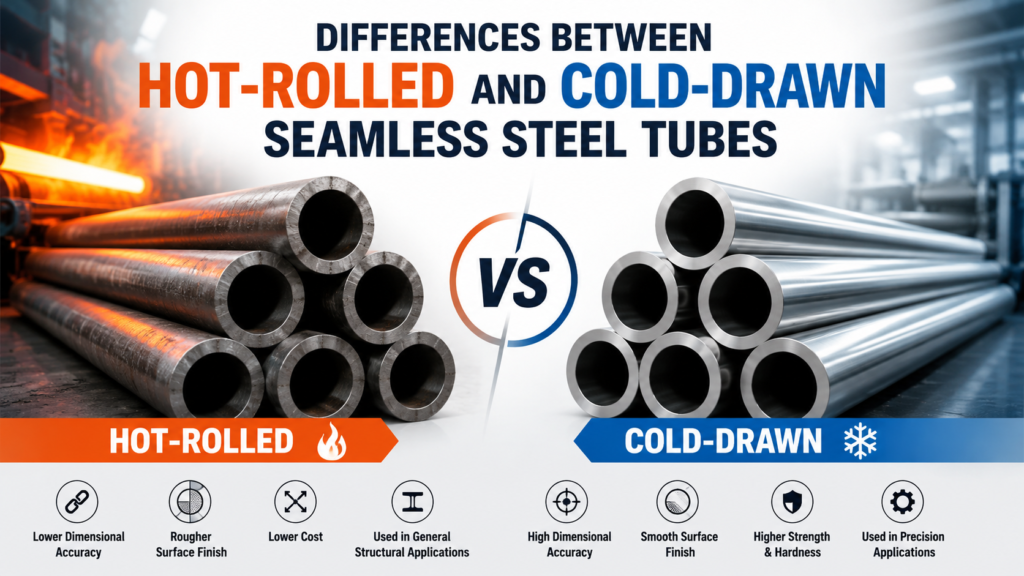
Hot-rolled tubes have a rough, scaled surface because of high-temperature oxidation. The finish is not smooth and may need extra cleaning or machining for some uses.
Cold-drawn tubes have a smooth, bright surface with a better finish. The cold working process removes surface imperfections and creates a cleaner look. Many customers prefer cold-drawn tubes when appearance matters or when the tube will be used without further processing.
Dimensional Accuracy and Tolerances
This is one of the clearest differences. Hot-rolled tubes have larger dimensional tolerances. The outer diameter, wall thickness, and straightness can vary more because the steel shrinks during cooling.
Cold-drawn tubes offer much higher precision. They have tight tolerances on diameter, roundness, and wall thickness. If your project needs exact sizes, cold-drawn tubes are usually the better choice.
Mechanical Properties and Strength
Hot-rolled tubes generally have good strength but lower hardness. The high temperature during production relieves internal stresses, making the material more ductile and easier to weld or bend.
Cold-drawn tubes are stronger and harder due to strain hardening from the drawing process. They have higher tensile strength and better yield strength. However, they may be less ductile and can sometimes require annealing to improve workability.
Cost Comparison
Hot-rolled seamless tubes are usually cheaper. The production process is simpler and faster, so manufacturers can offer lower prices, especially for large orders.
Cold-drawn tubes cost more because of extra processing steps, more labor, and longer production time. However, they can save money in the long run if you need less machining or waste.
Applications of Hot-Rolled Seamless Tubes
Hot-rolled tubes are ideal for applications where precise dimensions are not critical. Common uses include:
- Structural supports and scaffolding
- Oil and gas pipelines
- Boiler and heat exchanger tubes
- General engineering and machinery parts
- Large-diameter fluid transport
They work well in projects that need large sizes and good toughness.
Applications of Cold-Drawn Seamless Tubes
Cold-drawn tubes are preferred when accuracy and surface quality matter. You will often find them in:
- Hydraulic and pneumatic systems
- Automotive parts and shock absorbers
- Precision machinery and bearings
- Medical equipment
- Small-diameter high-pressure tubes
These tubes are chosen when tight tolerances and smooth surfaces reduce the need for additional machining.
Advantages and Disadvantages
Hot-Rolled Seamless Tubes Advantages: Lower cost, faster production, available in large sizes, good ductility. Disadvantages: Rough surface, larger tolerances, less strength than cold-drawn.
Cold-Drawn Seamless Tubes Advantages: High precision, smooth finish, higher strength, better mechanical properties. Disadvantages: Higher cost, smaller size range, may need annealing for some uses.
How to Choose Between Hot-Rolled and Cold-Drawn Tubes
Consider these questions when deciding:
- What size and tolerance do you need?
- Is surface finish important for your application?
- How much strength and hardness is required?
- What is your budget?
- Will the tubes need further machining or fabrication?
For general structural work, hot-rolled is often enough. For precision components or hydraulic systems, choose cold-drawn.
Always check the required standards and specifications for your project. Talk to your supplier about the best option for your specific needs.
For more information on quality seamless steel tubes and top manufacturers, feel free to click here.
You can also visit tuspipe.com to explore a wide range of seamless steel tube options and get expert advice.
Quality Control and Standards
Both hot-rolled and cold-drawn tubes must meet international standards such as ASTM, DIN, or GB. Good manufacturers perform tests for chemical composition, mechanical properties, and dimensional accuracy. Always ask for mill test certificates when ordering.
Final Thoughts
Hot-rolled and cold-drawn seamless steel tubes each have their own place. Hot-rolled tubes offer an economical choice for large sizes and general applications. Cold-drawn tubes provide superior precision, finish, and strength for demanding projects.
Understanding these differences helps you select the right product, avoid unnecessary costs, and ensure good performance. Take time to define your project requirements clearly before ordering. A reliable supplier can help you match the tube type to your actual needs.
Whether you need large structural tubes or small precision ones, choosing the correct production method makes your project smoother and more successful. Always focus on quality and suitability rather than just price.