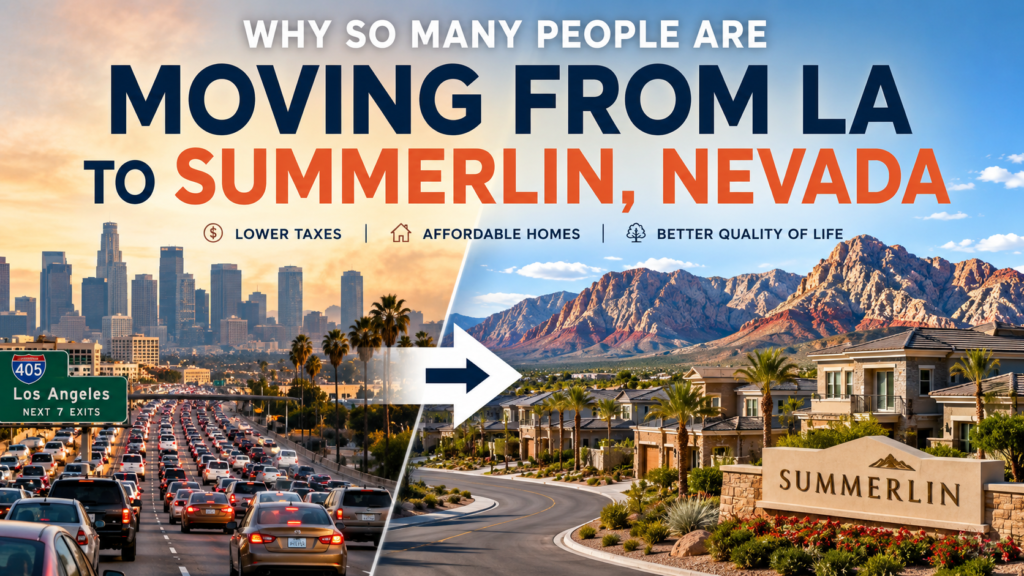
If you have spent any real time on the 405 lately, you already know the story. Los Angeles is a city full of dreamers, doers, and people who are quietly Googling “how much does a house cost in Las Vegas” while they sit in traffic. That second group has been growing fast, and a huge chunk of them are not landing on the Strip or in some random suburb. They are landing in Summerlin.
Summerlin sits on the western edge of Las Vegas, pressed right up against Red Rock Canyon, and it has become one of the most talked about destinations for LA transplants over the past few years. It is not hard to see why. The numbers make sense, the lifestyle feels familiar, and the daily friction of life is dramatically lower. If you are weighing a move, here is what you should actually know before you start packing.
The Financial Case Is Hard to Argue With
Most people who leave Los Angeles do not leave because they stopped loving it. They leave because the math stopped working. Summerlin offers a reset on almost every line item in your budget.
Nevada has no state income tax. That alone is a six figure swing over a decade for a lot of professionals. California’s top marginal rate sits above 13 percent, and even middle income earners are paying somewhere around 9 percent of their taxable income to the state. When you move to Nevada, that line on your paycheck simply disappears.
Housing tells a similar story. A home in Brentwood, Sherman Oaks, or Manhattan Beach that runs three to four million dollars has a comparable counterpart in Summerlin for a fraction of the price. You can find:
- Brand new construction homes in gated communities for well under a million
- Spacious single family homes with yards, pools, and three car garages in the 700K to 1.2 million range
- Luxury custom estates in The Ridges or Summerlin West that still come in lower per square foot than mid tier LA neighborhoods
- Modern townhomes and condos near Downtown Summerlin starting in the mid 400s
Property taxes in Nevada are also capped at a much lower effective rate than California, and utilities, insurance, and groceries all tend to run cheaper. The cumulative effect is significant. Families who were stretched thin in Los Angeles often find they can save aggressively, upgrade their home or find a luxury home, and still have money left over for travel and lifestyle.
The Lifestyle Translates Surprisingly Well
One of the things that makes Summerlin click for Angelenos is that it does not feel like a downgrade in quality of life. If anything, the day to day feels easier. The community was master planned by the Howard Hughes Corporation, and it shows. Everything is intentional, well maintained, and built around how people actually want to live.
Downtown Summerlin is the social anchor of the area. It is an open air shopping and dining district with national retailers, local boutiques, sit down restaurants, a Whole Foods, and a year round calendar of events. On any given weekend you will see families at the park, couples out for dinner, and friends meeting for drinks. It has the feel of a walkable district in a much larger city, but without the parking nightmares.
For sports and entertainment, Summerlin has its own assets that did not exist a decade ago. The Las Vegas Ballpark hosts the Aviators, the Triple A affiliate of the Athletics, and the venue itself is one of the nicest minor league parks in the country. City National Arena, the practice facility for the Vegas Golden Knights, sits right in the community. You can grab coffee and watch NHL players run drills on any given morning.
Food is also a pleasant surprise. Summerlin has matured into a legitimate dining scene with high end steakhouses, sushi spots, Italian, ramen, modern Mexican, and a strong cafe culture. The talent pool from the Strip has spilled outward, and a lot of well known chefs now have neighborhood restaurants in the area.
The Outdoors Are a Real Selling Point
Angelenos who love the beach often worry about losing access to nature. Summerlin solves this in a different way. Red Rock Canyon National Conservation Area is less than 15 minutes from most of the community. You can be on a trail surrounded by sandstone cliffs and desert quiet before you would have made it through your morning commute in LA.
There are more than 150 miles of interconnected trails inside Summerlin itself, dozens of parks, and some of the most highly rated golf courses in the Southwest, including TPC Summerlin. Mount Charleston is about 45 minutes north for snow in the winter and cooler elevation hikes in the summer. Lake Mead is a short drive east. If you are someone who builds your weekends around being outside, Summerlin gives you more options than people realize.
The climate does take adjustment. Summers are hot, often above 105 degrees from June through August. Locals tend to start their outdoor activities early in the morning and finish before the sun is fully up. The other nine months of the year are genuinely beautiful, with mild winters, low humidity, and the kind of dry warm spring weather that makes you understand why anyone retires here.
What to Expect During the Transition
Moving from LA to Summerlin is not just a financial or logistical change. It is a pace change. Here are a few things that catch new arrivals off guard, in both directions.
- Driving across town takes 15 to 20 minutes, not 90. This is the single most common comment from new transplants. You stop dreading errands.
- The pace of daily life is calmer, which some people love immediately and others have to grow into. If you are used to LA’s constant energy, the first month can feel quiet.
- The job market has expanded beyond hospitality and gaming. Tech, healthcare, finance, professional services, and remote work have transformed the workforce, and many LA professionals keep their existing jobs and work remotely.
- Schools in Summerlin are among the best in the state. There is a strong mix of well regarded public schools, magnet programs, and private options like The Meadows School and Faith Lutheran.
- You will need a car, and you will use it. Public transit is limited. The upside is that driving is genuinely pleasant compared to what you are used to.
A Few Honest Tradeoffs
No move is perfect. Summerlin is not the ocean, and it is not Los Angeles. If your identity is deeply tied to the LA arts scene, the beach, or being able to access multiple distinct neighborhoods in a single day, you may feel the difference. Las Vegas has a growing cultural footprint, but it is still smaller than what you are leaving.
Summer heat is real. So is the lack of mature trees in newer developments, although the older parts of Summerlin have filled in nicely over the past 30 years. And while Nevada has no state income tax, sales tax in Clark County is higher than in many California counties, so that helps offset some of the savings on everyday purchases.
That said, most people who make the move tell the same story a year in. Their quality of life went up. Their stress went down. They have more money, more time, and more space. They visit LA when they miss it, and they come home to a place that feels easier to live in.
For a lot of Los Angeles natives, that is exactly the trade they were looking for.
Finding a Summerlin Realtor
If you’ve ready through this article and you are considering moving from Los Angeles to Summerlin, you’ll need a qualified real estate agent with immense experience in the area. Not only does Michael Bondi, a Summerlin Realtor, have this type of experience, but he is a transplant from Los Angeles himself and can answer any questions you have about moving. Take a look at michaelbondi.realtor and give him a call if you’re considering a move.