
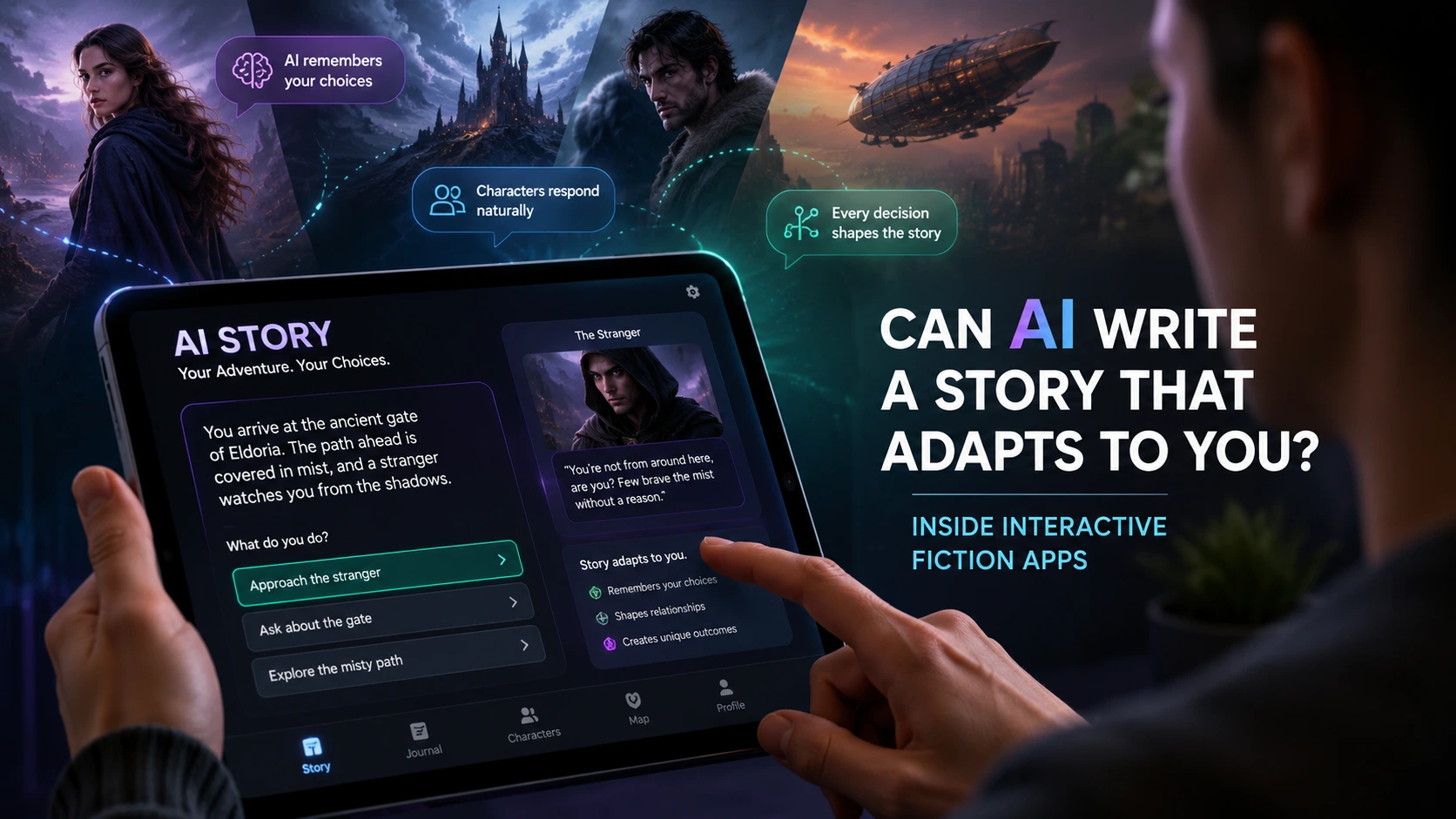
Interactive stories used to follow a fairly predictable formula. You pick a “story to tell.” It branched into one of several pre-written paths. You reached one of a handful of endings. It was entertaining. However, it also had clear limits. Once you explored the available options, there was not much left to discover. Artificial intelligence is changing that experience.
Modern AI-powered interactive fiction apps are moving beyond fixed storylines. Instead of choosing between a few scripted responses, readers can now have conversations with characters, influence the plot naturally, and watch the story develop based on their decisions. Every interaction has the potential to create something slightly different. This way, each playthrough feels more personal. So, can AI really write interactive stories that adapt to you? Let’s check that together.

From Branching Paths to Dynamic Storytelling
Interactive fiction is based on pre-established content. All possible branches are created by the writers. That is, all possible scenarios are in play before the player even opens the app. This can be a good solution for a lot of people. But it does, of course, restrict how much freedom readers can have in re-writing the story. AI provides a significantly more versatile means of storytelling. Talefy is a good example. The solution combines interactive storytelling with AI-powered character conversations.
Rather than choosing the next scene from a predefined list of prewritten scenes, modern language models can produce dialogue, descriptions, and plot elements as the story progresses. The characters respond to your actions and speech as they happen. This helps conversations seem much more natural than navigating through a set of scripted menus.
What if you were in a little fantasy town and got to know a mysterious traveler? A typical interactive story may only offer a few preprogrammed options for you to choose from. Those restrictions are significantly lowered with an AI-generated story. You might ask why everyone seems to be afraid of the woods, invite them to dinner before they get to the business, ask if they have a great secret to share, or take an entirely different turn in the conversation. The AI reads what you input and creates the story.
The boundaries that developers impose still keep the story from getting off track and keep it coherent. Despite this, interactive fiction with AI is more adaptable than the branching varieties.
Characters That Remember Your Decisions
One of the biggest improvements AI brings to interactive fiction is memory. Many newer systems are designed to remember important details from previous interactions. Thus, characters can refer back to earlier conversations, significant choices, or events that happened several chapters ago.
If you helped a companion early in the story, they may become more willing to trust you later. If you betrayed an ally or broke a promise, those actions could affect future conversations or change how other characters respond to you. Even smaller details can become part of ongoing interactions. The result is a much stronger sense of continuity. Instead of feeling like a collection of disconnected scenes, the story starts to resemble a living world where characters remember your actions and relationships evolve naturally over time.
Every Reader Gets a Different Adventure
The best thing about AI is personalization. Two people can begin with exactly the same opening scene and finish with completely different adventures. One reader may transform the story into a political drama filled with negotiations and shifting alliances. Another might focus on romance. Instead of forcing every player through identical scenes, AI adapts dialogue, pacing, side quests, and character relationships based on the decisions each reader makes throughout the story.
Some platforms also recognize broader storytelling preferences over time. Readers who consistently enjoy witty dialogue, emotional conversations, or fast-paced action may naturally encounter more scenes that reflect those interests. This makes every playthrough feel increasingly tailored to the individual.
AI Does Not Replace Human Creativity
Despite the excitement surrounding AI storytelling, human writers remain at the center of the experience. Most successful interactive fiction apps combine handcrafted world-building with AI-generated dialogue and scene development. Writers establish:
- The setting
- The characters
- Major story arcs
- Lore
- Rules of the fictional world
- Emotional themes
AI then fills in the gaps. It expands conversations and reacts to player choices. At the same time, it stays within the creative framework established by the authors. Think of AI as an incredibly flexible narrator. Without strong writing, compelling characters, and thoughtful world-building, even the most advanced AI struggles to produce satisfying long-form stories.
The Challenges Behind Adaptive Stories
Developing stories that truly resonate with readers is much more complex than plugging in an AI system to an app. Consistency is one of the challenges. Characters must remain consistent in their personality, motivation, and relationship to one another, rather than changing their behavior from one scene to the next.
One of the challenges is recalling long journeys. As stories become longer and more complex, AI systems need to keep track of previous events without forgetting important details that may influence future chapters.
Developers also need to balance freedom and structure. Excessive freedom may lead to multiple or confusing storylines. Conversely, too much restriction can be a bit like old-fashioned branching fiction.
AI Can Work for You and Your Stories
AI is transforming interactive fiction from a series of branching story paths into a more dynamic and personalized experience. Instead of having a limited choice of ready-made answers, readers have the opportunity to affect conversations, develop relationships, and create narratives. The creative vision, interesting characters, and carefully designed worlds are still provided by human writers. AI, on the other hand, brings the flexibility that makes each journey truly unique. That’s a win-win solution.