
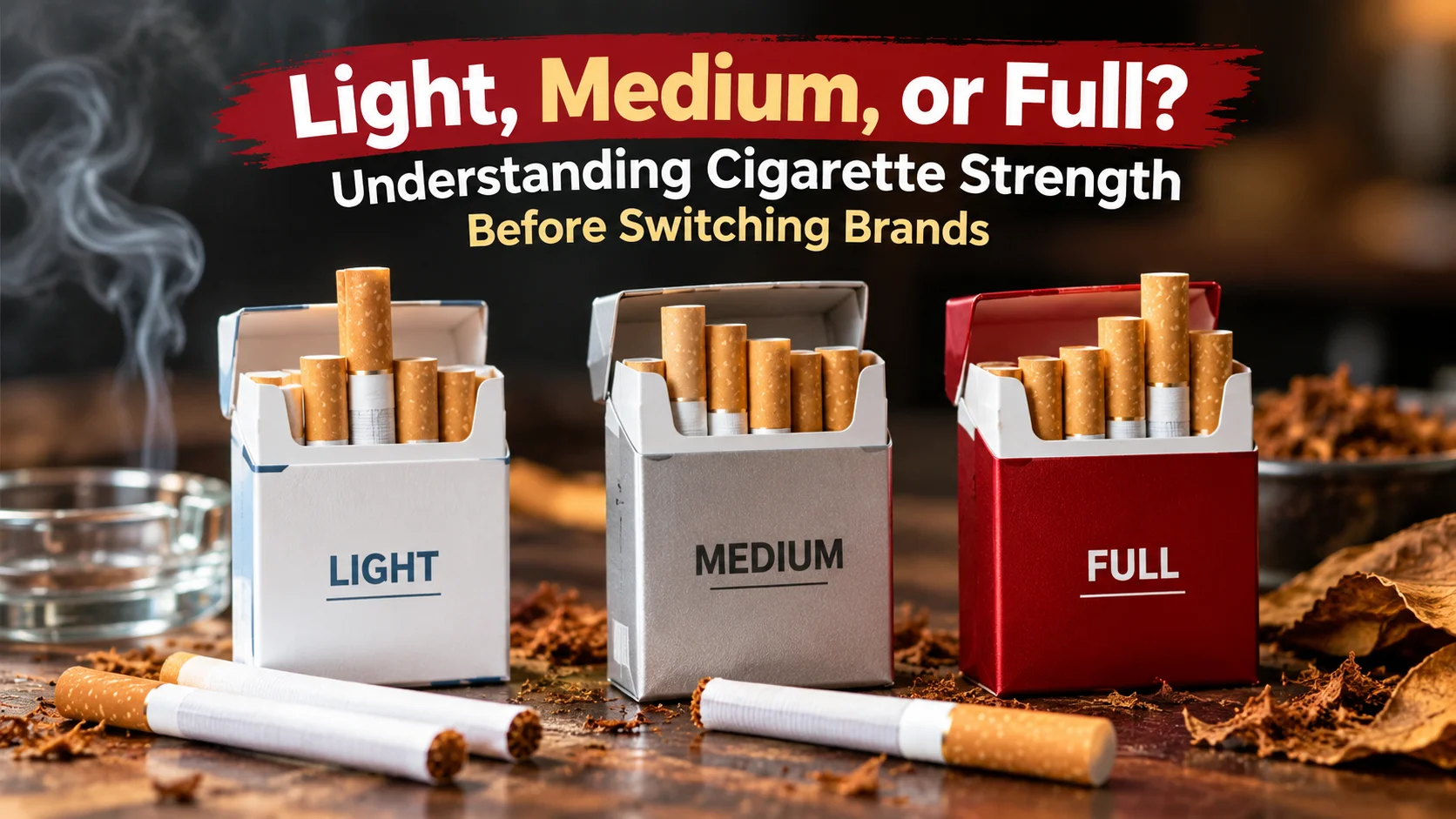

Thinking about switching to a new cigarette brand?
When choosing a new pack of cigarettes most smokers rely on one factor — strength. Light, medium or full flavor. It seems easy enough. However what those descriptors mean to the consumer aren’t always correct.
Here’s the problem:
The wording on the pack (or colour of it) was never an indicator of how “safe” a cigarette is. It simply talks about taste and draw. Nothing else.
Lets go over how tobacco strength works BEFORE you look at a list of popular cigarette brands and pick the first “smooth” cigarette.
Let’s break it down.
Inside This Guide:
- What Does Cigarette Strength Actually Mean?
- Why “Light” Turned Into A Colour
- The Compensation Trap
- How To Compare Strength Across Brands
- Switching Brands The Smart Way
What Does Cigarette Strength Actually Mean?
Cigarette strength refers to the perceived strength of smoke when inhaled. It depends on three primary factors:
- Tobacco blend: the type of leaf and how it’s cured
- Filter design: how much air gets mixed into each puff
- Rod size: the length and thickness of the cigarette
Regular or “full” cigarettes typically contain a tighter packed blend and a filter that allows less air to pass through. “Lights” have small holes in the filter that dilute smoke with air.
That’s it.
There’s not magically less tobacco inside. The filter dilutes each inhalation when a robot smokes it.
Open up a list of top cigarette brands and notice a trend. Majority of cigarette brand families offer full, medium and light products even though the packaging doesn’t reflect that anymore. Regular smokers who smoke factory cigarettes notice this frequently when comparing different Canadian cigarette brands. That’s because the descriptors were eliminated ages ago and replaced with brand new names.
Which leads to a pretty interesting story…
Why “Light” Turned Into A Colour
Here’s something a lot of smokers don’t know.
Canada banned the descriptors “light” and “mild” on cigarette packages in 2007. All the major tobacco companies pledged to drop them voluntarily following a complaint by the Competition Bureau — affecting 79 brands initially.
Why? Because the words were misleading people.
By 2005, 58 per cent of smokers in Canada were smoking light or mild brands. Worse still, a 2003 survey found that among light smokers, 37 per cent had switched for health reasons. They sincerely thought they were doing something less harmful to themselves.
So what happened next?
The descriptors changed. Terms such as “light” and “ultra light” were replaced with colours and more ambiguous terms such as silver, blue and smooth. And studies have found that smokers interpret these new descriptors in the same way they interpreted the old ones.
A lighter-sounding name doesn’t mean a lighter risk. It just means lighter marketing.
The US did so itself in 2010. Same outcome — different names, same concept.
The Compensation Trap
This is the biggie…
Light cigarettes derived their low yields from smoking machines. Machines take precisely the same puff every time.
People don’t.
When smokers transition to a light cigarette, their body still craves the same nicotine intake. Therefore, unconsciously they begin to:
- Take bigger, deeper puffs
- Hold the smoke in for longer
- Cover the tiny filter holes with their fingers or lips
- Smoke more cigarettes each day
Experts call this compensatory smoking. It negates the lower numbers you see on paper.
Major studies have discovered that there is no actual lung cancer benefit with low-tar cigarettes. Medical professionals have associated lung cancer increase with the vented filters on light cigarettes.
Bottom line: there is no safe strength.
Light, medium and full all have the same detrimental health effects. The only difference is the texture of the smoke.
How To Compare Strength Across Brands
Now to the practical part.
Old Labels No Longer Apply. You Must Rethink How To Measure Strength. Here’s how…
Check The Variant Name
Under Canadian plain packaging regulations, each pack will be standardized matte brown. Therefore the color of the package will no longer be distinguishing.
Check out the brand name. Terms such as “silver,” “blue” or “smooth” often indicate a light draw. Brand names containing “original,” “red” or “full” typically mean a full blend.
Look At The Filter
Here’s a simple trick.
Hold your cigarette up to the light. See a ring of small holes near the end? That’s called filter ventilation. More holes equal a lighter, airier draw.
Compare Within The Same Family
Potencies vary by manufacturer. A medium of one company could feel like a full of another.
That’s why you should always compare options within a brand family before looking elsewhere. After experiencing one brand’s versions, hopping through a popular cigarette brands list is much easier.
Think About Size
King size, regular and slim cigarettes all burn at different rates. A slim cigarette contains less tobacco, but it isn’t safer. Smoking slim just alters your puff.
The longer cigarette also gives you more puffs per stick. So a “light” king size may deliver just as much smoke as a shorter full-flavour one. Bear that in mind when you’re comparing two packs face to face.
Switching Brands The Smart Way
Trading up brands really comes down to personal preference. Approach it with realistic expectations.
If you switch from full-flavor to light, pay attention to how you smoke. Many smokers who have “cut down” found their daily numbers increasing — rather than decreasing.
And that defeats the whole point.
Wait a week or two before judging any new brand. No matter what you buy, your first few packs will feel weird. The taste, draw, and even smell will be different than what you’re used to.
It’s also worth noting where Canada currently ranks. In 2024, just 11% of adult Canadians reported smoking. Close to 300,000 Canadian smokers quit in 2024 after smoking in 2023.
Pretty impressive, right?
If your true reason for switching is cutting down, your low-yield cigarette is not the bridge to quitting it seems to be. Proven alternatives include nicotine patches, gum and prescription medications — and your doctor or pharmacist can help you choose which is best for you.
Before You Switch: The Final Word
Understanding cigarette strength is easily one of the most confusing aspects of smoking. The labels make it sound knowledgeable… but they only rate flavor and draw, not safety.
To quickly recap:
- Strength comes from the blend, the filter and the size
- “Light” and “mild” were eliminated in Canada during 2007.
- Smokers of lighter cigarettes often puff harder to make up the difference
- Compare versions inside one brand family before jumping to another
- No strength of cigarette is safe
Find out what they REALLY stand for before you convert — and you’ll be able to make a smarter decision.