
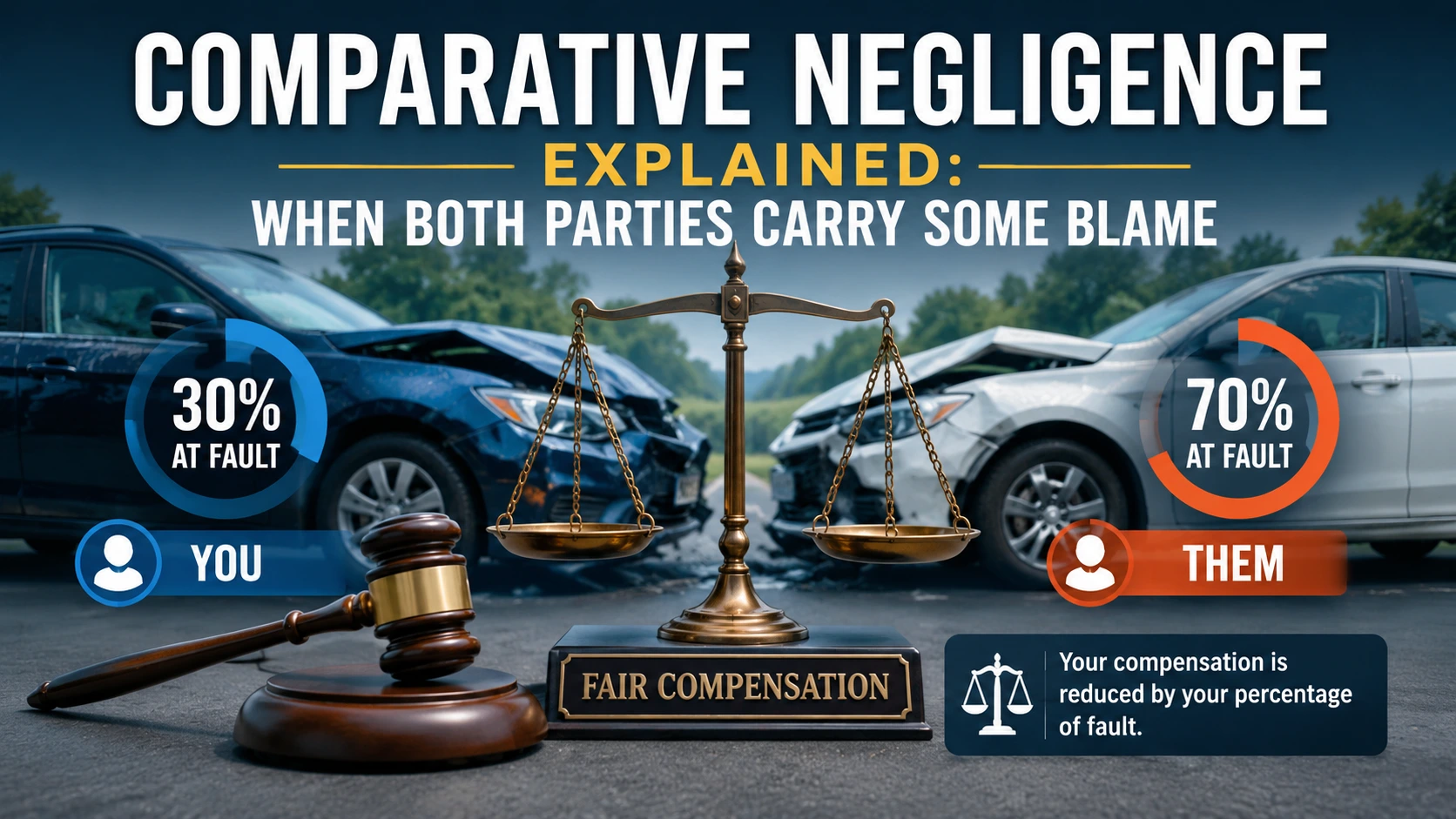

Ever been told an accident was “partly your fault”?
There are few things more insulting for an injured victim to hear. You were injured. Your world was turned upside down in an instant. And now some guy at a call centre is accusing you of causing it.
But here’s the thing…
Being partially at fault doesn’t leave you with zero dollars. Comparative negligence is what most of the country uses to apportion fault among all parties and pay proportionately. This statute greatly affects how much of a settlement will go into your pocket.
They’re also not small figures either. According to NHTSA’s final crash reporting data, 2.42 million people were injured on U.S. roadways in 2024. The majority of these claims include some form of shared fault.
Here’s how it all works…
What you’ll walk away with:
- What Is Comparative Negligence?
- The Three Fault Systems Used Across The US
- How Insurers Use Shared Blame Against You
- Why Fault Percentages Matter Most In Severe Cases
What Is Comparative Negligence?
Comparative negligence is a tort rule that apportions blame to each party who played a role in causing an accident. Each party’s award is reduced by their percentage of fault.
Here’s a simple example:
A jury awards $500,000 in damages. However, they find that the injured driver was 20% at fault for speeding. The award is reduced by 20%. The final award amounts to $400,000.
That’s the whole idea. Nothing more complicated than that.
However when injuries are life altering, that percentage goes from being a math problem to someone’s new normal. A 20% reduction from a $5 million spinal cord injury settlement means a difference of $1 million dollars. That’s why firms such as The Law Offices of Max G. Arnold battle so fiercely over percentages of fault before a case even goes to trial. Any great catastrophic injury attorney understands that in brain injury, amputation or permanent paralysis cases, how liability is split is just as important as the medical costs.
Pretty important, right?
The Three Fault Systems Used Across The US
Not every state plays by the same rules.
The location of your accident matters. There are three systems at work and the difference between them is astronomical.
Pure Comparative Negligence
This is the fairest system. Even if you are determined to be 99% at fault for an accident, you can still collect 1% of your damages.
California, NY and WA are states that follow this model. It almost never prevents anyone from filing a claim. However, insurance companies will still attempt to raise your fault percentage as high as possible. Each percentage point is pure profit for them.
Modified Comparative Negligence
Most states use this version, and it comes with a hard ceiling.
Damages are only recoverable if your percentage of fault remains below a certain threshold. Some states use 50%, others use 51%. If you exceed the threshold by even one percent your claim is valued at zero.
Consider what that means for one second. A victim determined to be 49% at fault could walk away with hundreds of thousands of dollars. Increase that fault to 51% and that same victim receives nothing. That swing of two points can be the battle line of a serious injury case.
Contributory Negligence
This rule is the most extreme of them all. Fortunately only a few places implement this.
Alabama, Maryland, North Carolina, Virginia and D.C. have contributory negligence. This means if you’re 1% at fault you can’t recover damages. One second looking at your phone, one second you forget to click your seatbelt. The courthouse doors close on you.
Nota bene: A couple of these places have since created exceptions for pedestrians and cyclists. The overall rule remains barbaric.
How Insurers Use Shared Blame Against You
Here’s something most injured people never see coming…
Insurance claims adjusters are not disinterested referees. It is their job to push your percentage of fault higher, because each percentage point moved means real money saved by the company. On a major claim, adjusting fault by 15 percent can save an insurer six figures with one phone call.
So how do they do it?
Typically, the first move is the recorded statement. An adjuster calls a few days after the wreck. They sound nice and ask leading questions to fish for small admissions on tape. “Were you in a hurry?” Harmless answers become later portrayed as admissions of negligence.
Watch out for these common blame-shifting tactics:
- Twisting an apology at the scene into an admission of guilt
- Pointing to a missing seatbelt or helmet to reduce damages
- Pulling phone records to suggest distraction
- Arguing you had time to brake or swerve and simply failed to
- Claiming your injuries were pre-existing rather than crash-related
None of that is against the law. It’s just how the game is played. That’s why telling as little as possible to the other party’s insurance company works FAR better for your case than trying to justify yourself.
Why Fault Percentages Matter Most In Severe Cases
The stakes climb fast when injuries are permanent.
In 2024 the National Safety Council reported 4.9 million medically consulted injuries caused by motor vehicle accidents. Injury costs totaled $559.3 billion. They quietly settle the vast majority. The battles occur when lifetime care is at stake.
And that makes perfect sense when you think about it.
An insurer won’t spend much time debating a small whiplash claim. Lifetime nursing care, home-care renovations and lost earnings? You bet. The more money at stake, the more they’ll work to show you’re at fault. A catastrophic injury lawyer knows that fight is coming.
Shared liability becomes more complicated when there are multiple parties involved as well. One truck accident could place liability on the driver, the trucking company and the manufacturer of a part — each blaming the other while the injured party is caught in the middle.
What Actually Moves The Percentage
Fault isn’t decided by whoever tells the better story. It’s decided by evidence.
Scene photographs, dashcam video, traffic camera video, black box data from both vehicles, and independent witness testimony all have weight. Accident reconstruction experts can testify to speeds and braking distances that completely debunk an adjuster’s story.
Medical records are important as well. Good notes connecting each symptom to the wreck make it difficult to attribute your condition to something preexisting.
The lesson learned here is straightforward. Information obtained early on almost always decides what percentage of fault is litigated over many months down the road.
The Bottom Line
Comparative negligence is not here to punish you. Real accidents are complicated and fault often lies with more than one person.
To quickly recap:
- Fault is divided as a percentage between everyone involved
- Your payout shrinks by whatever share of blame you carry
- Pure states let you recover almost no matter what
- Modified states cut you off at 50% or 51%
- A few states still block recovery over a single percentage point
Getting told that you are partially responsible for your accident doesn’t mean your claim is dead. It’s just the start of a negotiation and negotiations are something you should take seriously.
After all, when people are catastrophically injured permanently, a couple of percentage points is worth more than most salaries in 10 years.