
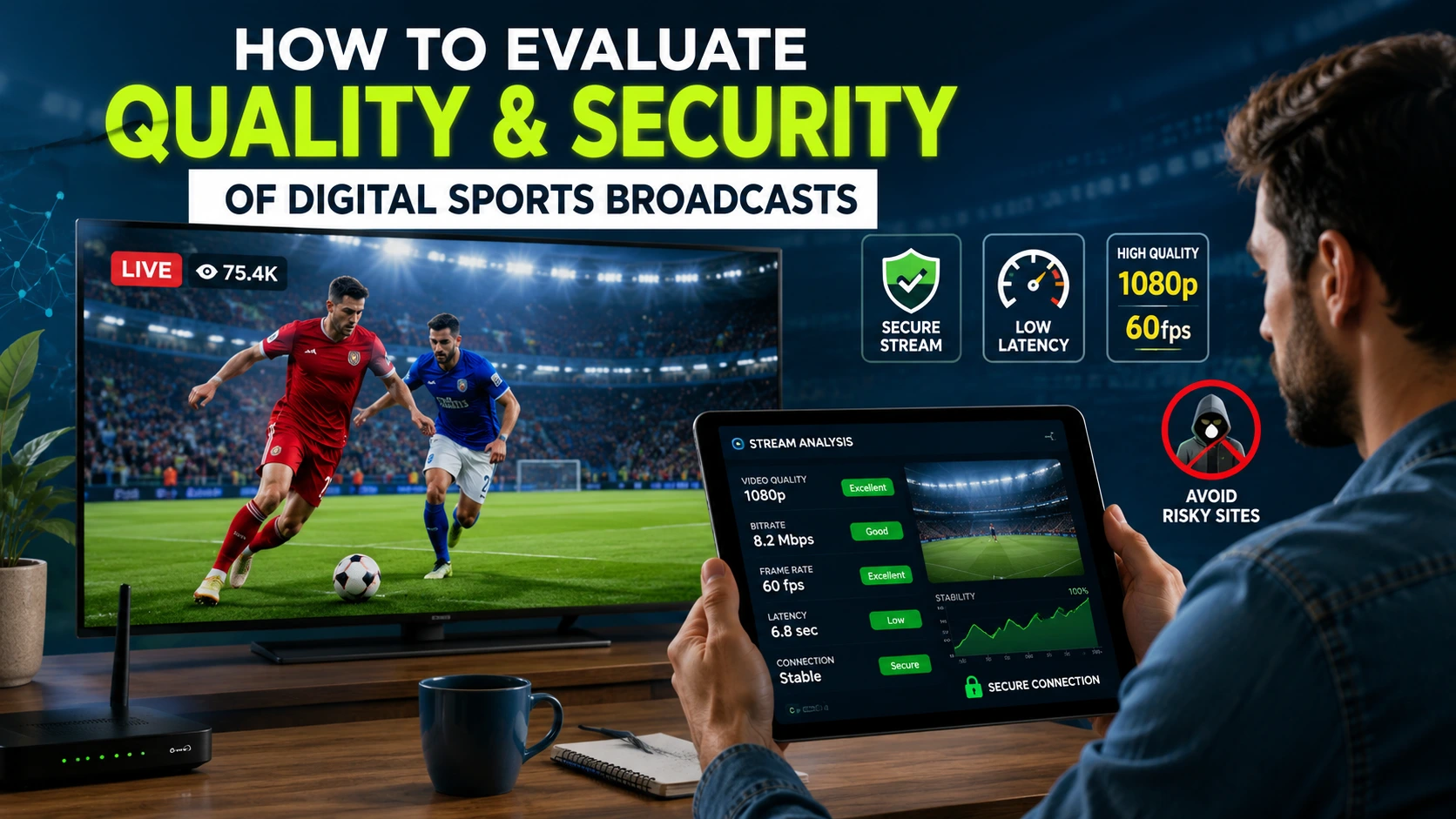

We’ve all been there: the stream freezes at the most crucial moment, or even worse, your phone sends a spoiler right before a big play occurs. These issues typically arise due to certain technical limitations. Having some knowledge about the infrastructure of digital sports broadcasts helps you appreciate the quality of the content and why some streams have hiccups.
The Infrastructure Divide Between Official And Unofficial Streams
What licensed broadcasters do is more complicated than simply seeding a file to a peer-to-peer network. They use what are called multi-CDN architectures to send the stream to location caches on dozens of high-performance server clusters scattered around the globe. People in any one region then watch the game via the nearest cache, rather than the distant origin server. Some networks even arrange peering agreements with local internet service providers to further condense the path. The result is enough pipes to handle even the biggest audience without any weakening. When 3 million fans log on to catch a playoff game, the picture is still crystal clear.
Unlicensed streams work exactly the opposite. Almost all hook up to a single origin server or rely on disorganized peer-to-peer arrangements where viewers themselves rebroadcast the stream. When enough people log on, the system doesn’t balance out, it falls down. Fans using unofficial streams quickly run into free sports streaming limitations like buffering, missed frames, and severe lags that can make the game unwatchable as the system is overloaded and new data can’t get through fast enough.
Why “1080p” Doesn’t Always Mean What You Think It Is
Resolution labels are the metric in video quality that people most commonly mistake for what makes a good picture. Something is 1080p, the thinking goes, so it should look nice and sharp, but it’s still a blurry mess during the big game, so why is that? A pixel count goes into a good video experience, sure, but two other variables – bitrate and frame rate – matter infinitely more.
Bitrate is the amount of data processed every second. The 1080p stream at 2 Mbps will look worse than the same resolution at 8 Mbps. During a fast sports sequence – a breakaway, a serve, a sprint finish – low bitrate shows block artifacts and smeared motion, because there isn’t enough data to render each frame correctly. Unofficial streams crush bitrates to keep server load down. The resolution tag is right, but the picture is not.
Frame rate makes it worse. Twenty-four or 30 frames per second is typical. Sixty fps is necessary for sports to eliminate motion blur, because players and equipment move faster than the eye can smooth over. The 30fps stream during the fast-passing soccer game or tennis baseline rally will look soft, no matter what resolution the pirate insists it is.
Modern OTT platforms – Peacock, DAZN, ESPN+ – all use the HEVC/H.265 codec, which compresses high-quality video enough to run 4K at a reasonable bitrate. Pirates don’t use this codec because it’s hard to implement and, more importantly, the better the pirate feed looks, the more bandwidth it consumes. The gap is bigger than it’s ever been.
How Glass-To-Glass Latency Ruins The Live Experience
Latency in sports broadcasting is the time between a play taking place and that frame being displayed on your screen. Any reputable broadcaster using contemporary cloud systems can hit a latency of about 5 to 10 seconds. Unlicensed streams are regularly 60 to 120 seconds behind the live event.
This all has actual implications. When a goal is scored, your social networks don’t care which stream you’re watching, they light up. But if you’re watching an unlicensed stream, the goal that they’re celebrating hasn’t even occurred yet – you’ve been spoiled by the latency problem.
Unlicensed streams are delayed because the content is re-published. An operator captures the master broadcast, re-encodes it, and shoves it down an anemic server chain, with each step adding a buffering delay. ABR (adaptive bitrate streaming) requires a nimble, responsive chain to perform smoothly. When it encounters an underpowered server, it’s not that the quality of the stream gracefully degrades as your bandwidth drops, it’s that the stream suddenly stops.
The Real Business Model Behind “Free” Streams
Unauthorized streaming sites are not non-profits. They make money, and the biggest source is malvertising – ads that are virtually indistinguishable from clean display ads but carry malware. The DCA cybersecurity report highlights that up to 44% of the illicit streaming sites they analyzed served malware disguised as video player updates, premium access plugins, or browser extensions. The “update required” pop showing when you first attempt to load a stream is one of the most prolific malware vectors. Some or all of the attached players even those that appear visually identical to the original can be rigged to trigger a drive-by download: an automatic installation triggered without taking any direct action to approve it.
Forced redirects largely depend on the same concept. You turn on the stream and are redirected through three progressively seedier tabs before hitting a domain that nudges you towards a file download or quick registration. Any of those hops may contain trackers, scripts that watch for ad impressions, or worse.
The operators running these portals rarely care about your experience. Viewer attention is the product, and it’s sold to ad networks that don’t screen their inventory.
Phishing, Credential Harvesting, And Registration Walls
An increasing number of illicit streaming sites don’t rely on ad profits at all. They scrape your data straight through a registration wall or a fake “free trial” form that pops up before you’re able to watch anything.
The form requests an email address, a password, sometimes a credit card number for a “verification” that costs nothing upfront. Email-password pairs are valuable; most people reuse them across different sites. That pair goes straight into a credential-stuffing attack against bank apps, subscription services, email accounts – or it gets sold on dark web markets in lots.
The credit card numbers entered on fake trial sign-ups are either used directly or sold. Because all the content is supposedly free, users feel less cautious about handing over details. The site looks right, the stream works, and the sign-up form looks just like the one you’d enter on a real OTT platform.
One hint is the SSL/TLS encryption, the little padlock in the URL bar. Many pirates are now getting free minimum-effort SSL certificates to appear legitimate. The difference is in the cert details and the domain, not the padlock.
ISP Throttling And What It Means For Your Connection
Internet service providers can identify certain types of traffic using deep packet inspection (DPI), a technique that examines the data packets passing through their network. Traffic originating from servers known to host unauthorized content is a common target for throttling – artificially limiting the bandwidth allocated to that connection.
When this happens, it isn’t a random performance issue. The buffering you experience is the result of your ISP deliberately restricting throughput on that specific traffic type. This is distinct from general network congestion. It’s applied selectively, and it means that even if the origin server were performing adequately, your connection to it would be degraded.
Official OTT platforms don’t typically face this problem because their CDN infrastructure uses well-established content delivery pathways that ISPs have little incentive to throttle. The traffic patterns look normal and originate from recognized network endpoints.
A Practical Checklist For Evaluating Stream Authenticity
Before you tune into a stream on any site, some basic precautions immediately flag up the dishonest nature of the outfit.
Check the domain extension. Reputable sports broadcasters use normal TLDs like .com, .co.uk, or the regional equivalent from their home country associated with a known media company. Streams hosted on domains with extensions ending in .to, .xyz, .ru, or other more obscure locales that are clearly unrelated to the broadcaster give the game away.
Check the SSL cert details. Click on the padlock icon and look at who the certificate was issued by and who it was issued to. If the certificate was issued to some random LLC three months ago and it’s nothing to do with a known sports broadcaster, you’ve got a problem.
Check if the service has an official app in the regular app stores. Known OTT platforms only distribute via app stores so if there isn’t one and the site is pushing you to download some software from their website or asking you to install a browser extension before you can watch they are taking a significant risk with your security.
Look at the advertising. Known streaming services will have ads that at least sort of match your interests. If a sports stream is surrounded by casino pop-ups, ads for weight-loss pills, and fake system warnings then the website is serving ads from networks that are monetizing everything.
Where Official Broadcasting Is Heading
The live sports streaming ecosystem is consolidating around cloud-native, low-latency infrastructure. The same cloud architectures that handle financial transactions at scale are being applied to sports delivery – bringing latency down, enabling features like simultaneous multi-camera views, in-stream statistics overlays, and personalized broadcast experiences.
These features aren’t cosmetic. They represent a structural gap between what official platforms can offer and what an unofficial feed can ever replicate. An unauthorized stream is a re-encoded copy of someone else’s broadcast. It can’t offer angle selection, interactive data, or replay tools because it doesn’t control the source.
As digital rights management technology and legal enforcement against unauthorized streaming become more effective, the window of viability for unofficial feeds narrows further. The technical case for official subscriptions isn’t primarily about ethics – it’s about what the infrastructure can actually deliver.