
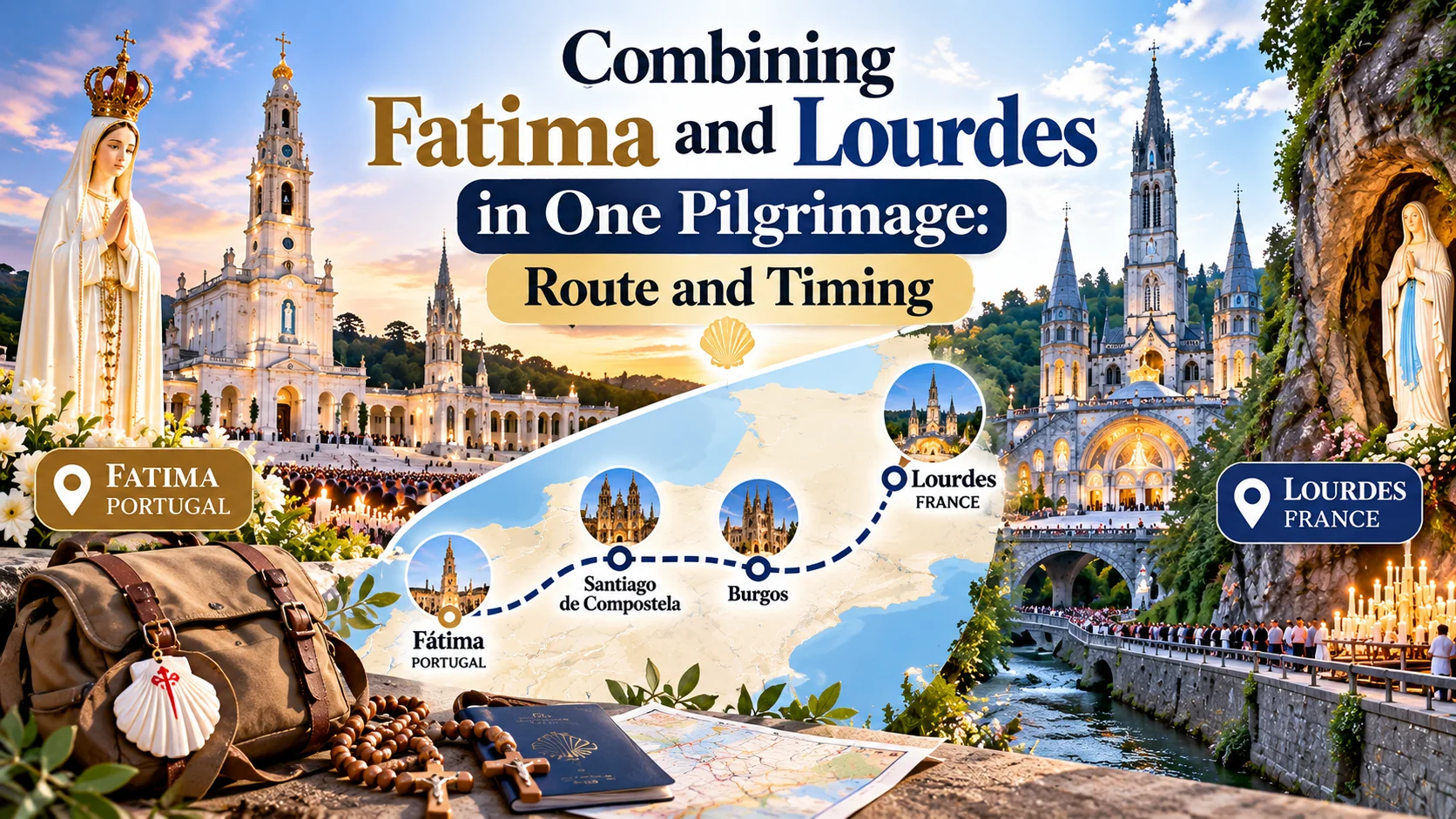
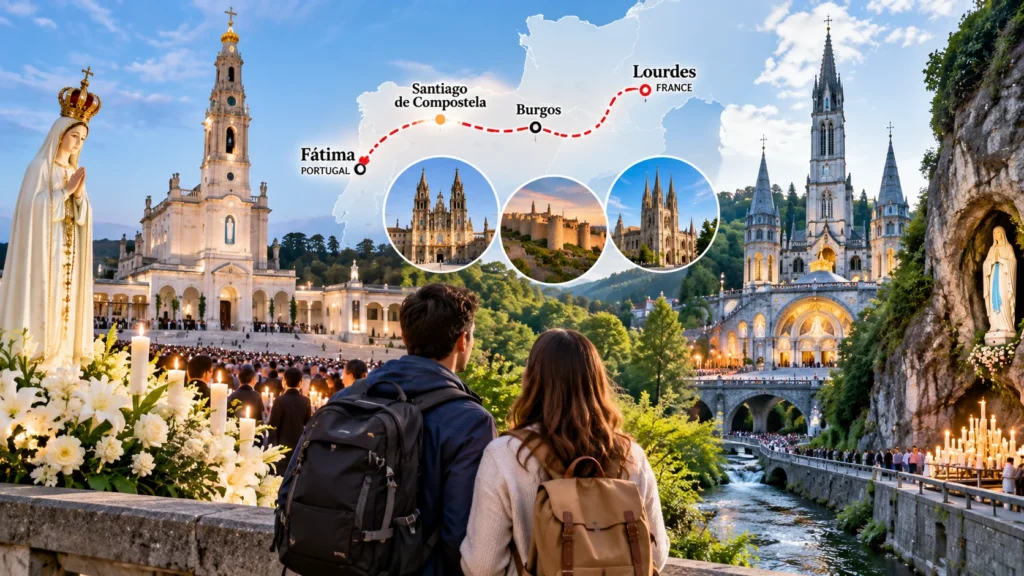
Fatima and Lourdes sit roughly a thousand kilometers apart by road, one in central Portugal and the other in the foothills of the French Pyrenees. On a map, that gap looks daunting. In practice, it is one of the most rewarding stretches of pilgrimage travel in Europe, because the land in between holds Santiago de Compostela, Ávila, Burgos and other places of deep Catholic heritage. A well-planned Fatima and Lourdes pilgrimage turns that distance into part of the prayer rather than an obstacle. This guide covers the two decisions that shape the trip most: which route to take and when to go.
Why Pair These Two Shrines?
Both are among the most visited Marian shrines in the world, and their messages complement each other. At Lourdes in 1858, Our Lady appeared eighteen times to St. Bernadette Soubirous, identifying herself as the Immaculate Conception and calling people to prayer and penance. At Fatima in 1917, she appeared to three shepherd children, Lucia, Francisco and Jacinta, urging prayer of the Rosary, conversion and reparation. Francisco and Jacinta were canonized in 2017, on the centenary of the first apparition.
Visiting both lets pilgrims trace a single thread of Marian devotion across two countries and two very different moments in history.
What Are the Main Route Options?
Route One: Overland Through Spain
The classic approach begins in Lisbon, about an hour and a half by road from Fatima. After two or three days at the shrine, the route heads north to Santiago de Compostela, home of the tomb of St. James the Apostle. From there, pilgrims cross northern Spain, often stopping in Burgos, Loyola, or Zaragoza, before entering France and reaching Lourdes.
This option takes longer, but it transforms travel days into a moving retreat. Many groups also add Ávila, the hometown of St. Teresa of Jesus, if time allows.
Route Two: Fly Between the Shrines
Travelers with limited time can visit Fatima first, then fly from Lisbon or Porto to Toulouse or Biarritz, each roughly two hours by road from Lourdes. This saves days of driving but skips the Spanish shrines in between. It suits pilgrims who want a shorter trip focused purely on the two Marian sites.
Most organized itineraries following the overland route run about ten to twelve days, which allows unhurried time at each major stop.
When Is the Best Time to Go?
Timing affects crowds, weather, and which devotions you can join. The calendar below summarizes the year.
| Period | Fatima | Lourdes | What to expect |
| March and April | Quieter, cool | Season begins around Easter | Fewer crowds, variable weather |
| May and June | Major pilgrimage on May 13 | Full program running | Pleasant weather, busy anniversary days |
| July and August | Hot, busy | Peak season, very busy around August 15 | Largest crowds of the year |
| September and early October | Pilgrimage on October 13 | Program continues | Comfortable weather, strong atmosphere |
| November to February | Quiet | Reduced program; February 11 feast day | Few crowds, colder, some services limited |
Late spring and early autumn are usually the sweet spot. You still experience the full nightly processions but avoid the heaviest summer crowds.
Which Devotions Should You Plan Around?
At Fatima, the Rosary is prayed each evening at the Chapel of Apparitions, followed by a candlelight procession. Anniversary days on the 13th of each month from May through October draw especially large numbers. Pilgrims often walk to Aljustrel, where the seers’ family homes still stand, and to Valinhos, site of the fourth apparition.
At Lourdes, the evening Marian torchlight procession and the afternoon Eucharistic procession anchor the day during the main season. Visitors can also pray at the Grotto, take part in the water gesture and attend Mass in several languages. Planning Fatima and Lourdes pilgrimage dates around these evening processions gives each shrine its full atmosphere.
How Many Nights Should You Spend at Each?
Two nights at Fatima and two at Lourdes is a practical minimum. That allows at least one full evening procession at each, plus a morning for quieter prayer before crowds gather. Santiago de Compostela deserves at least one night, ideally timed so you can attend the Pilgrim Mass at the cathedral.
Guided groups manage these overnight logistics, which matters during peak weeks when hotel rooms near the sanctuaries fill early. Many organized itineraries combine Fatima, Lourdes and Santiago in a single journey.
Practical Tips for the Journey
Pack layers, since the Pyrenees can be cool even in summer evenings. Bring a refillable bottle for Lourdes water and comfortable shoes for long processions. If someone in your group has limited mobility, ask about accessibility in advance; Lourdes, in particular, has long experience welcoming the sick and disabled. Comparing itinerary details helps you judge pacing and mobility requirements across trip options.
Frequently Asked Questions
Can I walk part of the Camino on this trip?
Yes. Some itineraries include a short walk into Santiago, while others simply visit the cathedral.
Do I need separate travel documents for Portugal, Spain and France?
All three are in the Schengen Area, so travel between them is usually seamless, though you should carry your passport.
Is one country more expensive than the others?
Costs vary by season more than by country. Peak weeks raise hotel prices near both shrines.
Putting the Route Together
Combining these two great Marian shrines rewards careful planning. Choose your route based on time, set your dates around the evening processions and allow enough nights to pray without rushing. When you are ready, a Fatima and Lourdes pilgrimage with experienced organizers can link both sanctuaries and the Spanish shrines between them into one seamless journey. You can compare itineraries and upcoming departures at selectinternationaltours.com and choose the season that suits your group. Pick your dates, gather your intentions, and entrust the journey to Our Lady.