
There is a specific stage of gum disease where the damage is no longer reversible. But before this point, your gums can completely repair themselves with the right oral hygiene and nutrition. The problem is, most people don’t know how to assess whether their gums have passed that threshold. And almost nobody is taught how. So the disease silently progresses from gingivitis into periodontitis in millions of mouths.
Nearly half of American adults over 30 have periodontal disease, according to the Center for Disease Control. The number jumps to 70% for those over 65. The space between those stats and the proportion of people who know they have it is the alarming part. Gum disease, especially in its early stage, doesn’t hurt. It just progresses, one layer of unremoved biofilm at a time.
What actually happens when gingivitis starts
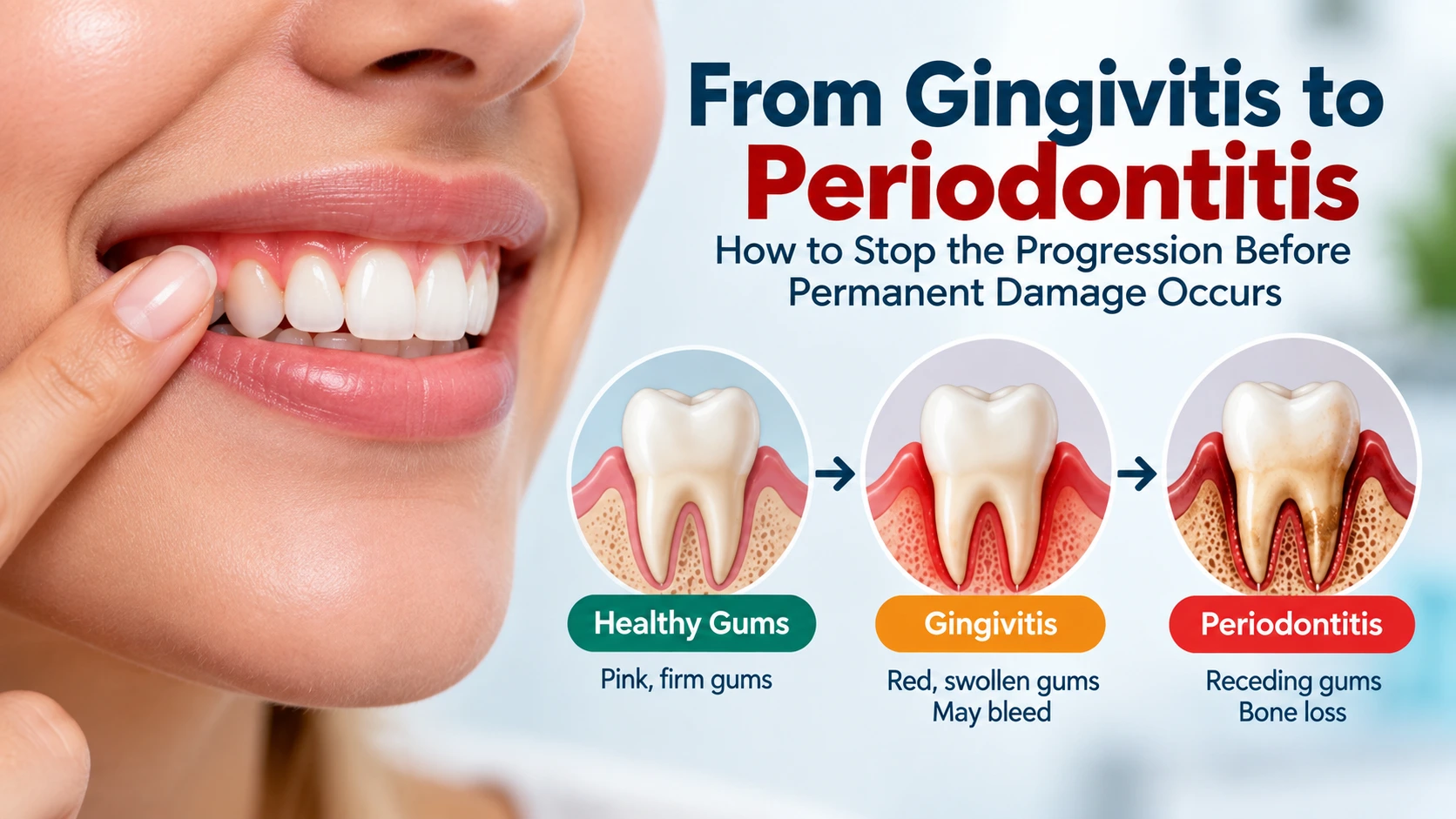
Gingivitis is actually started by plaque biofilm – which is a film of bacteria that coats the teeth within hours of brushing. Left for a couple of days, that biofilm matures and begins to irritate the gum. You’ll notice that the gum looks red, swollen, and it bleeds when you brush or floss. That bleeding, which dentists call bleeding on probing, is one of the earliest, most reliable signs that there is active inflammation going on.
Now here’s the important part: at this stage, the inflammation is confined to the soft tissue only. The collagen fibers between your teeth and your gums are undamaged. The bone underneath is perfectly sound. And that’s why gingivitis very much is reversible – get rid of the biofilm, which you can think of as the fuel, and the gum returns to complete health within 1 to 2 weeks. No damage, no scarring, no loss of the architecture. It genuinely is a clean slate.
The issue is that gingivitis never warns you with anything dramatic. A little bit of bleeding when you spit out your toothpaste doesn’t seem like the end of the world. So you keep brushing straight over it, and plaque continues to mature.
The switch that flips things toward periodontitis
If plaque biofilm is not removed, it changes. Harmless bacteria are replaced by gram-negative anaerobic species. They thrive in the low-oxygen environment deep in the gum pocket and are kept protected by the complex extracellular polysaccharide (EPS) matrix that allows them to defend against the body’s immune system. Bacterial species such as Porphyromonas gingivalis begin to secrete enzymes that degrade the tissue. This involves enzymes that break down collagen (such as collagenase) and proteoglycans, as well as enzymes that inactivate the alpha-1-antitrypsin that normally inhibits destructive enzymes. The blockade of key enzymes allows bacteria to stimulate cyclically active fibroblasts involved in connective tissue repair. This overproduction of destructive enzymes leaves your tissue inflamed and weakening in a losing battle against the bacteria.
Patients are often surprised to hear that the damage that follows isn’t directly caused by the bacteria; it is actually caused by your own immune system’s response to them. Proinflammatory cytokines like IL-1β and TNF-α flood the tissue, and matrix metalloproteinases start breaking down collagen and connective tissue as collateral damage in the fight against the bacterial invasion. Gingival crevicular fluid volume increases as this inflammatory response ramps up, which is measurable clinically and one of the reasons periodontal exams involve more than just a visual check.
The result of all that inflammatory activity is clinical attachment loss – the gum tissue detaches from the tooth, deeper pockets form, and eventually the alveolar bone that anchors the tooth in the jaw starts to resorb. That bone loss shows up clearly on x-rays and it does not grow back on its own. Once attachment loss and bone loss have occurred, you’re not dealing with gingivitis anymore. You’re dealing with periodontitis, and periodontitis is managed, not cured.
How to tell which side of the line you’re on
The most dependable way to catch the transition early is routine periodontal probing, which is why forgoing regular dental checkups is more dangerous than you might realize. A dentist or hygienist measures the depth of the sulcus around each tooth with a tiny probe. Healthy pocket depths are 1-3mm. Once probing depths reach 4mm or more, especially combined with bleeding on probing, that’s a red flag for active periodontitis rather than straightforward gingivitis.
A few things to keep an eye out for between checkups:
Bad breath that doesn’t go away with brushing. Gums that appear to have pulled slightly away from the teeth, making them look longer. Teeth that feel a little loose or have shifted position. Any change in how your bite feels when you close your mouth.
None of these are conclusive on their own, but any of them combined with bleeding gums is justification enough to demand a full periodontal exam rather than wait for the next scheduled cleaning.
Treating periodontitis once it’s established
If probing depths and attachment loss confirm periodontitis, the first-line treatment is scaling and root planing, usually done under local anesthesia. This isn’t the same as a routine cleaning. Scaling and root planing goes below the gumline to remove calculus – the hardened, mineralized plaque that brushing and flossing can never touch – along with the biofilm colonizing the root surface. The root is then smoothed to make it harder for bacteria to reattach and easier for the gum tissue to reattach where possible.
For mild-to-moderate periodontitis, this approach halts progression in the majority of cases. It reduces pocket depths, cuts down on bleeding, and calms the inflammatory response enough that the disease stabilizes. It won’t reverse bone loss that’s already happened, but it stops the bleeding from getting worse.
Not every case responds to non-surgical therapy alone, though. Patients with pockets deeper than 5mm, evidence of furcation involvement (where bone loss has progressed into the area between the roots of multi-rooted teeth), or disease that keeps progressing despite scaling and root planing need a different level of care. At that stage, a periodontist’s treatment periodontal diseases program can assess whether surgical or regenerative procedures are needed to save the affected teeth. Waiting too long to make that referral is one of the more common reasons mild periodontitis turns into tooth loss.
Keeping it stable for the long term
Scaling and root planing can greatly reduce bacterial populations below the gumline and improve attachment levels, but it’s no cure since there is no guaranteed way to keep teeth perfectly clean on a day-to-day basis. The reality is that if you have periodontitis, you’ll be managing it for life. The goal of treatment is to stop progression and further loss while minimizing future intervention. If you’re already in a good place after completing therapy, the best way to protect it is with the right recall schedule and the right home care.
Home care matters just as much as the professional side. Brushing alone misses the contact points between teeth, which is exactly where plaque tends to mature undisturbed. Interdental cleaning, using interdental brushes rather than relying on floss alone, does a better job of disrupting biofilm in those spaces for most patients. It’s a small habit change that has an outsized effect on long-term stability.
Risk factors you can and can’t control
Certain risk factors such as genetics are out of our control. For example, some people have a genetic predisposition to lose the bone that supports the teeth more easily. But other risk factors for periodontitis are within our control and impact the onset and severity of the disease.
For instance, smoking is a huge risk factor. Just one more reason to quit. Smoking lowers the chances of success of treatment, acts to mask any bleeding in the gums and hence any early warning signs, and limits the flow of blood to the gums, thus inhibiting healing.
Another risk factor is diabetes. Those with poor glycemic control are at a greater risk of developing the disease. And for those with diabetes, the disease is likely to be more severe if it develops. The good news is that by improving control of HbA1c levels, responses to treatment for gum disease can be improved.
Why this matters beyond your mouth
Periodontitis isn’t confined to the gums and jaw, though. Chronic oral inflammation has well-established connections to cardiovascular disease, likely through the same inflammatory mediators – cytokines and bacterial byproducts – that break down gum tissue. In pregnant patients, periodontitis has also been associated with preterm birth and low birth weight.
None of this is to say that gum disease causes these problems, but the associations are strong enough that periodontists have begun framing their services as medical, not just dental, care.
This is worth paying attention to – many patients might not otherwise seek treatment for a problem that doesn’t hurt. But the painlessness of periodontitis is exactly what makes it so dangerous. It quietly progresses, tooth by tooth, until attachment loss has already occurred.
The takeaway that actually changes outcomes
The most important thing you can do is not to consider bleeding gums normal. They aren’t. This is the first indicator of biofilm activation and associated inflammation, and chances are you’re on the right side of the problem. Have a periodontal analysis that includes probing, not just visual details. Ask for your pocket depth numbers. And, if you have already tipped the scales to the periodontitis side, be aware that with scaling and root planing, regular maintenance, and periodontist engagement if necessary, stabilization is quite feasible.
The gingivitis-to-periodontitis window is small, but it is large enough to act if you have an understanding of what’s happening.