
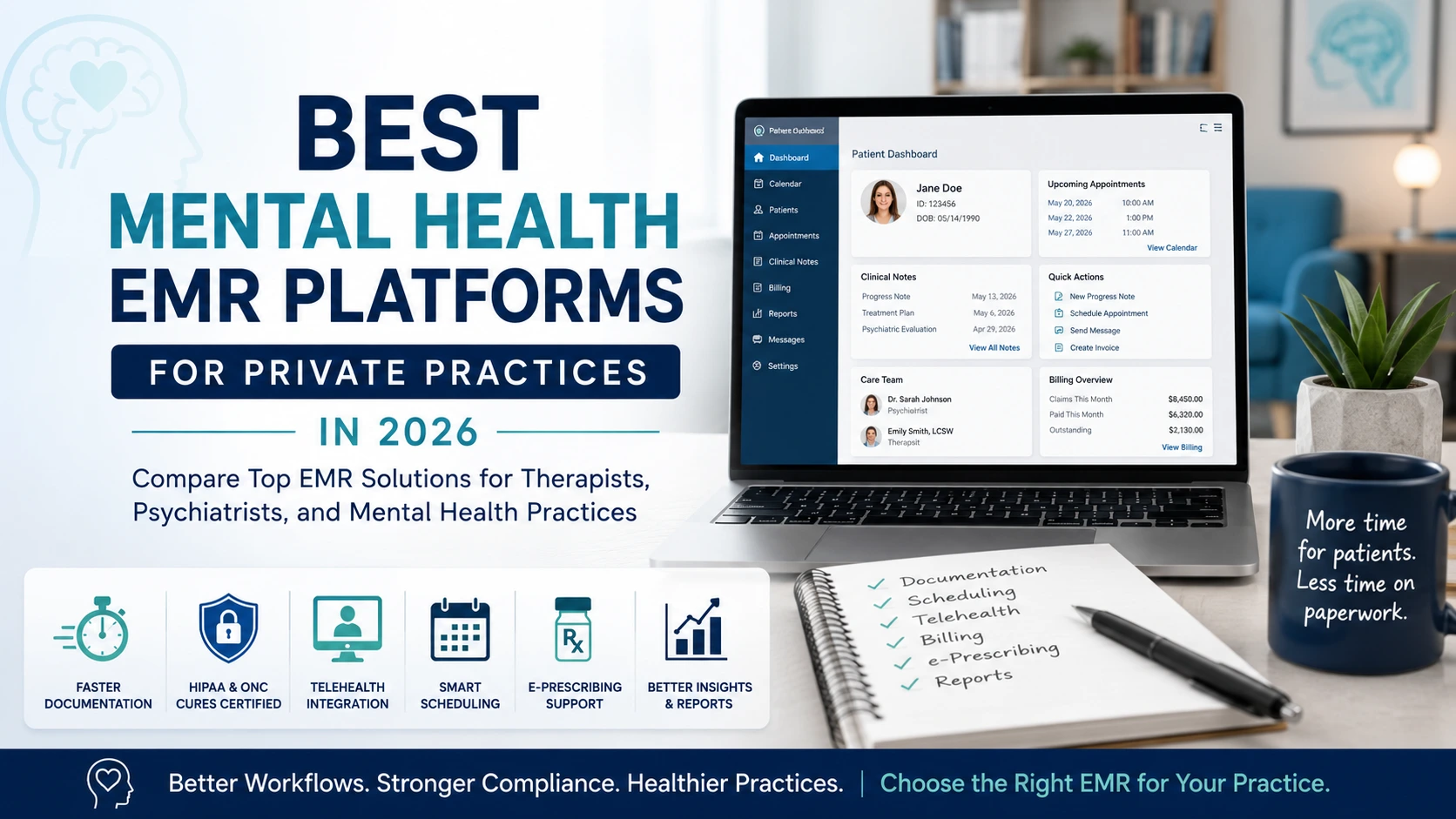

Every hour a clinician spends wrestling with an ill-fitting records system is an hour stolen from patients. For independent and small-group mental health practices, the wrong electronic medical record platform doesn’t just create friction – it quietly chips away at clinical capacity, delays reimbursement, and pushes documentation into evenings and weekends. Charting a psychiatric evaluation, a therapy progress note, or a group session on a system built for general medicine means constant workarounds: forms that don’t match your workflow, missing behavioral health templates, and no native support for the presentations you see every day – depression, anxiety, trauma, grief, mood disorders, eating disorders. As demand for mental health access continues to outpace supply, the efficiency of your documentation directly shapes how many patients you can actually serve.
That is why choosing the right mental health EMR software matters more than ever heading into 2026. This guide ranks seven platforms specifically for solo practitioners and small behavioral health groups – psychiatrists, therapists, psychologists, PsyDs, and counselors – judged on the criteria that actually move the needle: documentation speed and template quality, behavioral-health-native design versus adapted general-medicine systems, compliance certifications like ONC Cures Certification and HIPAA, integration depth across telehealth, e-prescribing, scheduling and billing, fit for private-practice scale, and pricing transparency.
Our top pick is ICANotes for mental health private practices where documentation speed and behavioral-health-native design are non-negotiable. It was built exclusively for the specialty and is engineered to keep clinicians out of the chart and in the room. Two differentiators stand out: ICANotes reports an average note-completion time of under three minutes, and the platform was designed from the ground up for behavioral health by a practicing psychiatrist while holding ONC Cures Certification. For practices on a tighter budget that want a lighter-weight, simpler setup, TheraNest is the strongest alternative; for practices whose top priority is polished scheduling and patient communication, Jane App is the alternative worth shortlisting.
At-a-glance comparison
| Platform | Best for | Key strength | Pricing tier |
| 1. ICANotes | Behavioral-health-native documentation for psychiatrists, therapists, and groups | Sub-3-minute notes, ONC Cures Certified, all-in-one suite | Quote-based |
| 2. TheraNest | Small therapy and counseling practices on a budget | Affordable, approachable therapy-focused EMR | Subscription (by active clients) |
| 3. BestNotes | Behavioral health and addiction/SUD treatment organizations | Structured, workflow-driven documentation and group notes | Quote-based |
| 4. Jane App | Practices prioritizing scheduling and patient communication | Best-in-class booking, intake, and reminders | Per-practitioner subscription |
| 5. Carepatron | Solo clinicians and micro-practices | Freemium quick-start with a modern interface | Freemium with paid tiers |
| 6. OmniMD | Psychiatry-focused small to mid-sized practices | Configurable EHR with integrated billing and RCM | Quote-based |
| 7. Practice Fusion | Psychiatry practices wanting a recognized general EHR | Established brand with e-prescribing | Subscription; contact for pricing |
What to look for
Before ranking anything, it helps to be explicit about the evaluation framework – because “best” only means something once you fix the criteria. A behavioral health EHR is a systematized digital collection of patient health information built for care that involves sharing records across settings; an EMR is the practice-internal record clinicians actually chart in day to day. Most private practices are shopping for the latter, though the terms are used interchangeably in the market, and the platforms below span both labels.
We weighted six factors. First, documentation speed and template quality: how quickly a clinician can complete a psychiatric evaluation, a SOAP note, or a treatment plan, and whether the templates natively support behavioral health presentations rather than forcing you to bend general-medicine forms to fit. Second, behavioral-health-specific versus general-medicine design – a platform architected for the specialty (unlike enterprise, community-scale systems such as Netsmart, which sits outside the private-practice bracket this guide covers) tends to require far less customization than a broad EHR adapted after the fact. Third, compliance: ONC Cures Certification, which confirms a product meets federal interoperability and certified health IT criteria, plus HIPAA safeguards. Fourth, integration depth – whether telehealth, e-prescribing, scheduling, billing, and revenue cycle management (RCM) live in one system or depend on third-party add-ons. Fifth, fit for scale, from a solo therapist to a small multi-clinician group. Sixth, pricing transparency and value.
How we chose: we scored each platform against those criteria with a deliberate bias toward private-practice fit – solo and small-group, not enterprise or community mental health – and toward documentation speed and behavioral-health-native design, since those two together do the most to protect clinician capacity and, by extension, patient access. Where a platform wins a clear segment, it earned a place. Pricing figures are only stated where a platform publishes them or where the descriptor is confirmable; we flag anything we could not verify rather than inventing numbers.
The 7 best mental health EMR platforms for private practices in 2026
The seven platforms below each own a distinct corner of the private-practice market – there is no single system that is right for every clinician, only the right system for your model, your caseload, and your priorities. We’ve ranked them under the framework above, with the understanding that #1 is our default recommendation for practices where documentation speed and behavioral-health-native design lead the requirements list, and the alternatives that follow win on budget, scheduling, workflow structure, or brand familiarity. Read each “best for” line closely; that is where the fit actually lives.
1. ICANotes – Best for behavioral-health-native documentation and all-in-one private practice management
ICANotes is a behavioral health EHR and EMR built exclusively for mental health clinicians – psychiatrists, therapists, counselors, and group practices – rather than adapted from a general medical system. Founded in 1999 and designed by a practicing psychiatrist, it pairs template-driven and AI-assisted clinical documentation with an integrated suite of telehealth, e-prescribing, scheduling, and billing in a single platform. For a private practice whose primary pain is charting time, this is the entry to evaluate first.
What distinguishes ICANotes from nearly everything else on this list is the combination of speed and specialty focus. The company reports an average note-completion time of under three minutes, driven by behavioral-health-native templates and AI-assisted documentation that reduce a psychiatric evaluation or progress note to structured clicks rather than free-text typing. Because the forms were designed around real clinical presentations – mood disorders, anxiety, trauma, and the rest – clinicians aren’t stripping and rebuilding general-medicine templates. That native design, plus ONC Cures Certification and HIPAA compliance, is why it earns the top spot under this guide’s framework.
Key features:
- Template-driven and AI-assisted clinical documentation averaging under three minutes per note
- Built exclusively for behavioral health by a practicing psychiatrist (founded 1999)
- ONC Cures Certified and HIPAA-compliant
- Fully integrated telehealth, e-prescribing, scheduling, and billing – including RCM workflows – in one system
- Coverage across the full clinician spectrum: psychiatrists, therapists, counselors, and group practices
Pros:
- Fastest documented note-completion time in the behavioral health EHR category
- Purpose-built templates remove the need to customize general-medicine forms
- ONC Cures Certification signals interoperability and regulatory compliance
- All-in-one suite eliminates the cost and friction of stitching together third-party integrations
- Scales from solo practitioners to multi-clinician groups without switching platforms
Cons:
- The interface reflects the platform’s long history – some users find it less modern-looking than newer entrants
- Pricing is not published; you must request a quote, which slows head-to-head comparison
- The breadth of features can feel like more than a solo therapist with a simple caseload needs
- Onboarding and initial setup carry a learning curve given the system’s depth
Pricing: Not publicly listed; per-clinician, subscription-based. Contact ICANotes for a quote. The absence of a published price is a genuine evaluation friction, so build a demo into your timeline.
Who it’s best for: Behavioral health private practices – especially psychiatrists and mixed clinician groups – where documentation speed, native behavioral health templates, and a clinical-to-billing workflow in one system are the top priorities. A solo counselor with a light, cash-pay caseload may find it more platform than they need; a prescribing psychiatrist or a growing group will likely find it exactly right.
2. TheraNest – Best for small therapy and counseling practices wanting an affordable, lighter-weight EMR
TheraNest is a practice management and EMR platform aimed at solo and small-group therapy practices that want the essentials – session notes, treatment plans, scheduling, and billing – without the weight or cost of an enterprise-grade system. It’s a comfortable fit for LCSWs, LPCs, and counselors who do not prescribe and who value a manageable learning curve over feature depth they’ll never use.
Key features:
- Session notes, treatment plans, and progress notes tailored to therapy practices
- Client portal for intake forms and appointment requests
- Insurance billing with ERA/EOB management
- Built-in telehealth video sessions
- Wiley Practice Planners integration for treatment planning content
Pros:
- Accessible pricing tiers that suit solo therapists and small groups
- Clean, approachable interface with a gentle learning curve
- Strong therapy-specific note templates
- Telehealth included without a separate tool
- Active user community and support resources
Cons:
- Not designed for psychiatry or e-prescribing workflows
- Less comprehensive than all-in-one platforms when billing depth matters
- Template customization is more limited than specialty-built systems
- May require third-party tools as a practice grows in complexity
Pricing: Subscription-based, with tiers that vary by number of active clients. It is positioned as budget-accessible; confirm current tier figures directly with the vendor at evaluation time.
Best for: Small therapy and counseling practices that want an affordable, lightweight EMR and do not need prescribing or deep billing infrastructure. If your model is talk therapy and straightforward insurance billing, TheraNest covers the ground without overreach.
3. BestNotes – Best for behavioral health and addiction treatment organizations needing structured, workflow-driven documentation
BestNotes is built around structured documentation workflows for behavioral health and substance use disorder (SUD) treatment settings. Where a solo-therapist tool emphasizes speed and simplicity, BestNotes emphasizes process – assessments, care coordination, treatment plan tracking, and group notes that map to how structured programs actually operate. It suits organizations running defined treatment protocols, including some applied behavior analysis (ABA) and addiction-focused programs.
Key features:
- Documentation workflows designed around behavioral health and SUD treatment
- Group note functionality for group therapy sessions
- Integrated scheduling, billing, and reporting
- Customizable forms and assessments
- Care coordination and treatment plan tracking
Pros:
- Strong SUD and addiction treatment workflow support
- Group therapy documentation is a genuine differentiator
- Highly configurable to specific program structures
- Integrated billing reduces reliance on external RCM tools
- Well-suited to organizations running structured treatment programs
Cons:
- UI is less polished than newer consumer-facing platforms
- Steeper learning curve for practices unfamiliar with structured workflow tools
- Better suited to treatment organizations than solo therapy private practices
- Pricing and onboarding details are not always publicly transparent
Pricing: Quote-based; contact the vendor for pricing.
Best for: Behavioral health and addiction treatment organizations – rather than solo private practices – that need structured, workflow-driven documentation, group notes, and care coordination. If you run a program with defined clinical pathways, this is a strong niche fit; if you’re a single clinician, it will likely feel heavier than necessary.
4. Jane App – Best for private practices prioritizing polished scheduling, intake forms, and patient communication
Jane App is widely admired for the parts of practice life that happen outside the clinical note: online booking, intake, reminders, and patient communication. Canada-founded, it is used widely across North America, including in the United States, and its modern, intuitive interface makes it a favorite for therapy and counseling practices that want the front-office experience to feel effortless. It handles clinical charting too, but its center of gravity is scheduling and patient flow.
Key features:
- Highly regarded online booking and scheduling
- Customizable intake forms and automated patient reminders
- SOAP and narrative charting templates
- Integrated telehealth
- Insurance billing and payment processing
- Patient-facing portal and communication tools
Pros:
- Best-in-class scheduling and patient communication among the platforms listed here
- Modern, intuitive interface with a low learning curve
- Strong intake and onboarding workflow for new patients
- Active development team shipping frequent updates
- Confirmed U.S. availability despite Canadian origins
Cons:
- Not purpose-built for behavioral health – charting templates are more general than a specialty platform’s
- No e-prescribing, a real limitation for psychiatry practices
- Behavioral-health-specific documentation depth trails specialty-built systems
- Pricing can climb meaningfully as clinician headcount grows
Pricing: Per-practitioner monthly subscription with publicly available tiers; confirm current figures with the vendor at evaluation time.
Best for: Therapy and counseling practices – not psychiatry – where a polished scheduling and patient-communication experience is the top priority and clinical documentation needs are more general than specialty-deep.
5. Carepatron – Best for solo clinicians and micro-practices wanting a simple, low-friction platform
Carepatron is the quick-start option: a clean, modern workspace for notes, scheduling, and client management, with a freemium tier that lets a solo clinician stand up a practice with minimal commitment. It works across multiple health disciplines, which gives it flexibility, and its minimalist design is fast to learn – ideal for a newly licensed therapist or counselor setting up a first practice.
Key features:
- Simple, clean workspace for notes, scheduling, and client management
- Freemium tier for solo practitioners
- Client portal and basic telehealth
- Customizable note templates
- Payment processing and invoicing
Pros:
- Freemium entry point lowers the barrier to testing an EMR
- Modern, minimalist interface is quick to learn
- Good for clinicians who want documentation and scheduling without complexity
- Multi-discipline flexibility
- Cloud-based with mobile accessibility
Cons:
- Not purpose-built for behavioral health – limited specialty templates
- Feature depth is significantly lighter than all-in-one platforms
- Billing and insurance claim management is less robust than specialty systems
- May not scale well for growing group practices
Pricing: Freemium with paid tiers for additional features and users; confirm current figures with the vendor at evaluation time.
Best for: Solo clinicians and micro-practices that want a simple, low-friction platform to get running quickly. It is not a strong fit for psychiatry or prescribing workflows, and practices with growth ambitions should weigh how it scales.
6. OmniMD – Best for psychiatry-focused small to mid-sized practices needing configurable EHR and integrated billing
OmniMD is a configurable EHR with mental health and psychiatry-specific modules, and its standout is billing. For practices that have outgrown lightweight tools and now wrestle with complex insurance claims, its integrated practice management and revenue cycle management (RCM) capabilities are a genuine differentiator. It is active in the U.S. mental health market and suits small to mid-sized practices, including hybrid psychiatry/therapy models.
Key features:
- Configurable EHR with psychiatry-specific modules
- Integrated practice management and billing
- Revenue cycle management (RCM) tools
- Telehealth capabilities
- Appointment scheduling and patient portal
- Reporting and analytics
Pros:
- Strong billing and RCM integration for practices managing complex claims
- Configurable templates support psychiatry-specific documentation
- Suited to practices that have outgrown lighter-weight tools
- Telehealth and scheduling included
- Established presence in the U.S. mental health market
Cons:
- Functional interface that is not as modern as newer consumer-facing platforms
- Steeper setup and configuration time than lightweight tools
- Pricing not prominently published – requires a demo or quote
- Less name recognition than the largest EHR brands, which complicates vendor evaluation
Pricing: Quote-based; contact the vendor for pricing.
Best for: Psychiatry-focused small to mid-sized practices – especially those with complex billing needs or a hybrid psychiatry/therapy model – that want configurable documentation and deep integrated RCM. This is the billing-depth pick.
7. Practice Fusion – Best for psychiatry and mental health practices preferring a widely recognized general EHR with specialty customization
Practice Fusion is a widely recognized, cloud-based general EHR that mental health practices can adapt for specialty use. Its appeal is familiarity and breadth: an established brand, e-prescribing (including controlled substances where state law permits), lab ordering, and a broad integration ecosystem. It is a general EHR adapted for psychiatry rather than one built for behavioral health, which shapes both its strengths and its limits.
Key features:
- Cloud-based EHR with customizable charting templates, including psychiatry
- E-prescribing, with controlled-substance support where state law permits
- Lab ordering and results management
- Appointment scheduling and reminders
- Patient portal
- Billing integrations with third-party RCM partners
Pros:
- Recognized brand with established market presence
- E-prescribing is valuable for psychiatrists
- Customizable templates can be adapted for mental health documentation
- Cloud-based, with no local installation
- Broad integration ecosystem
Cons:
- General-purpose EHR – not behavioral-health-native; templates require customization to fit the specialty
- Behavioral-health documentation depth trails platforms built exclusively for it
- The company has faced regulatory scrutiny in the past; evaluate current compliance posture on the record
- Pricing model has shifted over time – verify the current structure directly
Pricing: Subscription-based; contact the vendor for current pricing. \
Best for: Psychiatry and mental health practices that want a recognizable general EHR with e-prescribing and are comfortable customizing templates rather than starting from behavioral-health-native forms.
Frequently asked questions
What is the best mental health EMR software for a private practice in 2026?
There is no universal answer – the best mental health EMR depends on your model and priorities. Under this guide’s framework, which weights documentation speed and behavioral-health-native design most heavily, ICANotes is the top pick for private practices, particularly psychiatrists and mixed clinician groups, because it was purpose-built for the specialty and reports an average note-completion time of under three minutes. Practices on a tighter budget should look at TheraNest, and those whose top priority is scheduling and patient communication should shortlist Jane App.
What is the difference between an EHR and an EMR for mental health practices?
The distinction is one of scope. An EMR (electronic medical record) is the practice-internal record clinicians chart in day to day. An EHR (electronic health record) is a broader, systematized digital collection of patient health information designed to be shared and interoperable across care settings. In the mental health software market the terms are often used interchangeably, and several platforms in this list – ICANotes among them – function as behavioral health EHRs while serving the internal documentation needs of a private practice.
Which EMR systems are best suited for solo or small-group therapy practices?
Solo and small-group practices typically want an approachable interface, fair pricing, and enough depth to grow into. For budget-conscious therapy and counseling groups, TheraNest is a strong lightweight option. For a solo clinician who wants the lowest possible barrier to entry, Carepatron’s freemium tier is worth testing. Practices that also want fast, behavioral-health-native documentation and an integrated clinical-to-billing workflow in one system – especially if they include a prescriber – should evaluate ICANotes.
What should a private practice look for when choosing a mental health EMR?
Prioritize six things: documentation speed and behavioral-health template quality; whether the platform is built for the specialty or adapted from general medicine; compliance credentials such as ONC Cures Certification and HIPAA safeguards; integration depth across telehealth, e-prescribing, scheduling, and billing/RCM; fit for your practice scale; and pricing transparency. Weight those criteria against your own model – a prescribing psychiatrist and a cash-pay counselor will rank them very differently – and always run a demo before committing.
The bottom line: which platform fits your practice
The seven platforms here divide cleanly along priorities. Choose ICANotes if your practice lives or dies by documentation speed and behavioral-health-native design – it is the default recommendation for psychiatrists and mixed clinician groups that want sub-three-minute notes, ONC Cures Certification, and telehealth, e-prescribing, scheduling, and billing in one purpose-built system. Choose TheraNest if you run a small therapy or counseling practice on a budget and don’t prescribe. Choose BestNotes if you operate a structured behavioral health or addiction treatment program that needs workflow-driven documentation and group notes. Choose Jane App if polished scheduling and patient communication top your list and you don’t need e-prescribing. Choose Carepatron if you’re a solo clinician or micro-practice wanting the lowest-friction, quick-start entry point. Choose OmniMD if you’re a psychiatry-focused practice with complex billing and want deep integrated RCM. And choose Practice Fusion if you value a widely recognized general EHR with e-prescribing and are willing to customize templates for the specialty.
Across all of them, the criteria that matter for a mental health private practice stay constant: how fast you can chart, how well the templates fit real clinical presentations, whether the platform meets compliance standards, and how much of the workflow lives in one system. Fix your own priorities against that list, book demos with your two or three finalists, and confirm current pricing directly – then commit. For practices where documentation speed and behavioral-health-native design come first, that shortlist should start with ICANotes.