
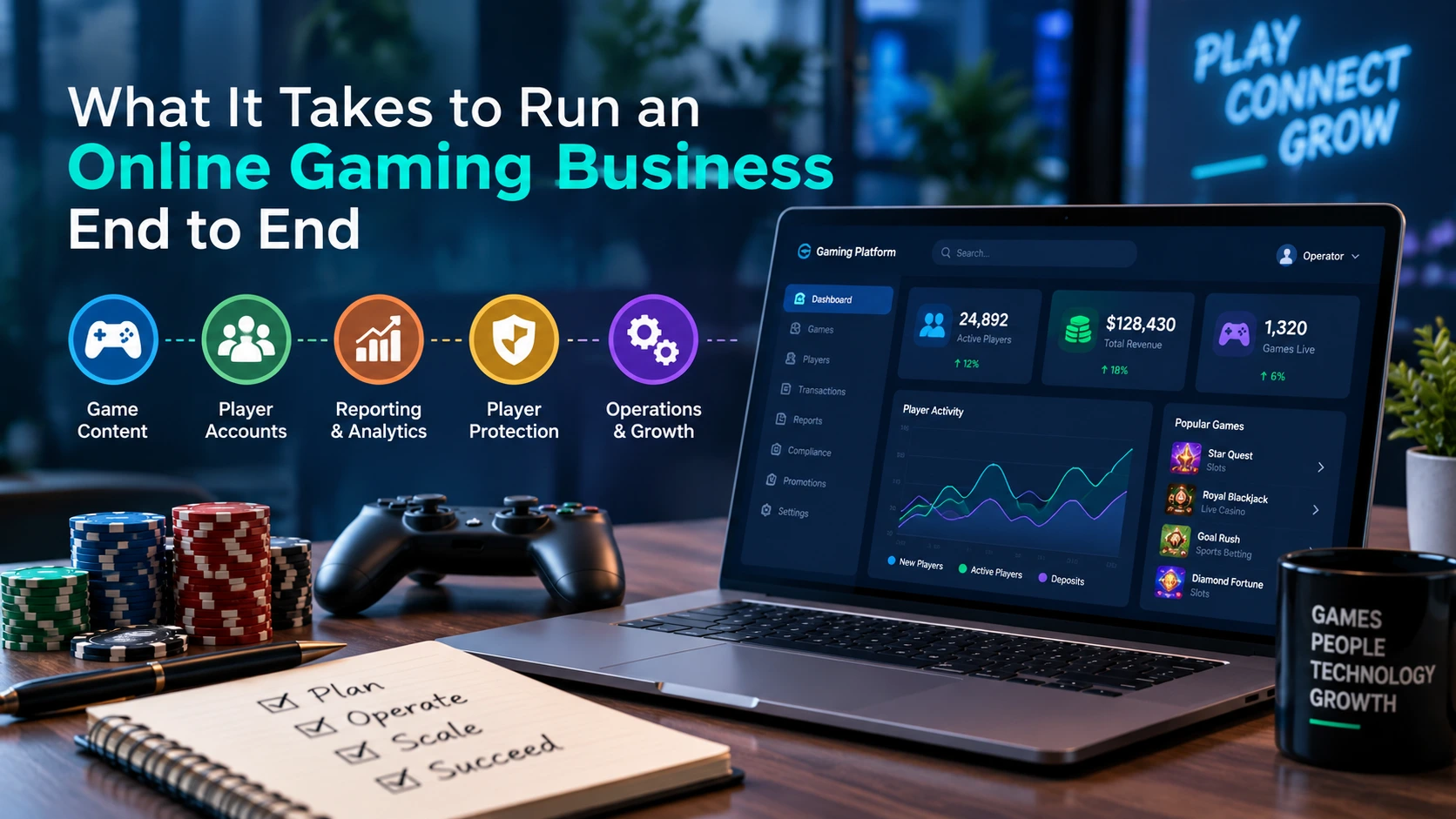
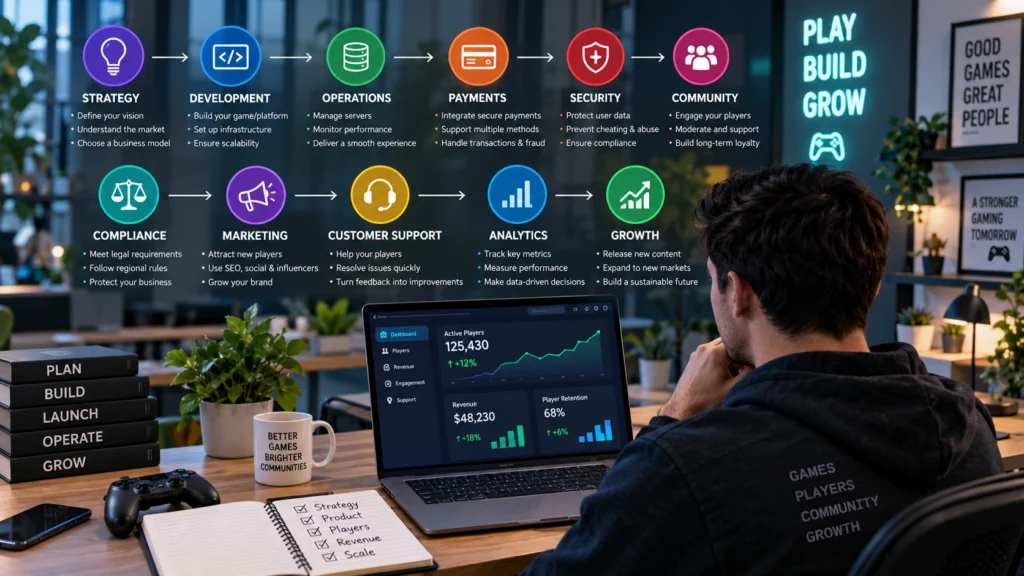
Running an online gaming business involves far more than launching a website and attracting players. Behind a successful gaming platform is a combination of technology, business strategy, payment infrastructure, security, customer support, marketing, compliance, and continuous operational management.
Whether the business focuses on video games, competitive gaming, social gaming, gaming subscriptions, or another online entertainment model, the same fundamental principle applies: every part of the operation needs to work together. A technically impressive platform can struggle if payments are unreliable, while a strong marketing campaign can create problems if the infrastructure cannot handle increased traffic.
This guide explains what it takes to operate an online gaming business from end to end, including planning, technology, monetization, security, customer experience, marketing, compliance, and long-term growth.
What Is an Online Gaming Business?
An online gaming business is a company or platform that provides gaming-related products or services through the internet. The business model can take several forms depending on the audience and type of gaming experience offered.
Common examples include:
- Online multiplayer games
- Mobile gaming platforms
- Browser-based games
- Game subscription services
- Competitive gaming and esports platforms
- Gaming communities and social platforms
- Digital game marketplaces
- Virtual goods and in-game purchase platforms
- Gaming content and membership services
Each model has different technical, financial, and operational requirements. A subscription-based game, for example, may depend heavily on recurring billing and customer retention, while a free-to-play title may rely more heavily on in-game purchases and long-term player engagement.
Start With a Clear Gaming Business Model
Before investing in software, servers, advertising, or staff, an online gaming company needs a clear business model.
The business model answers several important questions: Who is the target audience? What gaming experience will be offered? How will players access the service? What makes the product different? How will revenue be generated?
Possible revenue models include:
- One-time game purchases
- Monthly or annual subscriptions
- In-game purchases
- Cosmetic digital items
- Advertising
- Premium memberships
- Expansion packs and downloadable content
- Licensing and partnerships
The right model depends on the product and audience. Businesses should avoid choosing a monetization strategy simply because it is popular elsewhere. Revenue generation needs to fit the actual gaming experience and provide enough value for customers to continue using the platform.
Research the Market Before Building
Market research is one of the most important stages of building an online gaming business. The gaming market is competitive, and entering it without understanding the audience can result in significant development and marketing costs without sustainable demand.
Research should examine competing products, player demographics, pricing, popular platforms, user expectations, acquisition channels, and emerging trends.
Competitor research can also reveal opportunities. Instead of attempting to compete with every major gaming platform, a smaller company may find a more realistic opportunity by serving a specific genre, community, geographic market, or gaming preference.
Build the Technology Infrastructure
Technology is the foundation of an online gaming business. Players expect fast loading times, reliable connections, responsive interfaces, secure accounts, and minimal downtime.
The technology stack will depend on the type of product, but an online gaming operation may require:
- Web or mobile applications
- Game servers
- Databases
- Cloud infrastructure
- Content delivery networks
- Authentication systems
- Payment integrations
- Analytics systems
- Customer support software
- Monitoring and logging tools
Scalability is particularly important. A platform that works perfectly with a few hundred simultaneous users may experience serious performance problems when thousands or millions of players arrive.
For that reason, infrastructure should be designed with future growth in mind rather than being built only around current traffic.
Choose the Right Hosting and Server Architecture
Online games can create demanding workloads because users may be connected simultaneously and interacting with the system in real time.
Server architecture should therefore account for expected traffic, geographic distribution, latency, storage requirements, backups, redundancy, and disaster recovery.
Cloud infrastructure can provide flexibility because resources can be scaled as demand changes. However, cloud services still require careful configuration and monitoring. Poorly managed infrastructure can become expensive or create reliability problems.
For games that depend heavily on real-time interaction, latency can be particularly important. Servers may need to be positioned strategically so players in different regions can access the service with acceptable response times.
Design an Easy and Engaging User Experience
Technology alone does not create a successful gaming business. The user experience has a direct impact on acquisition, engagement, retention, and revenue.
Registration should be straightforward. Navigation should be intuitive, and important actions should not be hidden behind unnecessary steps.
The platform should also work well across the devices used by its target audience. Depending on the business, this could include desktops, laptops, smartphones, and tablets.
Good user experience design should cover the entire customer journey, including:
- Discovering the game
- Creating an account
- Downloading or launching the game
- Learning how it works
- Playing for the first time
- Making purchases
- Managing an account
- Contacting customer support
- Returning for future sessions
Set Up Secure User Accounts
Player accounts can contain valuable personal and financial information, making account security a fundamental part of an online gaming operation.
Businesses should use appropriate authentication controls, secure password handling, encryption where appropriate, access controls, suspicious-login detection, and other security measures suited to their platform.
Multi-factor authentication can provide another layer of protection for accounts, particularly where accounts contain payment information or valuable digital assets.
Security should also extend to employees and administrators. An attacker who gains access to an administrative account may be able to cause much more damage than one who compromises an individual player account.
Make Payments Reliable and Secure
If the business accepts payments, payment infrastructure becomes another critical operational component.
Depending on the business model and target markets, customers may expect options such as cards, bank-based payments, digital wallets, or other supported payment methods.
The payment experience should be simple while maintaining appropriate security controls. Failed transactions, unclear pricing, unexpected charges, and complicated checkout processes can quickly damage customer trust.
Businesses also need processes for refunds, payment disputes, failed transactions, subscription cancellations, and transaction monitoring.
Payment requirements can vary significantly between countries and business models, so companies should obtain appropriate legal and financial advice before launching payment services in new markets.
Understand Legal and Regulatory Requirements
Legal compliance is an important part of running an online gaming business. Requirements can vary depending on the nature of the game, the countries served, the age of users, payment methods, data collected, and whether the platform involves regulated activities.
Businesses may need to consider areas such as:
- Business registration
- Consumer protection
- Privacy and data protection
- Intellectual property
- Terms of service
- Age restrictions
- Advertising requirements
- Payment regulations
- Tax obligations
- Regional gaming or gambling regulations where applicable
One important distinction is between ordinary online video gaming and activities that may fall under gambling or other regulated categories. A business should not assume that a gaming website is automatically subject to the same rules everywhere.
Before entering a particular market, professional legal advice can help determine which rules apply.
Protect Intellectual Property
Gaming businesses often invest heavily in original characters, artwork, music, software, stories, names, logos, and other creative assets.
Those assets can become valuable intellectual property, so ownership and licensing need to be clearly documented.
If a company works with external developers, artists, musicians, writers, or agencies, contracts should clearly establish who owns the resulting work and what rights each party receives.
Businesses should also avoid using third-party assets without appropriate permission. Copyright and trademark problems can become expensive and disruptive after a product has already gained users.
Build Strong Security From the Beginning
Cybersecurity is not something an online gaming business should add after launch. It should be considered during development.
Gaming platforms can face threats such as account takeover attempts, automated abuse, credential attacks, fraud, malicious traffic, cheating, bots, and attacks against infrastructure.
A security strategy may include:
- Secure software development practices
- Regular vulnerability testing
- Web application protection
- Rate limiting
- Access controls
- Monitoring and alerting
- Automated abuse detection
- Regular backups
- Incident response procedures
- Employee security training
Security monitoring should continue after launch. New vulnerabilities and attack techniques appear over time, and a platform that was secure when launched may require additional protection months or years later.
Prevent Cheating and Abuse
For competitive games, fairness can be just as important as technical reliability.
Cheating can discourage legitimate players and damage the reputation of a game. Depending on the product, businesses may need systems that identify suspicious behavior, unauthorized software, automated play, account sharing, manipulation, or other forms of abuse.
However, enforcement systems need to be carefully designed. Incorrectly penalizing legitimate players can also damage trust.
A combination of automated detection, human review where appropriate, transparent rules, and effective appeal processes can provide a more balanced approach.
Customer Support Is Part of the Product
Customer support is often overlooked when companies focus heavily on technology and marketing.
Players may need assistance with login problems, payments, account recovery, technical issues, purchases, subscriptions, game progression, or reports of inappropriate behavior.
Support can be provided through help centers, email, chat, ticketing systems, and other communication channels.
The most useful support systems do more than answer individual questions. Support data can reveal recurring product problems. If thousands of customers contact support about the same feature, the underlying issue may need to be solved within the product itself.
Develop a Sustainable Marketing Strategy
Even an excellent game needs a way to reach potential players.
Online gaming businesses can use a combination of organic and paid marketing channels, including:
- Search engine optimization
- Social media
- Video content
- Influencer partnerships
- Gaming communities
- Email marketing
- Paid advertising
- Referral programs
- Esports and community events
- Content marketing
SEO can be particularly useful for capturing people who are already searching for information related to a game’s genre, features, characters, guides, or problems.
Instead of creating generic promotional content, businesses can build useful resources around genuine player questions. Guides, tutorials, troubleshooting articles, updates, developer insights, and community resources can attract relevant audiences over time.
Build a Community Around the Game
A strong gaming community can become one of an online gaming company’s most valuable assets.
Players often want more than the game itself. They may want to discuss strategies, share achievements, participate in events, follow updates, create content, and interact with other players.
Community management therefore becomes an ongoing responsibility.
Businesses should establish clear community rules and moderation processes. They also need to respond appropriately to harassment, spam, cheating, scams, and other disruptive behavior.
Track the Metrics That Matter
Running an online gaming business requires continuous measurement. Without reliable data, management decisions can become guesswork.
Important metrics may include:
- New player registrations
- Daily and monthly active users
- Player retention
- Average session duration
- Conversion rates
- Revenue per user
- Subscription renewal rates
- Customer acquisition cost
- Payment success rates
- Churn
- Support ticket volume
- Server uptime
Metrics should be interpreted together rather than individually. For example, a large increase in registrations does not necessarily indicate sustainable growth if most new users leave shortly afterward.
Plan for Ongoing Content and Updates
Many online gaming businesses depend on regular updates to maintain player interest.
Updates can introduce new content, features, challenges, maps, characters, cosmetic items, events, balancing changes, or technical improvements.
However, updates need planning. Development teams, community managers, marketing teams, support staff, and infrastructure teams may all be affected by a major release.
A structured release process can reduce unexpected problems and make it easier to communicate changes to players.
Manage the Financial Side of the Business
Revenue is only one part of financial management. An online gaming business also needs to understand its costs.
Potential expenses include:
- Software development
- Cloud and server infrastructure
- Payment processing
- Marketing and advertising
- Employee salaries
- Customer support
- Security services
- Legal and accounting services
- Software subscriptions
- Content production
Financial forecasting can help the business understand how much cash is required to reach important milestones and whether current revenue can support future development.
Build the Right Team
A growing gaming company may eventually require people across multiple disciplines.
Depending on its size and business model, the team could include software developers, game designers, artists, product managers, infrastructure specialists, security professionals, marketers, community managers, customer support representatives, finance staff, and legal advisers.
Smaller businesses may initially outsource some functions. The important point is to make sure critical responsibilities have clear ownership.
Prepare for Technical and Operational Problems
No online service operates without problems. Servers can fail, payment providers can experience outages, software releases can introduce bugs, and security incidents can occur.
An online gaming business needs contingency plans for these situations.
Useful preparations can include:
- Automated backups
- Disaster recovery procedures
- Redundant infrastructure
- Incident response plans
- Service monitoring
- Communication procedures
- Rollback processes for problematic releases
- Documented internal procedures
The objective is not to eliminate every possible problem. It is to reduce the impact of problems when they occur.
Scale Carefully
Growth can introduce challenges that do not exist when a platform is small.
More users mean more server traffic, more customer support requests, more payment transactions, more security events, and potentially more regulatory obligations.
Businesses should therefore scale infrastructure and operations alongside customer growth.
International expansion can introduce another layer of complexity. New markets may involve different languages, currencies, payment systems, consumer rules, privacy requirements, taxes, and customer expectations.
What Does It Really Take to Run an Online Gaming Business?
At the end of the day, running an online gaming business is a continuous operational process rather than a one-time launch.
The business needs a compelling product, reliable technology, secure accounts, dependable payments, appropriate legal compliance, effective marketing, responsive customer support, community management, useful analytics, and disciplined financial planning.
Perhaps most importantly, these functions need to work together. Marketing can bring new players, but the product needs to retain them. Technology can provide the platform, but security needs to protect it. Monetization can generate revenue, but the customer experience needs to justify the cost.
Businesses that approach gaming as a complete ecosystem are better positioned to identify problems early and make informed decisions as the operation grows.
Final Thoughts
Building an online gaming business from the ground up requires a combination of creativity, technology, business planning, security, customer understanding, and ongoing management.
The launch is only the beginning. Once players arrive, the company must maintain infrastructure, release improvements, protect accounts, process payments, answer support requests, manage its community, measure performance, and continuously improve the overall experience.
A successful long-term operation therefore depends on treating every part of the business as connected. When product development, infrastructure, security, marketing, finance, and customer experience are managed together, the company has a stronger foundation for sustainable growth.
Frequently Asked Questions About Running an Online Gaming Business
What is an online gaming business?
An online gaming business provides games or gaming-related products and services through the internet. It can generate revenue through purchases, subscriptions, advertising, virtual goods, memberships, or other business models.
How much does it cost to start an online gaming business?
The cost varies significantly depending on the type of game, development requirements, infrastructure, team size, marketing strategy, and geographic market. A small browser-based project can require far fewer resources than a large multiplayer platform.
What technology does an online gaming business need?
Depending on the product, it may require game servers, applications, databases, cloud infrastructure, authentication, payment systems, analytics, monitoring, security tools, and customer support software.
How do online gaming businesses make money?
Common revenue models include game purchases, subscriptions, in-game purchases, virtual goods, advertising, premium memberships, downloadable content, and licensing agreements.
Is security important for an online gaming platform?
Yes. Online gaming platforms can handle user accounts, personal information, payments, and valuable digital assets. Security measures can help protect both the business and its customers from unauthorized access, fraud, abuse, and cyberattacks.
Does an online gaming business need customer support?
Customer support is an important part of the overall gaming experience. Players may need assistance with accounts, payments, technical issues, purchases, subscriptions, and other problems.
How can an online gaming business attract players?
Businesses can use SEO, social media, video content, influencer partnerships, communities, advertising, referrals, events, and content marketing to reach potential players.
What is the biggest challenge in running an online gaming business?
There is no single challenge that applies to every gaming company. Common challenges include competition, player retention, infrastructure reliability, security, monetization, customer support, regulatory requirements, and the ongoing cost of developing new content.
Can a small company run an online gaming business?
Yes. A small company can begin with a focused product and scale gradually. Outsourcing selected services and using scalable infrastructure can also allow a smaller team to operate without building every capability internally.
What should a gaming company focus on after launch?
After launch, the company should monitor technical performance, player feedback, retention, revenue, security, customer support, and product engagement. Regular improvements based on reliable data can help the business adapt as its audience grows.