
Many people will tell you normal wash products are fine as long as you avoid wax or extra protectants. Not really. The detergent that cleans the pollen and bird droppings is systematically eroding whatever top-layer protection your finish has – be it clearcoat, vinyl, or ceramic. Meanwhile, the grime you just rubbed off your car is sinking into your wash mitt, ready to put scratch after scratch into the delicate paint when you swipe that mitt across the hood one more time.
It’s enough to make you leave the car dirty. Which is, unfortunately, worse.
What You’re Actually Protecting When You “Protect The Paint”
Each paint job consists of multiple layers, not just one individual layer. There’s an electrocoat foundation for protection against corrosion, a primer, the color layer that provides the car’s color, and finally, on top of all those, a clearcoat. The clearcoat is the layer that protects the car against the sun, grime, and chemical contamination, and it is extremely thin – usually between 1.5 to 2.0 mils, or roughly 38 to 51 microns. This amount is approximately the equivalent of a few sheets of paper.
This matters because every wash, every polish job, and every clay bar treatment either preserves that layer or wears it down. And once the clearcoat is gone, it’s not coming back. A single overly aggressive machine-polishing session can strip away a significant chunk of the one layer standing between your base color and UV rays, road salt, and rust.
So when people talk about “taking care of your car,” what they’re really talking about is managing a limited, non-renewable resource – one that happens to be sitting on the outside of a six-figure vehicle.
Coatings And PPF Don’t Protect You While You’re Parked
Here’s the thing: owners tend to forget that their cars can face damage even when they are not moving. Ceramic coatings and PPF can protect cars from external damages while in motion, but cannot protect them from gradual damage when a performance car is parked for several days or weeks. Ultraviolet (UV) rays can damage the clearcoat on the car over long periods, sap can still stick onto the car and damage its surface, and air pollution as well as dust can act as an abrasive. These things happen each time the wind blows dust and pollution against the panels of the car.
This is the reason that a car with a specialty finish should be covered for protection against UV, sap, bird droppings, and dust. A proper cover is not an added advantage but a necessity. This is perhaps the final step of protection, in addition to washing and coating the car. A properly lined cover ensures that the paint of the car remains fresh without shifting or rubbing against the mirrors and spoilers.
This is why buyers of German performance cars look for brand-matched Porsche car covers which are specifically designed to fit the exact body contour of the car so that the liner of the cover does not shift or rub or chafe over the paint of the car.
Matte, Satin, And Pearl Finishes Flip The Standard Playbook
If you’ve ever waxed a glossy car before, forget most of that when you move to a matte or satin clearcoat. That flat look isn’t an accident – the clearcoat itself is textured so it scatters light instead of reflecting it in a clean beam. Wax, sealant, or polish made for glossy paint will smooth or fill in that texture, and you’ll end up with shiny patches that are basically permanent. No amount of washing brings that back. So matte finishes need matte-specific shampoo and matte-specific sealant – that’s just the rule. Don’t try to sneak by with leftover carnauba wax “just this once.” It doesn’t work out.
Pearl and mica paints have their own trap to avoid. These paints have tiny reflective flakes suspended in the base coat, arranged just so, which is what gives you that shifting, iridescent color as the light hits it differently. But get heavy-handed with compounding or run a rotary polisher too aggressively, and you can knock those flakes out of alignment.
Once that happens, the color shifts unevenly across the panel, and there’s no fixing it short of repainting. Pearl finishes call for softer polishing pads, lower speeds, and way more patience than you’d use on a plain solid color.
Bottom line: figure out what kind of finish you’re dealing with before you touch it with anything. That one detail decides which products are even on the table.
Washing Is A System, Not A Chore
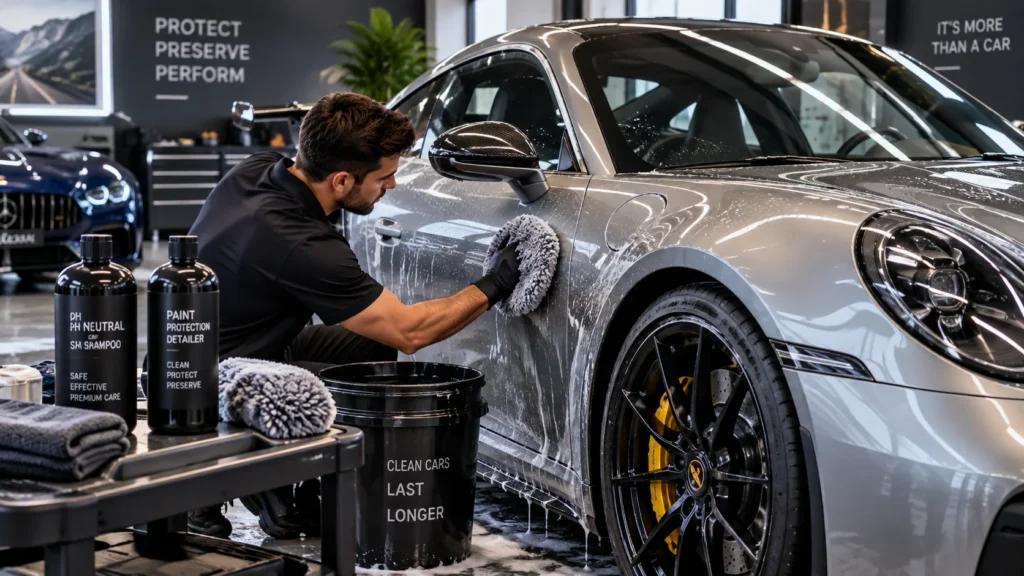
A specialty finish wash routine must include these four steps. pH-neutral shampoo, as alkaline degreasers remove wax, sealant, and ceramic layers more than they remove dirt. Two-bucket method: one bucket with soapy water, one for rinsing your mitt with grit guards at the bottom of each. The rinse bucket is important if you want to get loose grit off your mitt before going back into the soap and dragging particles over the paint.
Your contact media’s quality is as important as its chemistry. Use plush microfiber wash mitts, not sponges, and drying towels that never touch anything but clean paint. A cheap or contaminated towel is one of the most common culprits of fine marring on dark and satin finishes, as those swirl marks stand out under sunlight in ways light colors cannot hide them.
Drying is more important than you thought. Blot and pat-dry rather than dragging, and do it quickly. Mineral etching in water droplets left to air-dry can bite into your finish’s clearcoat within 24 hours. If you’re at risk due to hard water, filtered or deionized water as a final rinse removes most of the danger.
Decontaminate Before You Ever Pick Up A Polish
Washing your car is a good way to rid it of loose dirt, but it won’t eliminate bonded contaminants such as brake dust, rail dust, or industrial fallout that have chemically bonded to the clearcoat. In such cases, you need to use iron fallout removers, which are sulfur-based sprays designed to dissolve ferrous particles. They often turn a visible purple or red color as they react and lift the contamination in real time. For the sticky residue left behind by the road, tar removers are the way to go. They break down the sticky substances so that they can be simply rinsed away.
After using iron fallout and tar removers, you can then move on to the mechanical step, which involves using a clay bar or clay mitt. These work by pulling any of the remaining bonded particles out of the clearcoat, but only when the panel is extremely lubricated using a clay lubricant or soapy water.
If you use clay on a dry panel, you’ll immediately see scratches appear on the paint, which goes against the whole point of using it. When used correctly, however, clay helps to remove contaminants and leaves the paint feeling smooth.
Understanding The Protection Hierarchy
Different types of paint protection have different durability levels and it’s important to use the right cleaner depending on what you’ve got. Carnauba wax gives a warm, deep look but breaks down in a matter of weeks, especially with regular highway driving. Synthetic sealants last longer, usually a few months, and tolerate more frequent washing without stripping as easily.
Ceramic coatings are a different category entirely – an SiO2 nano-ceramic layer that chemically bonds to the clearcoat and can hold up for one to five years depending on the product and application quality. A ceramic coating changes how the paint behaves day to day: water beads and sheets off instead of clinging, dust rinses away more easily, and the surface resists chemical staining far better than bare clearcoat.
That hydrophobic shift also changes what you can safely use on the car. Harsh degreasers or high-alkaline shampoos will shorten a ceramic coating’s lifespan considerably, so once a coating is applied, you’re committed to pH-neutral products and ceramic-safe toppers going forward.
Paint Protection Film sits in its own lane altogether – a thermoplastic urethane film applied to bumpers, hoods, and mirrors that provides actual physical resistance to stone chips and self-heals light swirling with heat. PPF doesn’t stop UV fading or chemical etching the way a coating does; it stops impact damage. Many owners run both: PPF on impact zones, ceramic over the rest of the car, each doing the job the other can’t.
Bird Droppings And Bug Splatter Are Chemical Attacks, Not Stains
You can easily view bird droppings as a minor inconvenience that you’ll wash off next time. But while you leave it, the acidic mess, combined with the heat of the sun baking it onto the surface, can begin to eat through wax, sealant, and even relatively tough ceramic protection within a matter of hours. Bug splatter is a bit like that too – the enzymes in the splat will begin to break down clearcoat almost immediately.
So, in these cases, you should act fast: a blast with a spray of pH-neutral quick detailer or specific bug-and-tar remover, a gentle wipe with a soft microfibre towel and you’ve spared your car from a potential permanent and machine-polishing-requiring etch mark.
Knowing When To Call In A Professional
If you see light swirl marks that still remain after you’ve carefully washed and clayed your vehicle, you may be able to remove these by hand. Lightly apply a fine polish with a soft applicator pad. If you can still see the swirl marks after a hand pass, you should avoid guessing and test the clearcoat instead. The thickness of the paint can be measured by a paint depth gauge (magnetic or ultrasonic) before any machine polishing is attempted.
A professional detailer will determine whether there’s enough clearcoat to safely compound the panel or if the clearcoat is so thin that it will become too damaged. Since you only have 1.5 to 2 mils on most cars, the professional will also use this reading to determine how much clearcoat they have to play with. Owners who skip this precaution and go right to reconditioning their paint with a rotary polisher often take paint right off until they see color with no alternative short of a respray.
A vehicle with a specialty finish deserves not just extra time, but a more deliberate mindset during every phase – washing, decontaminating, protecting, and storing. Once you begin to regard every phase of detailing as a discipline unto itself, the finish that made your vehicle special in the first place will stay that way for years rather than months.