
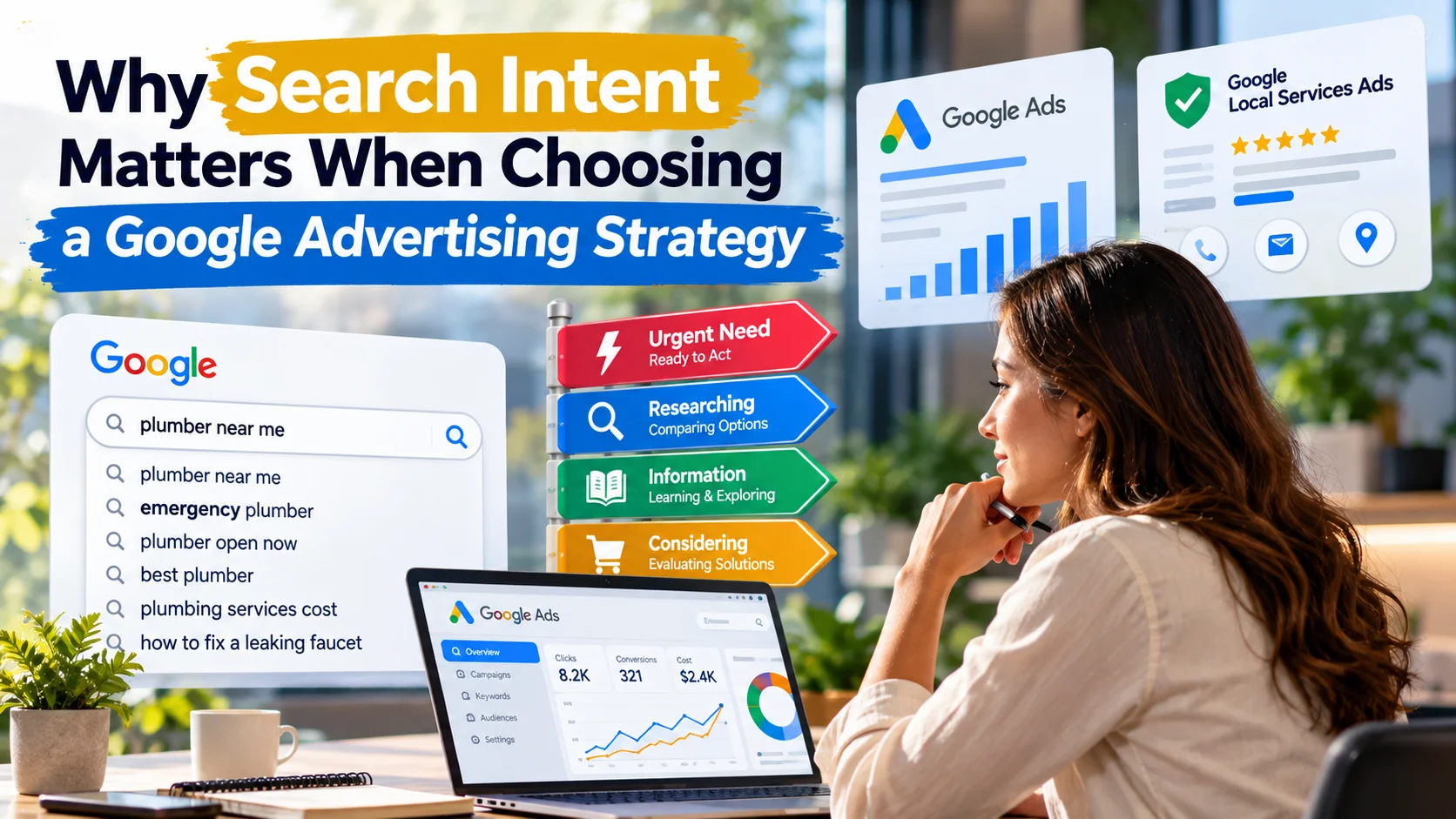

Businesses often approach online advertising by asking which platform is better: Google Local Services Ads or traditional Google Ads. While the comparison is understandable, the more important question is what the potential customer is trying to accomplish when they begin searching. Someone looking for immediate help behaves differently from someone researching options, and an advertising strategy should reflect that difference.
For businesses comparing Google Local Services Ads vs Google Ads, understanding search intent can provide a more useful framework than simply comparing features or costs. The effectiveness of an advertising format often depends on whether it matches the urgency, expectations, and decision-making stage of the person conducting the search.
Not Every Search Represents the Same Opportunity
A person searching online may be at almost any stage of the customer journey.
Someone searching for “how to fix a leaking faucet” may be looking for information and planning to solve the problem independently. Another person searching for “plumber near me open now” is likely dealing with an immediate problem and may be ready to contact a professional within minutes.
Both searches relate to the same industry, but the intent behind them is very different.
This distinction between Google LSAs vs. ads matters because advertising becomes more effective when the message matches what the searcher needs at that particular moment. A customer looking for immediate assistance may not want to read a lengthy educational page. Conversely, someone still researching a significant purchase may need more information before being ready to contact a business.
Consider How Quickly Customers Need to Take Action
Some services naturally involve urgent demand.
Home repairs, emergency services, and other time-sensitive situations often create customers who want a quick solution. These searchers may be less interested in extensive brand storytelling and more focused on finding a qualified provider who can respond.
In those situations, an advertising strategy that makes it easy to contact a business quickly can be particularly valuable.
Other industries involve longer decision-making processes. Legal services, major home renovations, financial planning, and certain healthcare decisions may require customers to research extensively before making contact.
A business operating in these areas may benefit from advertising that supports different stages of the research process rather than focusing exclusively on immediate leads.
The Customer’s Search Terms Can Reveal Intent
Businesses should pay attention to the language customers use when searching.
Terms that include words such as “near me,” “emergency,” “today,” or “available now” may indicate stronger immediate intent. Searches involving “cost,” “best,” “comparison,” or “how does” can suggest that the person is still gathering information.
These patterns are not absolute rules, but they can help businesses understand the mindset behind different searches.
Advertising campaigns can then be organized around the types of needs customers bring to the search process.
Instead of treating every keyword as equally valuable, businesses can consider what action is most likely to follow a particular search.
Match the Advertising Experience to the Search
The advertisement itself is only one part of the experience.
What happens after someone clicks or makes contact should align with their expectations.
A person looking for an urgent service should not have to navigate through several pages before finding a phone number. Someone researching a complex service should not be sent to a page containing only a generic contact form and no useful information.
The landing experience should continue the conversation started by the search.
If the advertisement promises immediate assistance, the next step should make immediate contact easy. If the search suggests someone is comparing options, the destination should provide information that helps them evaluate the business.
Budget Decisions Should Follow Customer Behavior
Businesses sometimes divide advertising budgets based on platform popularity rather than actual customer behavior.
Questions worth considering include:
- Which searches generate customers who are ready to act?
- Which searches lead to longer research journeys?
- How quickly do potential customers typically make decisions?
- What information do customers request before contacting the business?
- Which campaigns produce qualified leads rather than simply generating clicks?
The answers can help businesses allocate advertising resources based on the value of different customer journeys.
Test Instead of Assuming
Search behavior can vary between industries and local markets.
Rather than assuming one advertising approach will always outperform another, businesses can test campaigns, monitor lead quality, and adjust based on actual results.
A campaign with fewer clicks may still be more valuable if those clicks consistently produce qualified customers. Similarly, a high-volume campaign may appear successful until the business discovers that most inquiries do not convert.
The goal should be understanding the quality of the opportunity—not simply generating the largest possible number of interactions.
Key Takeaways
- Search intent helps explain what a potential customer wants at the moment they begin searching.
- Urgent searches often require a faster and more direct path to contacting a business.
- Research-focused searches may require educational content and additional information.
- Search terms can provide clues about where customers are in the decision-making process.
- The landing experience should match the expectations created by the advertisement.
- Advertising budgets should be guided by customer behavior and lead quality.
- Testing and measurement are more valuable than assuming one advertising format will work for every business.