
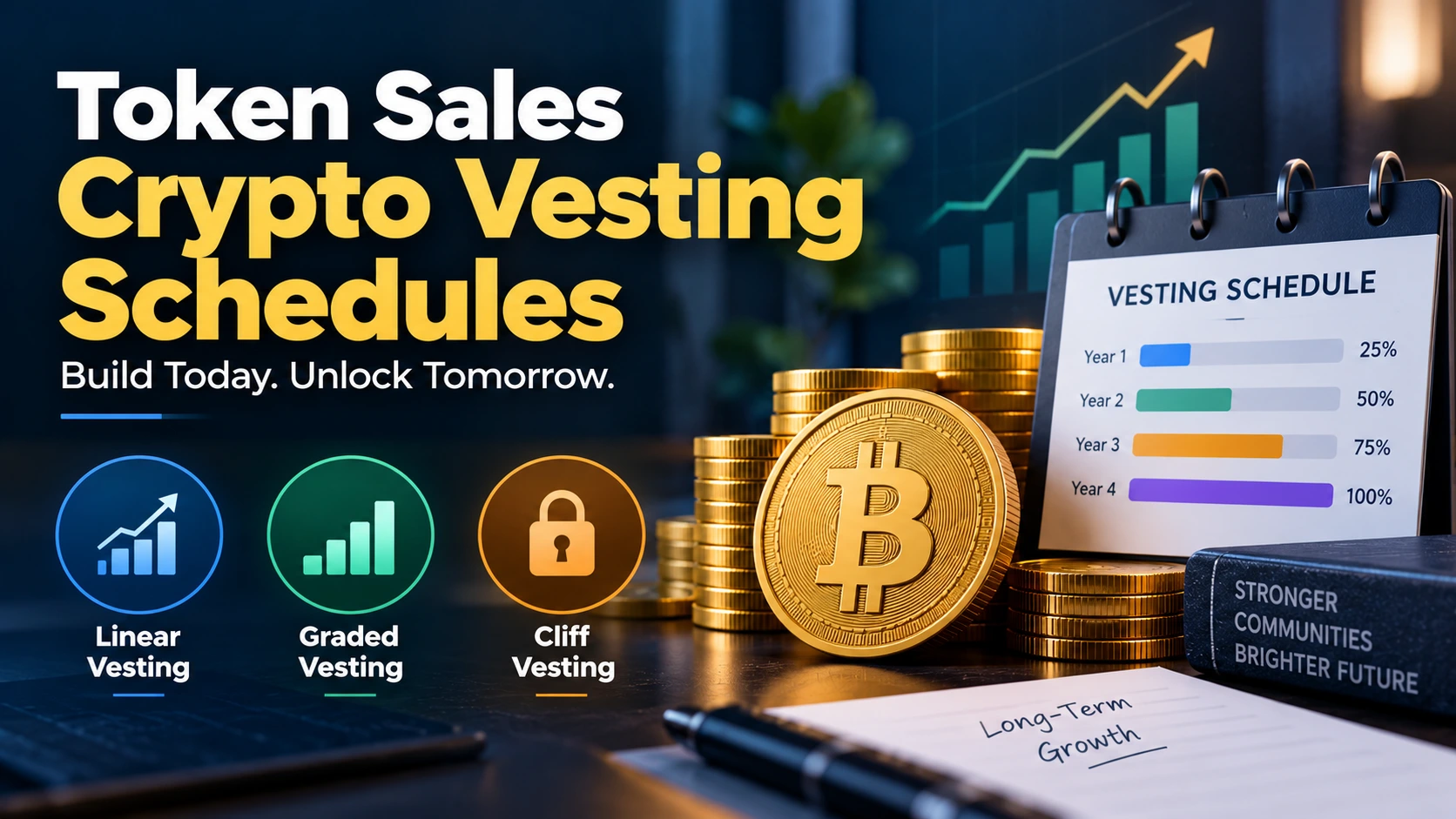

When launching a crypto project, deciding how and when tokens become available can be just as important as determining the total token supply. A crypto vesting schedule sets rules for when allocated tokens become transferable, helping projects manage the release of tokens assigned to founders, team members, advisors, investors, partners, and other stakeholders.
Vesting is particularly common with tokens allocated during private sales, presales, fundraising rounds, and team allocations. Instead of making an entire allocation available immediately, a project can lock tokens and release them according to a predetermined schedule. This can help align stakeholders with the project’s longer-term development and reduce the likelihood of a large amount of supply entering the market at once.
Understanding crypto vesting is therefore important for both project teams and token buyers. In this guide, we explain what a crypto vesting schedule is, how token vesting works, the main benefits, and three common vesting structures: linear, graded, and cliff vesting.
What Is Crypto Vesting?
Crypto vesting is a process that restricts when a token allocation becomes transferable. Rather than allowing recipients to access their entire allocation immediately, a project establishes a schedule that determines when portions of those tokens unlock.
For example, suppose a project’s founding team receives 10 million tokens. The project might place those tokens under a four-year vesting schedule with a one-year cliff. No tokens would become transferable during the first year, after which the remaining allocation could unlock gradually over the following three years.
The exact arrangement depends on the project’s tokenomics and the stakeholder receiving the allocation. A token vesting schedule may specify the initial lockup, cliff period, total vesting duration, release frequency, and percentage released at each stage.
Benefits of Vesting for Token Sales
Why do crypto projects use vesting instead of allowing immediate token sales? A carefully designed vesting schedule can provide several benefits for both project teams and token holders.
- Reduces the risk of immediate sell-offs: Locking a portion of tokens can prevent large allocations from becoming transferable immediately after a token launch. This may reduce short-term selling pressure, although vesting cannot guarantee that a token’s price will remain stable.
- Helps discourage short-term speculation: Investors, founders, advisors, and other stakeholders with locked allocations have a reason to remain aligned with the project’s longer-term development rather than immediately selling their entire allocation.
- Supports healthier token supply management: A predictable release schedule gives the market visibility into when additional tokens may enter the circulating supply. This is particularly important because large unlocks can materially change the amount of a token available for trading.
- Aligns stakeholders with project development: Longer vesting periods can encourage founders, employees, advisors, and early investors to remain committed to the project over time.
- Improves transparency: Publishing the vesting terms before or around a token launch allows potential buyers to understand future token supply changes rather than discovering them unexpectedly.
- Provides time for project development: A vesting schedule can give a project time to develop its product, ecosystem, and community before large stakeholder allocations become transferable.
It is important to remember that vesting is not a guarantee against market manipulation, price declines, or rug pulls. Investors should also examine the project’s team, token allocation, smart contracts, treasury, liquidity, governance, and overall business model.
How Does Crypto Vesting Work?
A crypto vesting schedule establishes the conditions under which locked tokens become available. Depending on the project, those rules may be implemented through a smart contract or documented as contractual obligations managed by the project.
On-chain vesting can automate token releases according to predefined rules. Contractual vesting, by comparison, relies on the issuer or another party to honor the agreed schedule. This distinction is important because investors should understand whether a published vesting schedule is technically enforced or simply a commitment made by the project.
Projects can determine the length of the vesting period and the frequency of token releases. For example, a project could establish a four-year schedule in which tokens remain locked for the first 12 months and then unlock monthly over the following 36 months.
Another project might release a percentage at the token generation event (TGE), followed by a cliff and then regular monthly unlocks. The structure depends on the allocation category and the project’s tokenomics.
Key Terms to Understand Before Choosing a Vesting Schedule
- Token Generation Event (TGE): The event at which a token is created or launched and initial tokens may become available.
- Cliff: A period during which no tokens from a particular allocation become transferable.
- Unlock: The point at which a portion of locked tokens becomes transferable.
- Vesting period: The total period over which an allocation becomes available.
- Tranche: A specific portion of an allocation released at a particular time.
- Circulating supply: The amount of tokens considered available in the market at a given time.
How to Grant Vested Tokens
There are two broad approaches projects can use to distribute tokens according to a vesting schedule.
- Manual vesting: The project maintains a record of its vesting schedule and manually transfers tokens to eligible recipients when the relevant release dates arrive. This approach can work, but it requires careful record-keeping and introduces greater reliance on the project to execute each release correctly.
- Automatic vesting: A smart contract or specialized vesting platform can manage token releases according to predefined rules. When the required conditions are met, the tokens can become claimable or transferable automatically.
For investors, the important question is not simply whether a project says that tokens are vested. It is also worth checking where the tokens are held, who controls the release mechanism, whether the rules can be changed, and whether the schedule is publicly verifiable.
3 Types of Crypto Vesting Schedules to Consider
The right vesting structure depends on the project’s goals, stakeholder groups, fundraising model, and expected token supply. Three commonly used structures are linear vesting, graded vesting, and cliff vesting.
1. Linear Vesting
Linear vesting releases tokens at a consistent rate throughout a specified period. Instead of releasing a large allocation on one date, the tokens are distributed gradually over time.
For example, suppose an investor receives 1.2 million tokens subject to a 12-month linear vesting schedule. If releases occur monthly and the schedule has no cliff, approximately 100,000 tokens could become available each month.
Linear vesting is relatively easy for investors to understand because the release rate remains predictable. It can also reduce the size of individual unlock events compared with a schedule that releases a large allocation all at once.
However, linear vesting still increases the circulating supply over time. Investors should therefore look at the size of each release relative to the token’s existing circulating supply, trading volume, and overall market demand.
2. Graded Vesting
Graded vesting uses different release amounts at different points in time. Instead of distributing exactly the same percentage throughout the entire schedule, the project creates several predetermined tranches.
For example, a project could release 30% of an allocation after six months, another 50% during the second year, and the remaining 20% during the third year. The exact percentages and dates can vary according to the project’s objectives.
This approach gives projects more flexibility than a simple linear schedule. It can be useful when token releases need to correspond with fundraising agreements, project milestones, contributor incentives, or specific phases of development.
The disadvantage is that larger scheduled releases can create more noticeable changes in circulating supply. Projects should therefore model the potential market impact of each tranche before publishing the schedule.
3. Cliff Vesting
Cliff vesting introduces an initial period during which none of the applicable tokens become transferable. Once the cliff ends, tokens may unlock either as a single tranche or according to a subsequent linear or graded schedule.
For example, a project could give its team a four-year vesting schedule with a one-year cliff. During the first 12 months, no team tokens would unlock. After the cliff, the remaining allocation could vest monthly over the next three years.
Cliffs can help align team members and early stakeholders with longer-term project development. They can also delay a potentially significant increase in circulating supply during the early stages of a token’s life.
There is, however, an important trade-off. If a large allocation becomes transferable immediately when the cliff ends, the resulting unlock can create significant short-term selling pressure. For this reason, many projects combine a cliff with gradual linear vesting rather than releasing the entire allocation at once.
Linear vs. Graded vs. Cliff Vesting
| Vesting type | How it works | Main advantage | Main consideration |
|---|---|---|---|
| Linear | Tokens unlock at a consistent rate | Predictable supply increases | Continuous selling pressure may remain |
| Graded | Different amounts unlock at predetermined stages | Flexible and customizable | Larger tranches can create supply shocks |
| Cliff | Tokens remain locked until a specified date | Strong initial lockup | A large unlock can occur when the cliff ends |
Which Crypto Vesting Schedule Should Your Project Choose?
There is no single vesting schedule that works for every crypto project. The best structure depends on who receives the tokens and what the project is trying to achieve.
- For long-term team alignment: A cliff followed by linear vesting can encourage founders and contributors to remain involved over a longer period.
- For predictable supply management: Linear vesting provides a relatively straightforward release curve that is easier for the market to model.
- For customized allocations: Graded vesting can be useful when different stakeholder groups require different release milestones.
- For investor transparency: Whichever model is selected, publish the allocation, initial unlock, cliff, vesting duration, release frequency, and future unlock dates clearly.
What Investors Should Check Before Buying a Token
A vesting schedule is only one part of tokenomics. Before buying a token, investors should examine the entire supply-release structure.
- How many tokens are circulating at TGE?
- What percentage of the total supply remains locked?
- When is the next major unlock?
- Which stakeholder group receives the unlocked tokens?
- How large is each unlock compared with the current circulating supply?
- Are tokens released monthly, quarterly, annually, or through one-time events?
- Can the project change the vesting schedule?
- Is the vesting mechanism enforced by a smart contract?
- Are there additional emissions, rewards, treasury distributions, or ecosystem incentives outside the main vesting schedule?
These questions matter because a token can have a long headline vesting period while still experiencing substantial increases in circulating supply through other allocation categories.
Crypto Vesting and Token Unlocks: What’s the Difference?
The terms vesting and token unlock are closely related but are not exactly the same. Vesting describes the rules governing when an allocation becomes available, while an unlock is the actual release of a portion of that allocation.
For example, a four-year vesting schedule might contain 48 monthly unlocks. Each monthly release represents an unlock under the broader vesting arrangement.
This distinction has become increasingly important because investors regularly monitor token unlock calendars to anticipate changes in circulating supply. Large cliff unlocks and ongoing linear releases can have very different effects on the amount of supply entering the market at a given time.
Final Thoughts
A well-designed crypto vesting schedule can help a project manage token distribution, align stakeholders, and provide greater transparency around future supply. However, vesting should not be treated as a guarantee of price stability or project success.
The three structures discussed above—linear, graded, and cliff vesting—give crypto projects different ways to control when allocated tokens become transferable. Many projects combine these approaches, such as using a cliff followed by linear vesting.
Ultimately, the strongest vesting strategy is one that is clearly disclosed, logically connected to each stakeholder’s role, and designed with the project’s long-term token economics in mind. Investors should also look beyond the vesting schedule and evaluate circulating supply, total supply, future unlocks, token utility, liquidity, governance, and the fundamentals of the project.
Frequently Asked Questions About Crypto Vesting
What is a crypto vesting schedule?
A crypto vesting schedule is a set of rules that determines when allocated tokens become transferable. It can include a cliff, a total vesting period, release frequency, and the percentage of tokens released at each stage.
What is linear vesting in crypto?
Linear vesting releases tokens at a consistent rate over a defined period. For example, an allocation could unlock in equal monthly portions over 24 or 36 months.
What is cliff vesting?
Cliff vesting creates an initial period during which no tokens from a specific allocation become transferable. After the cliff, the tokens may unlock in a single tranche or through another vesting structure such as linear vesting.
Does vesting prevent token price crashes?
No. Vesting can reduce the risk of a large allocation becoming available immediately, but it cannot guarantee price stability. Market demand, liquidity, project fundamentals, token supply, investor behavior, and broader market conditions can all affect a token’s price.
What is a token unlock?
A token unlock is the release of tokens that were previously restricted by a vesting or lockup arrangement. Unlocks can occur as one-time cliff events or through regular linear releases.
Is a longer vesting period always better?
Not necessarily. A longer schedule may support long-term alignment, but investors should also consider how much supply unlocks at each stage, who receives it, and whether the schedule is appropriate for the project’s economics.
Can token vesting be managed by a smart contract?
Yes. A smart contract can hold tokens and enforce predefined release conditions, allowing eligible recipients to claim tokens when the relevant vesting conditions are met. Investors should still verify the contract’s rules and whether the project has administrative permissions that could alter them.