
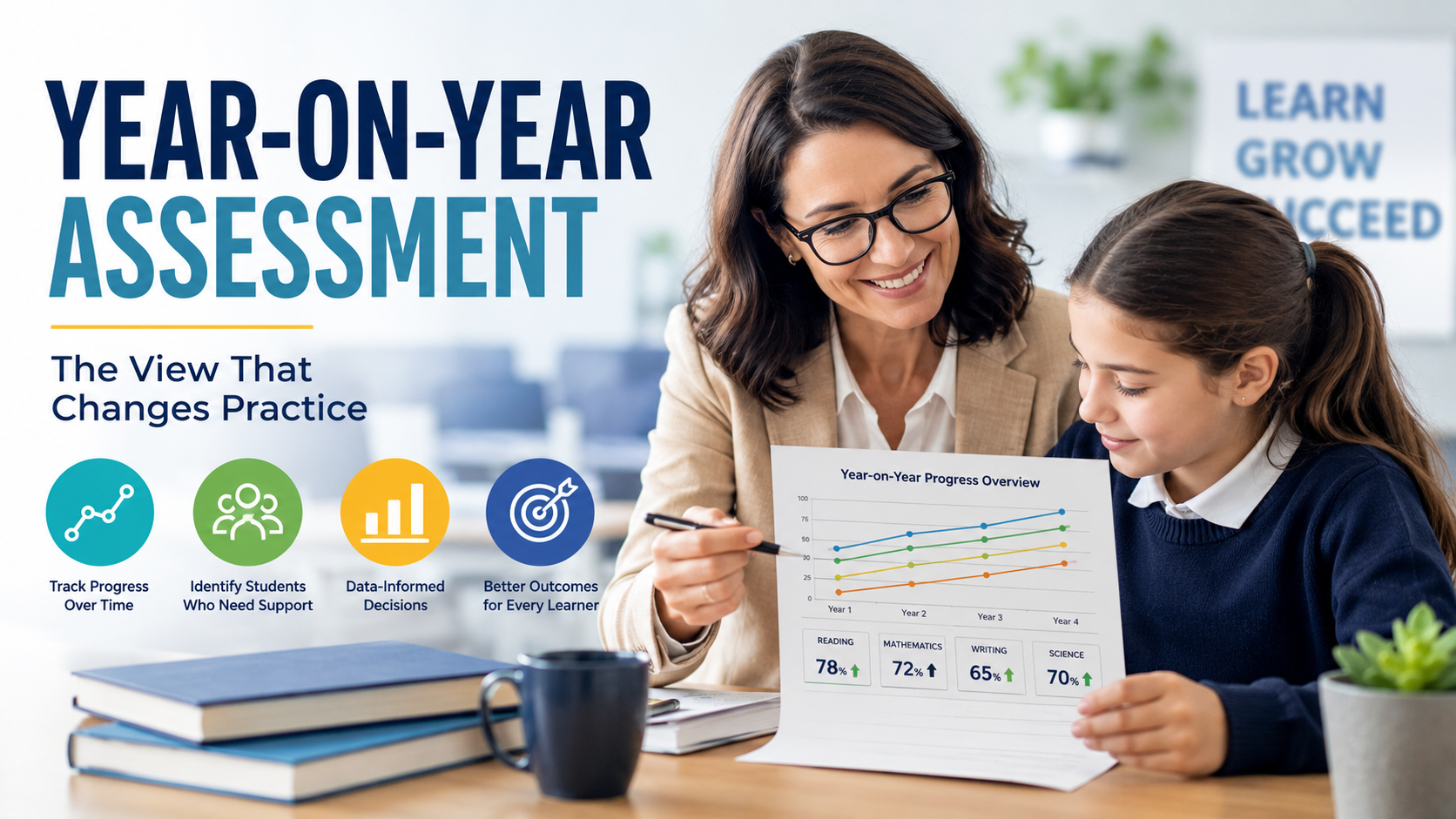

Australian schools are sitting on more assessment data than at any previous point in the nation’s educational history. The challenge is no longer collection. It is interpretation, and more specifically, interpretation across time. The schools making the best use of their data have moved toward something more powerful than the snapshot: a continuous, year-on-year view of student readiness that reveals trajectory rather than position, and equips educators to act well before a quiet drift becomes an entrenched gap.
That shift in practice is both achievable and well supported by evidence. Understanding what it looks like, and what it makes possible, is the starting point.
From Snapshot to Trajectory: What the Evidence Supports
A single assessment score answers a narrow question: where is this student right now? A longitudinal view answers the more consequential one: how has this student’s readiness changed relative to their peers across the past two, three, or four years?
The distinction carries real weight. Position tells you something. Trajectory tells you where a student is heading, and that is what determines whether the right intervention arrives in time to matter.
A 2025 study published in the Australian Journal of Social Issues, drawing on 25 years of national and international standardised assessment results, found that cross-sectional and longitudinal data tell meaningfully different stories about student achievement. Most institutional reporting still defaults to the simpler, cross-sectional picture. That default costs schools the layer of information most useful for planning: the pattern across years.
The good news is that most schools already have the underlying data. The assessment programs are in place. The year levels are being tested. What is often missing is the analytical framework that connects those data points across time, benchmarks them against comparable cohorts, and surfaces the students who are quietly losing ground rather than those who have already fallen.
The Students Who Stay Invisible Without Longitudinal Analysis
When readiness is measured at isolated intervals rather than tracked continuously, a particular group of students tends to go unnoticed. They are not flagged as low performers. Their scores never dip far enough to trigger a support referral. But year on year, their readiness for the demands of the next stage of schooling is quietly eroding.
PISA 2022 data, analysed by the OECD, found that the gap between high and low achieving students in Australia had widened over the preceding decade, with the proportion of low performers in mathematics rising by 6.7 percentage points while the share of top performers declined. That is not a sudden collapse. It is the cumulative result of trajectories that were not being watched at the year level.
Mid-range students, the ones who appear adequate on any given assessment, are especially vulnerable to this pattern. They remain invisible to intervention precisely because they never cross the threshold that would put them on a list. A year-on-year view changes that. It reveals the student who has held steady for two years while the cohort around them has moved ahead, and it does so while there is still time to respond.
What Educators Can Do With the Right Analytical Infrastructure
The obstacle here is rarely motivation or intent. A 2025 study in Behavioral Sciences titled Promoting Data Literacy: Using Social and Emotional Learning Assessment Data to Inform Teaching and Learning, conducted by researchers at the Yale Child Study Center across twelve schools, found that data review sessions were common, but translating data into changed classroom practice was far less so. The study identified the gap between having data and knowing what to do with it as a structural challenge, not a professional one.
Interpreting longitudinal patterns across cohorts, subjects, and year levels requires analytical infrastructure that most school teams were never trained to build and were not resourced to maintain. Recognising that is the first step toward addressing it. The second step is deciding where that infrastructure comes from.
For curriculum leaders and registrars, the practical value of any assessment program is only partially realised at the point of testing. The greater value lies in what happens to the results afterwards: how they are read against prior years, benchmarked against external norms, and translated into decisions about placement, extension, and early support. That is the analytical layer where most school programs currently stop short.
Schools that have addressed this gap have typically done so by moving from treating assessment as a periodic event to treating it as a continuous, interpreted process. The test itself matters far less than the questions asked of the data once it exists: Who has drifted? Against what baseline? Compared to which cohort? And what does the pattern across three years suggest about what this student will need next?
Specialist Assessment Partners: What End-to-End Support Makes Possible
For schools in the independent sector, the infrastructure question has a practical answer. Some schools have responded by engaging specialist assessment providers whose entire function is to design, administer, and interpret testing programs across year levels, sitting with school leadership to work through what the data actually means. An assessment service of this kind removes the burden of analytical interpretation from internal teams who were never equipped to carry it alone, and positions educators to act on evidence rather than instinct.
The value of this arrangement is not simply that it produces reports. It is that it produces interpreted findings: year-on-year comparisons, cohort benchmarks, and flagged trajectories presented in a form that school leaders can act on directly. The data moves from a reporting system that is consulted once to a working document that informs placement, curriculum sequencing, and support decisions before the window for intervention closes.
This is particularly significant for the mid-range students who tend to fall outside conventional intervention frameworks. When the analysis is done well, they become visible. Educators who have the data presented in trajectory terms, rather than as a single year’s score, are far better positioned to make the call that matters: not whether to intervene, but when and how.
What Consistent Year-on-Year Practice Delivers
The schools that use readiness data most effectively share a common characteristic. They have someone charged with watching what the data says from one year to the next, and with raising the question when a pattern looks concerning. The assessment infrastructure supports that person; it does not replace them.
A 2025 Australian policy review published in the Australian Journal of Social Issues noted that none of the National School Reform Agreement initiatives between 2019 and 2023 focused on addressing achievement gaps for equity student groups, despite the agreement explicitly targeting improved academic achievement as an outcome. The gap between policy intent and school-level practice is not new. What is increasingly clear is that year-on-year readiness tracking, done consistently and with proper analytical support, is one of the more tractable tools available to educators who want to close it.
The shift in practice required is neither expensive nor complicated. It begins with a decision: to treat the patterns in assessment data as a film worth watching across years, not a photograph to be filed and moved on from. Educators who make that decision, and who have the analytical support to act on what they see, are well placed to ensure that the gap they can see today does not quietly widen into the one they cannot close tomorrow.