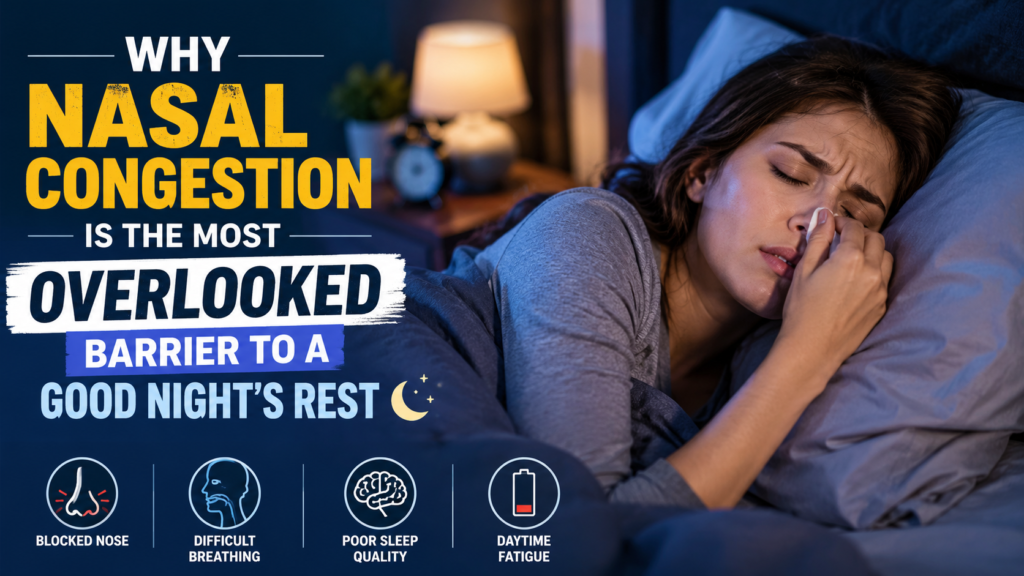
A lot of advice on how to sleep better focuses on the brain (e.g., reduce stress, establish a nighttime routine). But no amount of reading, meditating, or soothing music will help if you’re struggling for air. After all, you can function without eating or drinking for more than five times as long as you can without breathing.
What Lying Down Does To Your Nose
There is a biological phenomenon that occurs each time an individual lies down, and many are unfamiliar with it. Blood flows more readily to the head when one is reclined, along with it the soft tissue inside the nasal cavities (turbinates). The human body operates a natural “nasal cycle” during which airflow dominance shifts back and forth between each nostril roughly every few hours. The issue lies in the fact that this effect is amplified while horizontal, thus with the presence of turbinate hypertrophy, a deviated septum, or nightly histamine allergen activity, the normal swelling patterns reach the point of obstruction.
Side-sleepers are affected differently than back-sleepers, but when the nasal valve (the narrowest point along the entire airway) is already impacted, neither position is neutral. Sleep can still be disturbed even if the nose isn’t entirely blocked.
What You Can Actually Do About It
Environmental triggers are the first thing to address. Dust mite allergens are one of the most common causes of nighttime nasal inflammation. Washing bedding weekly in hot water and using allergen-barrier covers makes a real difference for people whose congestion is worse at home than anywhere else. Keeping the bedroom humidity between 40-50% reduces both dust mite activity and nasal dryness.
When the environment is controlled but restriction persists, the next step is mechanical. External nasal dilators work by physically lifting the lateral walls of the nasal passage outward, increasing the cross-sectional area at the nasal valve without any drug involvement. This matters because medicated decongestant sprays cause rebound congestion with regular use – the nasal lining becomes dependent on the medication to stay open, and the underlying problem gets worse over time.
Rhinogear Nasal Strips use a spring-like band that sits across the nose and gently holds the walls open, which directly addresses the structural narrowing that worsens at night. There’s no rebound effect, no systemic absorption, and the mechanism is straightforward: wider passage, less resistance, less effort required from the airway muscles to maintain flow during sleep.
For people with significant structural issues like a deviated septum, nasal strips won’t fully compensate – that’s a conversation for a clinician. But for the much larger group whose congestion is driven by positioning, inflammation, and valve narrowing, mechanical dilation is the most direct intervention available.
Why Mouth Breathing Is A Trap
When you are unable to breathe well through your nose, your body naturally adapts to mouth breathing as an alternative. While this may seem like a viable solution, in reality, it has far-reaching negative consequences.
You see, nasal breathing triggers the parasympathetic nervous system response, which prepares the body for restful activities like quality sleep. On the other hand, mouth breathing triggers the sympathetic nervous system response, which readies the body for stressful situations, causing alertness and exacerbating any existing stress. As a result, cortisol levels increase, and the body erroneously perceives restricted breathing as a potential danger.
From a chemical standpoint, nitric oxide, a molecule that acts as a vasodilator to improve the lungs’ oxygen absorption capacity, is mostly produced in the nasal cavities. Breathing through the mouth entirely bypasses this crucial step, leading to reduced nitric oxide levels, poorer oxygen absorption by the lungs throughout the night, and technically lower blood oxygen levels, even if you continue to breathe.
Micro-Arousals And The Illusion Of Eight Hours
This is where the link to daytime fatigue is clear. When breathing becomes labored during sleep, the brain doesn’t fully wake up – but it does shift out of deep sleep into a lighter stage to briefly increase respiratory effort. These are micro-arousals, and they can happen dozens or even hundreds of times a night without the sleeper being aware of them.
The result is that someone genuinely sleeps for eight hours and wakes up exhausted, with no obvious explanation. REM sleep – the restorative stage that consolidates memory and regulates emotion – keeps getting interrupted. The architecture of the night is disrupted even though the duration looks fine on paper.
The Floor Under Everything Else
Improved sleep quality is not achieved by piling habits on top of a blocked airway. The airway comes first. Get the hardware in order, then address the software. Everything else you do is predicated on that, and most people are currently optimizing on a terrible foundation.
This is worth sitting with, because it reframes a lot of frustration. If you’ve tried the routines and the supplements and the earlier bedtimes and still wake up feeling like you haven’t slept, the problem probably isn’t your discipline or your mindset. It’s something more mechanical – and mechanical problems have mechanical solutions.
The good news is that the foundation is fixable. For most people it doesn’t require surgery or a specialist. It requires taking the airway seriously as a starting point rather than an afterthought.