

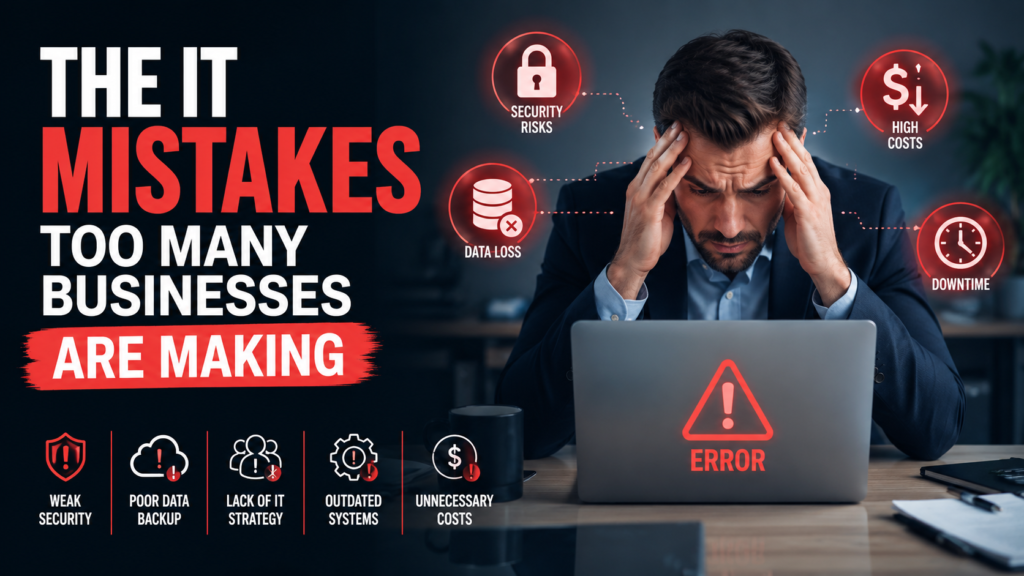
Technology has become the backbone of nearly every modern business. From communication and customer service to operations and financial management, companies rely on IT systems more than ever before. Yet despite this dependence, many businesses continue to make major mistakes in how they approach their IT infrastructure and cybersecurity.
The result is a growing number of businesses facing operational disruptions, ransomware attacks, data breaches, downtime, lost revenue, poor customer experiences, and damaged reputations. Don’t let your business be the next one to make these mistakes by knowing about them.
1. Assuming Basic Protection Is Enough
One of the most common mistakes businesses make is assuming that antivirus software and a firewall are enough to stay protected. However, cyber threats have evolved dramatically over the last decade. Attackers are using sophisticated phishing campaigns, ransomware operations, credential theft, and advanced malware techniques that can bypass traditional defenses. Many businesses still operate with disconnected security tools that do not communicate effectively with one another. This creates visibility gaps that attackers can exploit.
2. Waiting Until After an Attack
Another major IT mistake is treating cybersecurity as a reactive issue rather than a proactive priority. Too many businesses only begin investing seriously in cybersecurity after they have already experienced an incident. By then, the damage may already include:
- Lost customer trust
- Operational downtime
- Financial penalties
- Stolen data
Cybersecurity should never be viewed as something businesses “deal with later.” Threats are constant, and attackers often target smaller and mid-sized organizations specifically because they assume defenses are weaker. Preparation matters far more than recovery.
3. Relying on Too Many Separate Tools
Many companies build IT environments by continuously adding new tools over time. One platform handles email security, another handles endpoint protection, another handles monitoring, and another handles compliance. At first, this may seem manageable. Over time, however, it creates operational chaos.
Disconnected systems can lead to:
- Inconsistent security policies
- Slow response times
- Increased management complexity
- Higher costs
- Alert fatigue
- Missed threats
Instead of strengthening security, too many fragmented tools can actually make environments harder to protect. Businesses need a more unified approach. This is where the Todyl cybersecurity platform is becoming increasingly important for businesses looking to modernize their cybersecurity operations. This combines multiple security capabilities into a centralized solution, including areas such as SASE, SIEM, MXDR, endpoint security, and governance tools. Rather than forcing businesses to manage numerous disconnected products, the platform focuses on consolidation, visibility, and operational efficiency.
4. Relying on Outdated Technology
Many businesses continue using legacy systems and outdated software because replacing them feels expensive or disruptive. However, old systems often become slower, less compatible, harder to maintain, and more vulnerable to problems over time.
5. Dismissing the Importance of Training
Technology is only as effective as the people using it. Many businesses invest heavily in new software, cloud systems, communication platforms, and cybersecurity tools, yet fail to properly train employees on how to use them effectively. Without the right training, even advanced systems can become inefficient, underused, or mismanaged.
Employees may struggle to understand workflows, overlook important features, make avoidable mistakes, or develop inconsistent working practices that reduce productivity across the business. Poor training can also lead to staff frustration, lower adoption of new technology, and increased pressure on IT teams. In some cases, a lack of training can even create security risks if employees do not understand best practices for handling data, passwords, or suspicious activity online.
Businesses should view employee training as an essential part of any IT investment, ensuring teams have the knowledge and confidence needed to use technology efficiently, securely, and productively.
6. Poor Data Management
Many businesses collect large amounts of data without the right systems to properly organize, store, or analyze it. Over time, this can lead to duplicate information, reporting inaccuracies, compliance challenges, and operational confusion across departments. Poor data management can also slow decision-making, as employees may struggle to find reliable, up-to-date information when they need it most. Strong IT infrastructure should help businesses improve visibility, streamline workflows, and use data more efficiently to support growth and better decision-making.
Businesses Need to Take Action Now
The IT mistakes many businesses are making today are not minor technical issues. They are strategic risks that can have serious financial and operational consequences. Don’t let your business be the next one to make these mistakes.