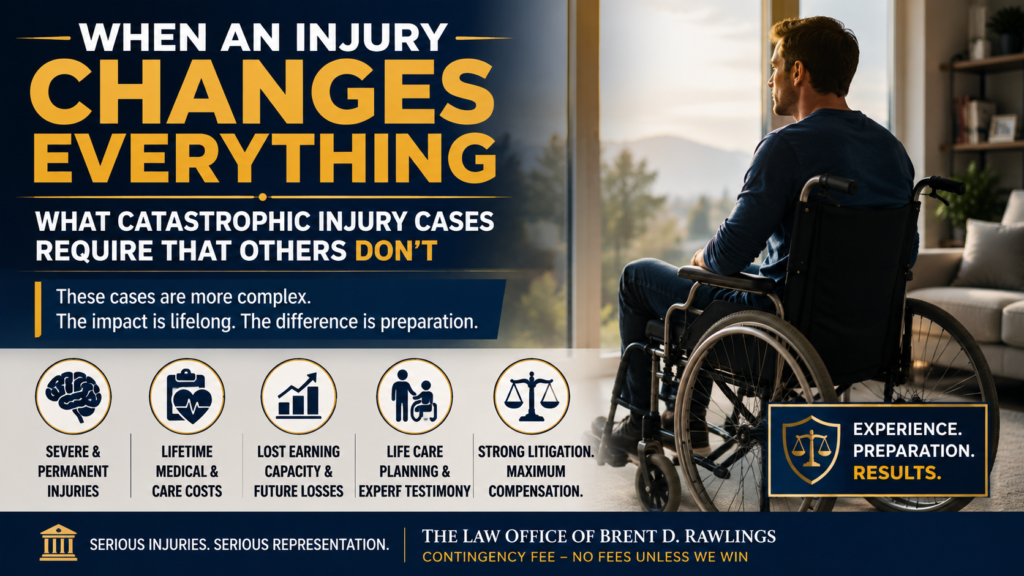
There’s a category of injury that crosses a threshold most accidents don’t reach — where the outcome isn’t a period of recovery followed by a return to normal, but a permanent alteration of what normal looks like. Traumatic brain injuries that affect cognitive function and personality. Spinal cord injuries that result in paralysis or permanent mobility limitations. Amputations. Severe burns. Injuries that require not just treatment but a complete restructuring of how someone lives, works, and moves through the world.
These cases are categorically different from standard personal injury claims — not just in the severity of what happened, but in what proving and recovering the full value of the damages actually requires. The stakes are higher, the complexity is greater, and the gap between what an underprepared claim recovers and what it should recover is wider than in any other category of personal injury case.
A California catastrophic injury attorney at The Law Office of Brent D. Rawlings handles cases at this level with the depth of preparation they require — expert witnesses, life care planners, economic analysts, and the litigation capability to take a case to trial against insurers and defendants who have significant resources to defend against large claims. The firm works on contingency throughout California — no fees unless the case is won. Understanding what these cases involve and why they require a different standard of preparation is the starting point for anyone navigating this situation.
What Makes Catastrophic Injury Cases Fundamentally Different
The damages calculation in a catastrophic injury case extends across a lifetime rather than a recovery period. Future medical costs for someone with a spinal cord injury include decades of specialized care, assistive technology, home modifications, and the ongoing support required for daily functioning. A traumatic brain injury may require cognitive rehabilitation, psychiatric care, and vocational retraining — costs that compound over time and require expert analysis to quantify accurately.
Lost earning capacity is a different calculation in catastrophic cases than in standard ones. It’s not lost wages during a recovery period — it’s the present value of an entire career that either ends or is permanently diminished. For someone injured at 30 with decades of earning potential ahead of them, that figure can be one of the largest components of the claim. Calculating it accurately requires economic expert testimony that projects career trajectory, accounts for inflation and investment returns, and presents the analysis in a form that holds up under cross-examination.
Life care planning is a discipline specific to catastrophic injury cases. A life care planner is a medical expert who develops a comprehensive projection of all future care needs — medical, therapeutic, assistive, and personal — and attaches costs to each element across the injured person’s projected lifespan. That document becomes the foundation for the future damages portion of the claim, and its quality determines whether the recovery actually covers what the injury will cost over time or falls short in ways that the injured person lives with for the rest of their life.
Non-economic damages in catastrophic cases reflect losses that are difficult to quantify but enormous in human terms. The loss of the ability to walk, to work in a chosen field, to participate in activities that defined someone’s life before the injury, to maintain relationships in the same way — these are compensable under California law, which imposes no cap on non-economic damages in most personal injury cases. Presenting them effectively requires more than a description of what was lost. It requires building a picture of who the person was before the injury and what the injury took from them in concrete, documented terms.
Why These Cases Require Litigation Capability
Catastrophic injury claims involve large numbers. Large numbers attract serious defense — insurance companies and defendants retain experienced defense counsel, accident reconstruction experts, and medical experts specifically to challenge the plaintiff’s version of events and the damages being claimed. A plaintiff’s attorney who is not genuinely prepared to take the case to trial, to cross-examine defense experts effectively, and to present a catastrophic injury claim to a jury is negotiating from a weaker position against opponents who know it.
The credibility of the litigation threat is what produces fair settlements in these cases. An insurer facing a catastrophic injury claim evaluates the risk of a trial verdict that could be substantially larger than the settlement being demanded. That evaluation is based on who is on the other side of the case — their track record, their preparation, and their demonstrated willingness to litigate when the offer isn’t fair. Attorneys who settle everything regardless of the number don’t generate that risk calculation in the insurer’s favor.
Investigation in catastrophic injury cases is more intensive than in standard claims. Accident reconstruction may be required to establish exactly how the injury occurred and who bears responsibility. Product liability analysis may be needed if a defective vehicle component or road condition contributed to the outcome. Multiple defendants may share liability in ways that require careful legal analysis to identify and pursue. All of this work happens before a demand is made, and the quality of it determines what the demand can credibly support.
The Law Office of Brent D. Rawlings represents catastrophically injured clients and their families across California — from the initial consultation through the full investigation, expert development, negotiation, and trial if that’s what the case requires. No fees unless the case is won. For families dealing with the aftermath of a life-altering injury and trying to understand what the legal process looks like and what the case might be worth, the free consultation is the right starting point — and it costs nothing to have that conversation.