
Ever notice how the same accident keeps happening in the same spot?
An employee slips by the loading dock. Another person falls in the same spot a week later. Something wasn’t repaired. The hazard was still present causing two injuries instead of one.
That’s what’s wrong with so many work environments. They view injuries as accidents. A box falls off a shelf. Sure, they clean up the spill, but who questions why there was a spill?
Here’s the truth…
When an injury recurs, it is almost never an accident. It’s a failure of the system. And the only way to prevent it permanently is by embedding accountability into your entire team’s safety culture.
If your employer allows a slip and fall injury to occur once, and doesn’t correct the hazard, it is almost certain to occur again. And before you know it, costs can accumulate quickly. Injured employees who have repeatedly been injured because no one addressed the hazardous condition may contact a law office such as Meshbesher law firm to find out about their rights following a preventable slip and fall injury.
The good news?
Building a real accountability system is easier than you think. Let’s break it down.
What you’ll walk away with:
- Why Repeat Injuries Keep Happening
- The Building Blocks Of Accountability
- How To Make It Actually Stick
Why Repeat Injuries Keep Happening
Here’s something most managers miss…
Hazards continue to injure people repeatedly since no one takes ownership of the solution. The spill is cleaned up but the leaking pipe is not fixed. A mat is duct taped down but the poor lighting is never reported.
It doesn’t take a scientist to see that. Falls on the same level rack up about $10.5 billion dollars a year for U.S. employers. They are the second leading cause of serious workplace injuries. That isn’t an anomaly. That is a trend.
Slip and fall injuries are some of the most common — and most preventable — accidents. Think about it. Why do so many businesses continue to react to them as if they were completely unforeseeable?
Why does this keep happening?
- There’s no clear process for reporting hazards
- Nobody is assigned to follow up
- There’s no tracking to spot repeat problems
Sound familiar? If you don’t fix the system, you’ll just keep patching up people.
The Building Blocks Of Accountability
Ok but how do you create a system that prevents repeat injuries? There are a few important parts that need to be mesh.
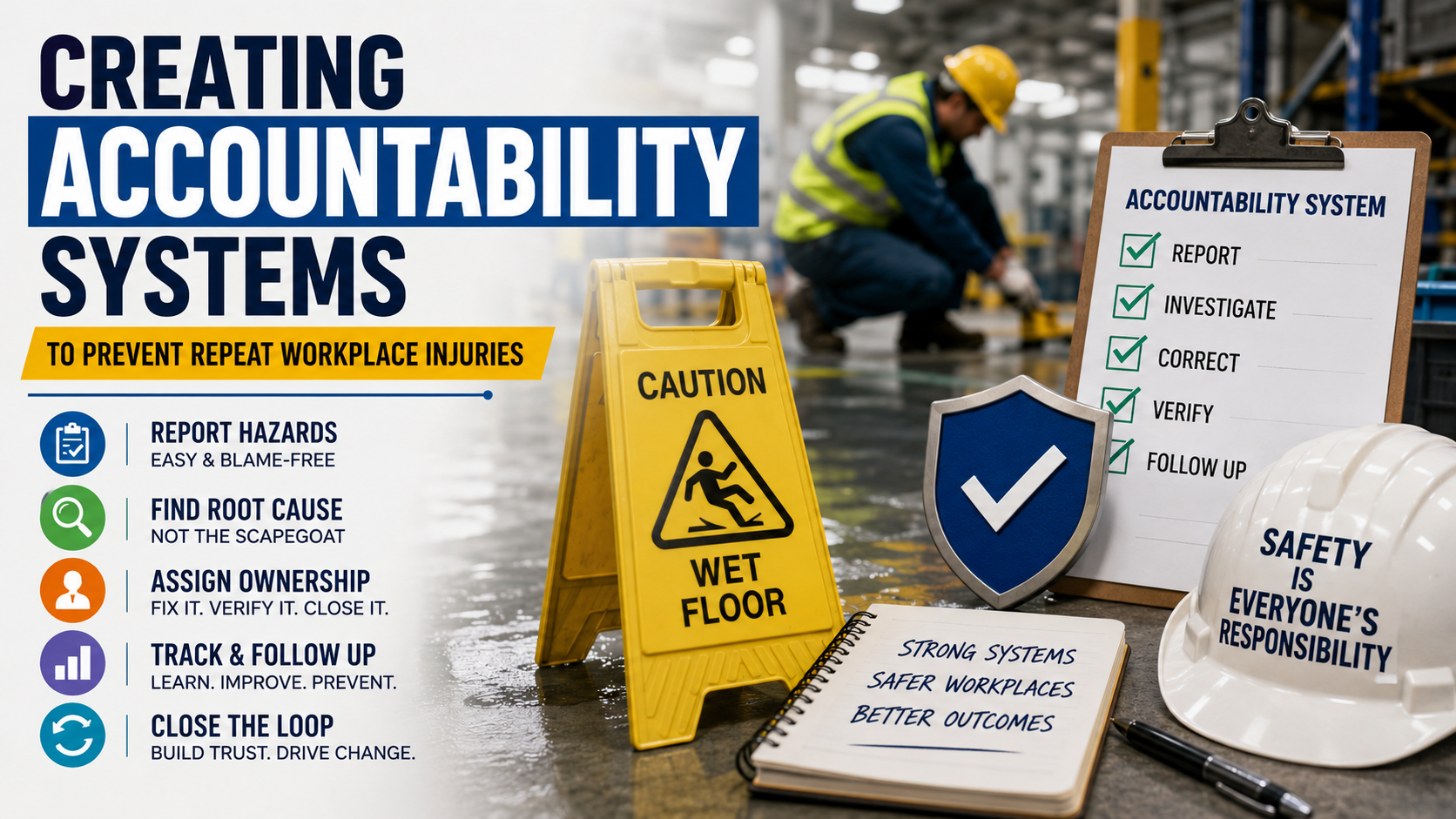
Make Reporting Easy (And Safe)
Here’s where most companies get it wrong…
Employees will never report hazards if they fear retaliation. If hazards aren’t reported, they will never be addressed.
You need a reporting process that is:
- Simple to use
- Quick (no ten-page forms)
- Completely blame-free
Encourage your employees to report near-misses as well. A near-miss is an ounce of prevention. It’s a free warning sign that tells you where the next slip and fall injury will occur before it happens.
Find The Root Cause, Not The Scapegoat
The easy way to react when someone is injured is to blame the employee. “They weren’t watching what they were doing.”
But here’s the thing…
If a worker falls down because of a slippery floor, the question isn’t “why weren’t they careful?” The question is “why was the floor slippery, and why wasn’t it signed?”
Dig into the actual cause:
- Was it a maintenance problem?
- Was it poor lighting?
- Was it a missing handrail or warning sign?
Eliminate the cause and you eliminate the risk to everyone – not just the individual who was injured on this occasion.
Assign Clear Ownership
This is the piece that holds everything together.
All risks must have someone owning them. Someone has to be accountable for the remediation and someone has to verify that remediation occurred.
Without clear ownership, hazards fall through the cracks. With it, things get handled.
A simple ownership system looks like this:
- One person logs the hazard
- One person fixes it
- One person verifies the fix
That’s it. Three jobs, three names, zero confusion.
How To Make It Actually Stick
Creating accountability isn’t enough. Here’s how to maintain it in your day-to-day operations.
Track Everything
You can’t fix what you don’t measure.
Record all injuries, near misses and hazard reports. Then analyze them. Are you having repeated problems with the same machine? Is one shift experiencing many more incidents than the others?
Tracking transforms unpredictable chaos into reliable information. And information tells you precisely where to direct your efforts.
Train Like It Matters
A one-time safety video doesn’t cut it.
True accountability is training that leads to behavioural change. And it has a big impact. A NIOSH-backed study found that providing food service workers with slip-resistant shoes decreased slip-related claims by 67%. One small change. Monumental impact.
The lesson? Small, steady actions beat big one-off gestures every single time.
Hold Leadership Accountable Too
Here’s something a lot of businesses forget…
Responsibility must begin with management. If they turn a deaf ear to safety concerns, so will the employees.
Leaders who take safety seriously and walk the talk will have followers. Safety will no longer be considered a secondary thought.
There’s actual money on the line here. The National Safety Council says that the average serious workplace injury results in seven days away from work. Seven days of lost productivity, lost pay and a hurting employee is all because someone didn’t follow the procedures that were in place to prevent that injury.
Close The Loop
Here’s a step that gets skipped all the time…
Once a hazard has been corrected, notify the crew. Notify the individual who reported the hazard. Notify the employee who was injured.
Why does this matter so much?
Citizens become discouraged from reporting problems if they believe that nothing will come from it. Once they see that their diligent reporting has created actual change, they will continue to voice their concerns. Each complaint is an opportunity to prevent another slip and fall trip to the hospital.
Closing the loop builds trust. And trust is what keeps the whole system running.
Tying It All Together
Repeat workplace injuries aren’t bad luck. They’re a sign that the system is broken.
The fix isn’t complicated, but it does take real commitment. You need to:
- Make reporting easy and blame-free
- Chase the root cause, not the scapegoat
- Assign clear ownership for every single fix
- Track the patterns and follow up
Don’t wait for the second injury to happen. Every slip and fall injury you prevent saves someone actual agony — and saves your business actual dollars.
Build it once and it defends everyone, everyday. Now that is effective accountability.