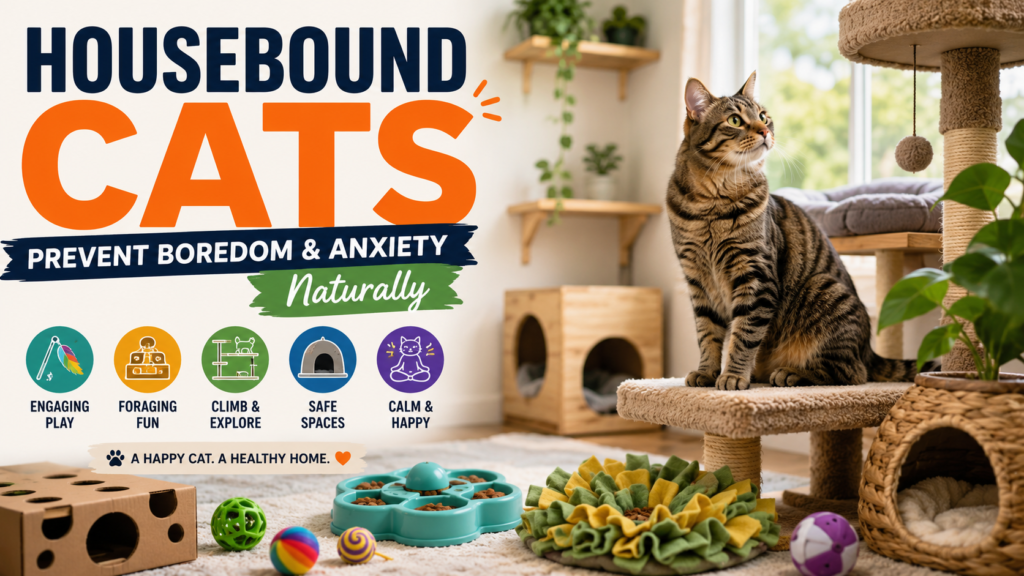
Indoor cats do not inherently lounge about as placid little housemates. They’re solitary hunters trapped in a box with no prey, no risk, and nothing to do. Every flicker of movement outside a window, every unfamiliar scent drifting under a door, is a reminder of a world their instincts are built to navigate but their circumstances deny them.
The body that evolved to cover miles of territory in a night is instead pacing the same twelve feet of hallway. When nothing in their world requires them to express those natural, easy-going instincts, that’s not peace – that’s a locked cell.
Recognizing The Signs Before They Escalate
Early stress indicators are easily overlooked since cats do not exhibit them the way dogs do, by whining, restlessness, etc. Signs are more understated: patches of thinning hair due to excessive grooming, sudden attacks of manic play, or a litter tray going unused. People tend to see clawing as a naughty behavior rather than a reaction to stress.
Over-grooming should not be ignored. A stressed cat will lick the same area repeatedly, sometimes to the point of infection and baldness. If any of these indicators are present, blame the environment first, not the cat.
Structuring Play Around The Predatory Cycle
Cats are predators. As such, their motivation to go after something isn’t just in the chase. They are driven to go through the complete hunt-catch-kill-eat-groom-sleep sequence. Release and feeding is as important a part of the process as pursuing prey is. That stuck-in-red-dot-chasing mode doesn’t just go away if the staring red dot suddenly vanishes.
The best way to play with a cat (indoors or out) is with something that simulates that growth of energy and movement – like dragging a string along the floor, or a toy on the end of a stick that wiggles extravagantly.
The game starts quiet, proceeds with silence, and ends quietly. This mimics the natural hunt and doesn’t just satisfy the cat’s instincts, it exhausts that core and lets the rubber band go back to rest. When it comes to keeping indoor cats entertained, a toy that looks alive (something twitching and wiggling) and encouraging the cat silently is the best way to spend 20 to 30 minutes. Then you should feed your cat a little bit of its meal.
Building Territory Without Adding Square Footage
Cats need adequate, usable space. A cat tree in the corner of a room that nobody walks past is barely better than nothing. Cats need vertical pathways they can actually use to monitor their environment.
Wall mounted shelves, a window perch with a view, and at least one area of height per main room. Hiding spots matter just as much. Covered beds, boxes, furniture with accessible space underneath. It gives the cat the option to withdraw, and having that option even if they never use it reduces baseline stress measurably.
Height means safety for a cat. They will not relax if they are hiding under the furniture worrying that another animal might come along and eat them. They are ambush hunters and have to able to see their whole environment.
Replace The Food Bowl With A Foraging System
A still food bowl doesn’t activate the predator system within cats’ brains. A bowl used for the singular purpose of food strikes cats (who largely hunt small prey) as something’s-wrong-with-this-picture territory.
A puzzle feeder, conversely, does. The limiting factor is your creativity, not your wallet. Muffin tins with tennis balls in the cups, a five-minute snuffle mat, a cardboard toilet paper roller wrapped in duct tape (allergy fighters: use masking tape instead) with dry food stuck in the adhesive, and cutting holes in a clean cardboard box are all simple, inexpensive starters.
The only rule is: cats have to paw, nudge, or lick the device to make food fall out of it. Voilà. They’re working for their eats.
Toy Rotation And Novelty Management
Cats get used to objects. A toy that remains on the floor for a week becomes part of the furniture. Also, a toy that was ignored in January can become the most interesting object in the room in March if it has been stored in the closet since then.
Rotate objects weekly: Keep a box of toys out of reach and rotate what’s available. When you reintroduce something, add a pinch of dried catnip or silver vine to rekindle interest by smell. Olfactory senses are one of the quickest ways to get a cat to focus on an object they have lost interest in.
Also, clicker training goes a long way to help with this. Even a short, two-minute session will teach the cat that what they are doing at that moment has a direct effect. It’s mentally more engaging than static toys.
The behavioral needs of an indoor cat don’t go away because they are indoors. Either the environment we create meets those needs, or it doesn’t, and the cat’s behavior will let us know.