
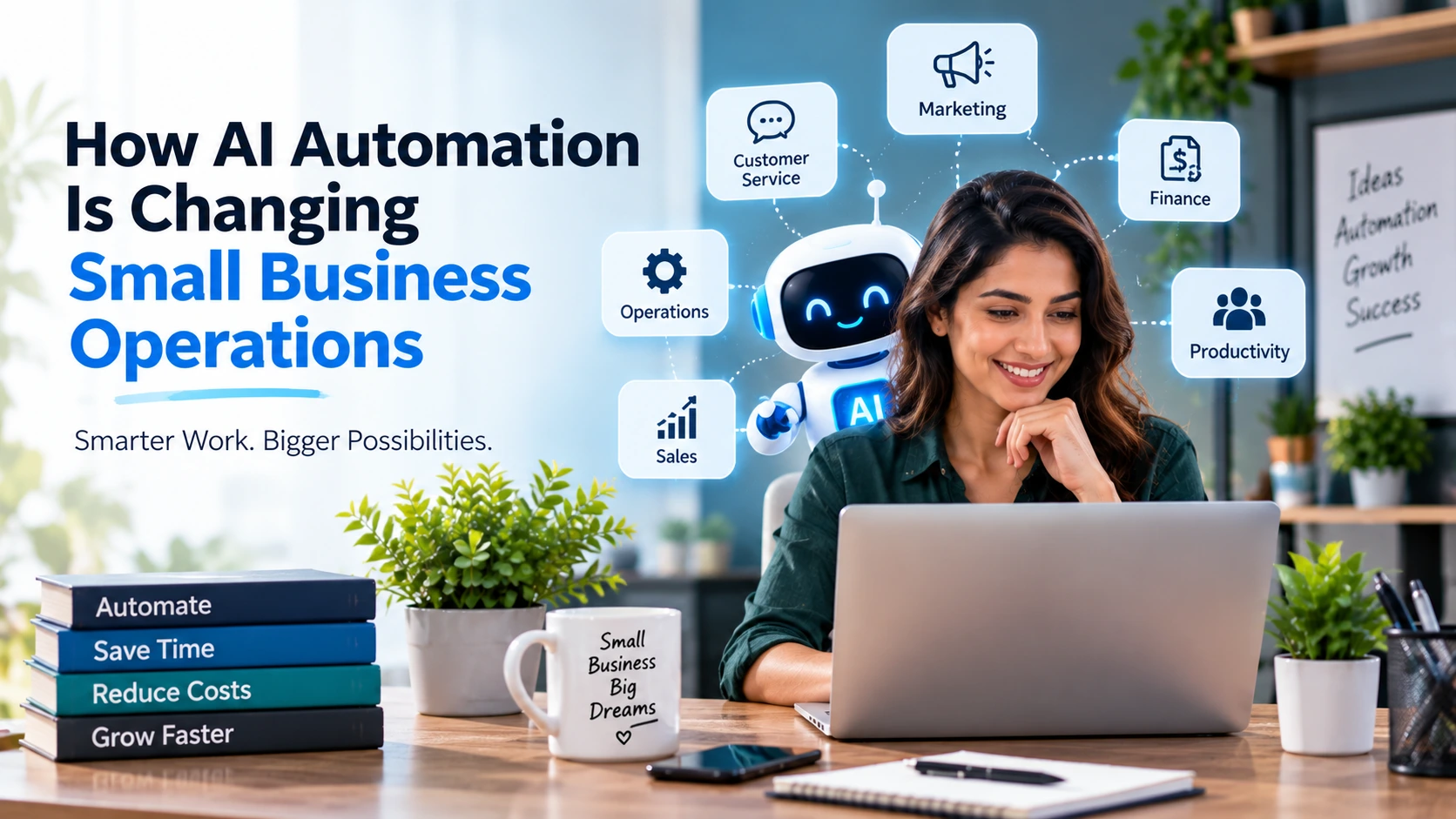

Artificial intelligence is no longer something reserved for large technology companies with massive budgets. Small businesses are increasingly using AI automation to handle repetitive work, respond to customers, organize information, and make everyday operations more efficient.
For a small business owner, the biggest advantage is not simply having access to advanced technology. It is being able to save time, reduce operational costs, and give employees more time to focus on work that requires human judgment.
From automated customer service to AI-assisted marketing and financial administration, AI automation is changing how small businesses operate—and the shift is likely to continue.
What Is AI Automation?
AI automation combines artificial intelligence with automated workflows to complete tasks that would traditionally require human involvement.
Traditional automation usually follows predefined rules. For example, an email system might automatically send a confirmation message whenever someone completes a purchase.
AI automation can go further. AI systems can analyze information, understand natural language, recognize patterns, generate content, and make recommendations based on available data.
A small business might use AI automation to:
- Answer common customer questions
- Sort and prioritize emails
- Schedule appointments
- Generate marketing content
- Analyze sales information
- Summarize documents
- Follow up with potential customers
- Automate repetitive administrative tasks
- Identify patterns in customer behavior
The goal isn’t necessarily to replace employees. In many cases, the more practical goal is to automate repetitive work so employees can concentrate on higher-value activities.
Why Small Businesses Are Turning to AI Automation
Running a small business often means doing more with fewer resources. Owners may have to manage sales, customer service, marketing, accounting, operations, and administration with a relatively small team.
This makes repetitive tasks particularly expensive in terms of time.
Consider a business that receives dozens of similar customer questions every day. An employee could spend hours responding to those messages. An AI-powered system can handle many routine questions automatically while sending unusual or complicated requests to a human employee.
That difference can become significant over weeks and months.
AI automation can help small businesses improve operational efficiency, customer experience, productivity, and scalability without requiring a proportional increase in staff.
1. Customer Service Is Becoming More Automated
Customer service is one of the most visible applications of AI automation.
AI-powered chatbots and virtual assistants can respond to frequently asked questions, provide basic information, help customers find products, and direct inquiries to the appropriate department.
For example, an online retailer could use an AI assistant to answer questions about:
- Shipping times
- Return policies
- Product availability
- Order status
- Payment methods
- Store hours
This doesn’t mean every customer interaction should be automated.
Complex complaints, sensitive situations, and questions requiring judgment are still better handled by people. The strongest approach is often a combination of AI for routine interactions and employees for situations that require empathy or expertise.
2. AI Can Reduce Repetitive Administrative Work
Administrative tasks can consume a surprising amount of time in a small business.
Employees may spend part of their day copying information between systems, organizing documents, writing routine emails, scheduling meetings, or preparing reports.
AI automation can reduce some of this workload.
For example, an automated workflow could receive an inquiry, extract relevant information, add it to a customer relationship management system, and notify the appropriate employee.
Similarly, AI tools can summarize lengthy documents or meetings, helping employees find important information without manually reviewing everything.
The result is not necessarily fewer employees. Instead, employees can spend less time on repetitive processes and more time serving customers or improving the business.
3. Marketing Can Become Faster and More Consistent
Marketing is another area where small businesses are experimenting with AI.
Creating social media posts, email campaigns, product descriptions, advertisements, and blog outlines can take considerable time. AI tools can help marketers generate initial ideas and drafts much faster.
For example, a small business could use AI to:
- Brainstorm content ideas
- Create email subject lines
- Develop social media captions
- Draft product descriptions
- Analyze customer feedback
- Personalize marketing messages
- Repurpose existing content
However, businesses should avoid publishing AI-generated content without reviewing it.
Human editing remains important for accuracy, brand voice, originality, and credibility. AI can accelerate the creative process, but businesses still need people who understand their customers.
4. Sales Teams Can Spend More Time Selling
Salespeople often spend a significant amount of time on administrative work rather than actual selling.
AI automation can help with lead management by organizing customer information, identifying potential prospects, summarizing previous interactions, and suggesting follow-up actions.
For example, when a potential customer fills out a contact form, an automated workflow could immediately record the lead, categorize it, send an appropriate acknowledgment email, and notify a salesperson.
AI can also help sales teams analyze conversations and identify common customer concerns.
This allows employees to spend more time building relationships and less time maintaining spreadsheets and manually updating records.
5. AI Is Improving Business Decision-Making
Small businesses generate large amounts of information through sales transactions, websites, customer interactions, advertising campaigns, and other activities.
The challenge is turning that information into useful insights.
AI-powered analytics tools can identify patterns that may be difficult to spot manually.
A business might use AI to examine:
- Sales trends
- Customer purchasing behavior
- Marketing performance
- Website activity
- Inventory movement
- Customer feedback
- Revenue patterns
For example, an online retailer may discover that certain products sell particularly well during specific periods. The business can then use that insight to improve inventory planning and marketing campaigns.
AI doesn’t eliminate the need for human decision-making. Instead, it can give business owners more information to work with.
6. Financial Administration Can Become More Efficient
Accounting and financial administration contain many repetitive processes that can potentially be automated.
AI-enabled financial tools can assist with tasks such as expense categorization, invoice processing, transaction analysis, and financial reporting.
For a small business, even modest improvements can make a difference.
Instead of manually entering every piece of information, employees may be able to review automatically processed data and focus on exceptions that require attention.
That said, businesses should be particularly careful when using AI for financial information. Sensitive data should be protected, and important financial decisions should be reviewed by qualified professionals where appropriate.
7. AI Automation Can Help Small Businesses Scale
One of the biggest advantages of automation is scalability.
Imagine a business that receives 50 customer inquiries per day. If the company grows to 200 inquiries, manually handling every request may require additional employees.
Automation can absorb some of the increase.
The same principle applies to marketing, sales administration, reporting, appointment scheduling, and other repetitive processes.
This means a small company can potentially handle a larger workload without increasing its operational complexity at exactly the same rate.
For growing businesses, that can be a significant competitive advantage.
8. Employees Can Focus on Higher-Value Work
There is an understandable concern that AI automation will eliminate jobs. But for many small businesses, the immediate impact is more likely to involve changing how employees spend their time.
If an employee previously spent three hours each day performing repetitive administrative tasks, automation could potentially reduce that workload.
Those hours could instead be used for:
- Customer relationships
- Product development
- Sales
- Strategy
- Creative work
- Problem-solving
- Employee development
The real value of AI automation is therefore not simply doing tasks faster. It is helping businesses redirect human effort toward activities where people add the most value.
9. AI Automation Can Improve Customer Personalization
Customers increasingly expect businesses to understand their needs.
AI can help small businesses analyze customer information and deliver more relevant experiences.
An e-commerce business, for example, could use AI to recommend products based on browsing or purchasing patterns. A service business might use customer history to personalize follow-up communications.
Personalization can also be applied to email marketing, product recommendations, and customer support.
However, businesses need to use customer data responsibly and comply with applicable privacy requirements.
10. Cybersecurity and Risk Management Are Also Changing
AI is increasingly being used to identify unusual patterns and potential security threats.
For small businesses, this can be especially valuable because they may not have large internal cybersecurity teams.
AI-assisted security systems can help identify suspicious activity, unusual login behavior, potentially malicious messages, and other warning signs.
However, AI should be viewed as one layer of a broader security strategy.
Strong passwords, multi-factor authentication, employee training, software updates, backups, and access controls remain important.
Challenges Small Businesses Should Consider
Despite its advantages, AI automation isn’t a solution to every business problem.
There are several issues small businesses should consider before implementing AI.
Data Privacy
AI systems may process customer, employee, or business information. Companies need to understand how data is stored, processed, and protected.
Accuracy
AI systems can make mistakes. Generated information should be reviewed when accuracy is important.
Implementation Costs
Some AI tools are inexpensive, while more advanced systems may require integration, customization, or professional support.
Employee Training
Employees need to understand how to use AI tools effectively and when human review is necessary.
Over-Automation
Automating every possible interaction can make a business feel impersonal. Customers often still want to speak with a real person when dealing with complicated problems.
How to Start Using AI Automation in a Small Business
Small businesses don’t need to automate everything at once.
A better approach is to start with one repetitive process that consumes significant time.
Step 1: Identify Repetitive Tasks
Make a list of activities employees perform repeatedly.
Look for tasks involving:
- Copying information
- Answering identical questions
- Scheduling
- Data entry
- Reporting
- Email management
- Content production
Step 2: Choose One Practical Use Case
Select a process where automation could produce a measurable improvement.
For example, a business could start by automating appointment reminders rather than attempting to automate its entire customer service operation.
Step 3: Measure the Results
Track how much time the automation saves and whether it improves the customer experience.
Useful measurements might include response time, employee hours saved, conversion rates, or customer satisfaction.
Step 4: Keep Humans Involved
Create clear rules for situations that should be transferred to an employee.
This is particularly important for customer complaints, financial decisions, sensitive information, and other high-impact situations.
Step 5: Expand Gradually
Once one automation works reliably, the business can look for other processes that could benefit from similar technology.
The Future of AI Automation for Small Businesses
AI automation is likely to become increasingly integrated into everyday business software.
Instead of using separate AI applications for individual tasks, businesses may increasingly encounter AI features built directly into customer relationship management platforms, accounting software, communication tools, marketing systems, and other applications.
The most successful businesses won’t necessarily be those that use the most AI.
They will likely be the businesses that identify the right problems to solve with AI while maintaining strong human oversight.
Automation works best when it supports a clear business objective rather than being adopted simply because the technology is available.
Final Thoughts
AI automation is changing small business operations by reducing repetitive work, improving access to information, supporting customer service, and helping employees work more efficiently.
For small businesses operating with limited time and resources, these improvements can have a meaningful impact.
The key is to approach AI strategically. Start with repetitive, measurable tasks, protect sensitive information, review AI-generated results, and keep people involved where judgment and human connection matter.
Used thoughtfully, AI automation can give small businesses more time to focus on what technology cannot replace: building relationships, solving meaningful problems, and creating better experiences for customers.