
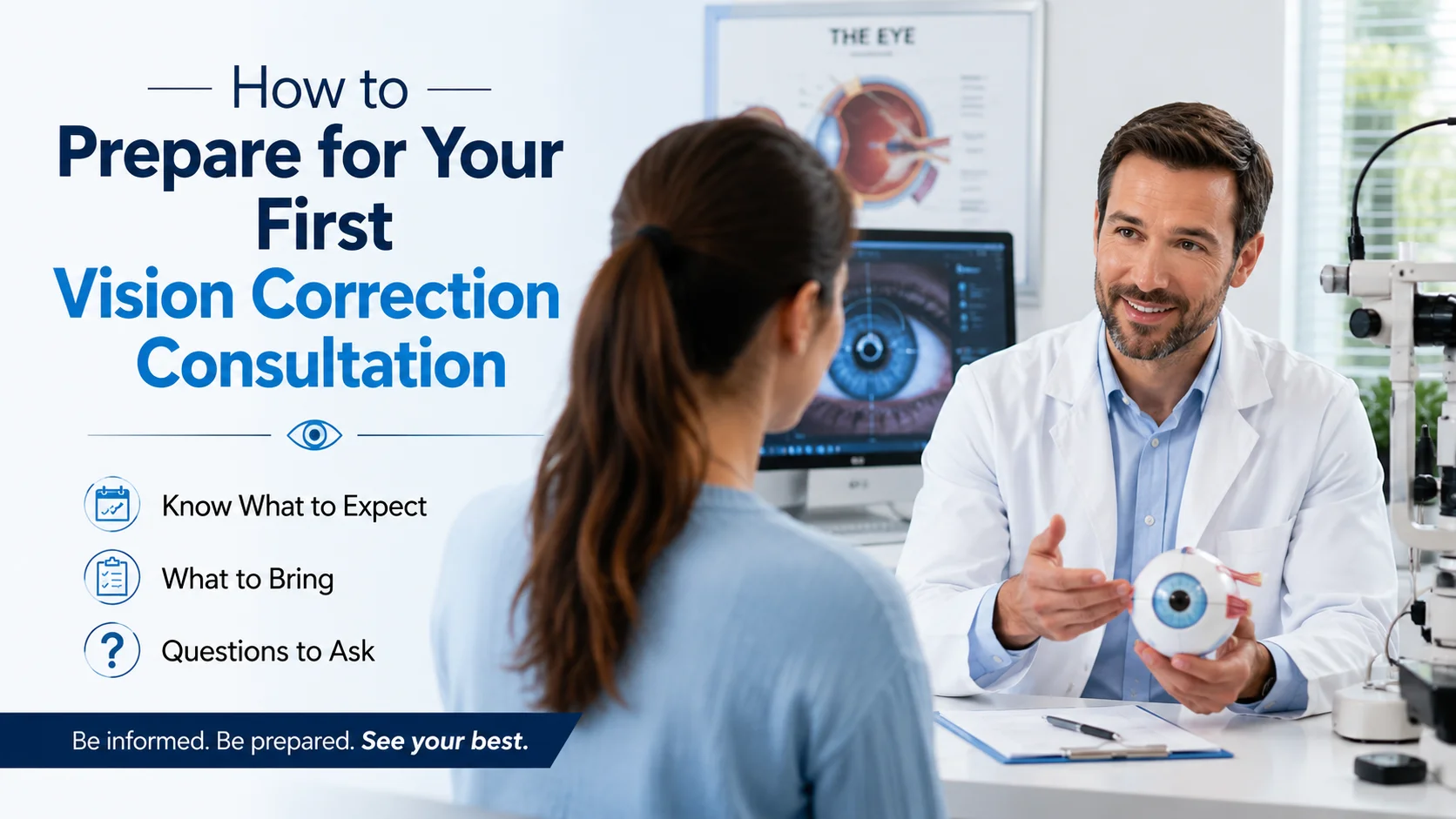

Many people think the first appointment is a ten-minute meet-and-greet and a quick penlight-to-the-eyes. It’s not. The consultation is a full diagnostic workup – a mutual interview in which the clinic is examining your eyes, and you are determining whether you trust these people to operate on them. The amount of reading you do in advance will determine whether you walk out with a certain yes, a solid no, or a tentative maybe.
Stop wearing your contacts before you go
The most common self-sabotage tactic we see among patients. Here’s the deal: your contact lenses rest on the surface of your cornea. And, over time, physically push down on top of it too. When you take them out, your cornea has to rebound to its natural shape. The problem? This takes days. Sometimes even weeks, depending on the type of your lenses.
For soft lenses, you should stop wearing them two weeks before your consultation. For our friends who wear rigid gas-permeable lenses, you’ll have to play the waiting game for longer. Sometimes up to four or more weeks. If you fail to take this break and let your cornea recover – roughly meaning, if your eye is scanned while still in that distorted state from the lens – your baseline measurements are inaccurate. And your whole surgery plan can’t go through as intended. Normally, that leads to a reschedule of your entire slot.
What to bring with you
Make sure to bring all your current eyeglasses, your prescriptions from the last two to three years, a list of all your current medications, and details of any old or current illness which might have affected your eyes or immune response. E.g., autoimmune diseases, diabetes, etc.
If you are currently pregnant or breastfeeding, you must disclose it because this affects the shape of your cornea and, hence, the prescription. Generally, most surgeons won’t treat you until twelve to twenty-four months after pregnancy or finished breastfeeding. If you want to learn about vision correction surgery before your appointment, doing that reading early will help you understand why stable prescriptions matter so much.
The surgeon also needs to rule out conditions like thin corneas, dry eyes, large pupils, glaucoma, or cataracts, which may influence the decision or cause problems during surgery. Most places will do all of these checks during your consult. But if you can collect the info yourself, all the better.
Arrange a ride home
Having drops put in your eyes and then being unable to drive is inconvenient, but it is a necessary precaution. The drops can cause your pupils to dilate for at least four to six hours. This will affect how well you see and how sensitive to light your eyes are. The light-sensitive part can be especially dangerous, depending on the time of your appointment. If it’s in the evening, the drive home could easily be impacted by the reduction in how well you see in low light.
The diagnostic tests and what they’re measuring
The eye exam encompasses more details than a routine eye check. Here’s what to expect and why each specific evaluation matters.
Corneal topography maps out the contours of your cornea in intricate detail. It’s one of the standout tests in this sequence as it highlights irregularities that disqualify patients from laser surgery and indicates to the operating physician which surgery your physiology calls for.
Central corneal thickness is precisely what the measuring of your cornea’s thickness refers to. Since the laser is removing corneal tissue, there must be enough tissue available to remove safely. Logic stands that if it’s too thin, laser ablation isn’t an option.
Refraction testing determines your specific kind of refractive deficiency that needs to be corrected – whether that is myopia, hyperopia, or astigmatism.
Tear film and dry eye assessment draws attention to an already existing condition. If you have dry eyes pre-surgery, they may only get worse post-surgery. Addressing them in advance at least gives a heads-up to the surgeon. At best, they may decide to try to account for them in the chosen treatment or rule you out for the specific surgery.
Questions to ask the surgeon
The conversation goes both ways. While the clinical team is examining your eyes, you should be examining the practice. Come with a short list of questions – not twenty, but four or five sharp ones.
Ask which laser platform they use specifically, and why. Ask what their complication rate is and how they approach complications when they arise. Ask the surgeon directly how many procedures they’ve done. Ask what the day of the surgery is like – the schedule, the sensations, the duration. Ask what the first week of recovery is actually like, not the best-case scenario.
More than 95% of LASIK patients were satisfied with their vision outcomes in a 2017 FDA report – the kind of statistic that’s quoted in the industry all the time. But that number doesn’t mean zero complications, and a surgeon who is open about that is more reliable than one who leads with the 95%.
Be honest about your lifestyle
If you are open about how you need your eyes to function in everyday life, they will guide you to the best treatment plan. If you spend your day looking at a computer, you might not be a great candidate for the more expensive, glamour-laden treatment. If you wear safety goggles or are in the military, you may not want flap-making technology and the daily drop that comes with it.
The surgery will probably still be an option, but this extra info will direct you to the type of surgery that will give you the best outcome with the least amount of hassle.