

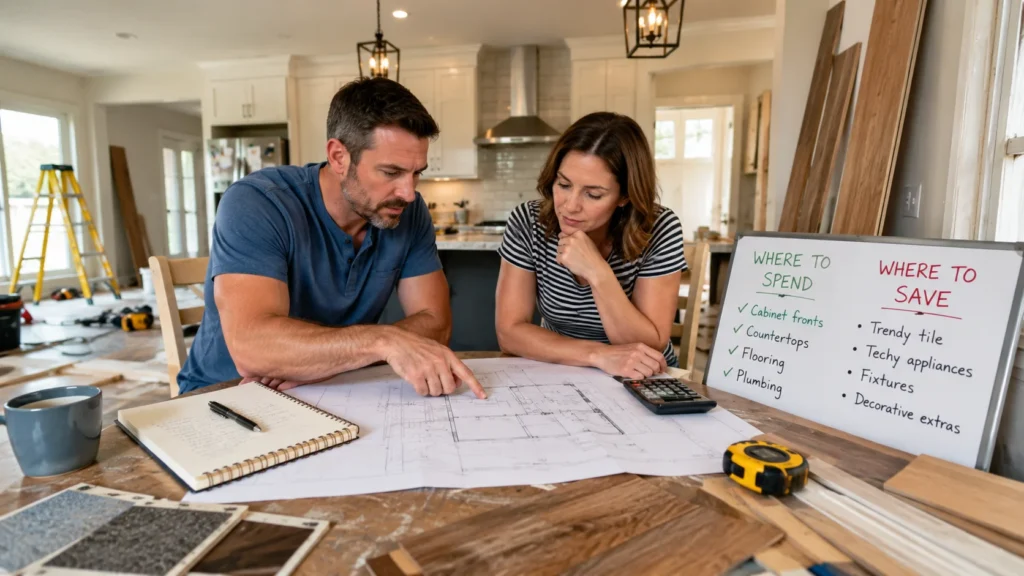
Each dollar you invest in a renovation is essentially going to war with every other dollar to win back the same assignment: returning to home base when you close. There are a few upgrades that almost always pay off. Then there are these. They make your house nicer while you’re there. The key to a high-ROI renovation budget is knowing what group you’re spending on before you write that check.
What “High-ROI” Actually Means
A remodel with high ROI recoups most or all of its cost based on how much the value of your home increases. That’s the only math that matters. The appraiser who determines how much your home is worth to the bank isn’t impressed by your remodeling choices. He grades you on square footage, room count, and other guidelines that define his algorithm. That said, some upgrades tend to bring more money at sale than others. Most of us aim to make those upgrades. A bathroom for every bedroom is a high ROI remodel. Two master bedrooms, in the appropriate location, is a very high ROI remodel. A pool, historically, is not. A pool with Viking appliances is still not.
The Data Says Surfaces Beat Showpieces
Remodeling magazine’s Cost vs. Value Report has been following repayment for quite a long time, and the pattern remains constant across most releases: unassuming, surface-level projects reliably beat luxury remodels. Replacing or restoring wood flooring has traditionally recovered approximately 106% of its cost when resold, which means it can pay for the entire project (Remodeling magazine, Cost vs. Value Report). Compare that to a major upscale kitchen remodel, which often fails to recover even 60% of your expenses.
A lot of homeowners are surprised by this difference. The intuition is that the largest, most costly space deserves the biggest budget. In fact, buyers thank you for projects that are finished and low-risk more than projects that feel pricey. For example, a quartz waterfall island can cost five figures and almost certainly not raise your sale price if the surrounding floors are obsolete or incompatible.
This does not mean you should skip the kitchen. This means that you need to spend in the kitchen with the same level of control as in other rooms.
Where to Spend in Kitchens and Bathrooms
Kitchens and bathrooms continue to be the most important rooms where you can spend your renovation budget. However, even then, it’s important to spend strategically. Here’s where to save and where to splurge.
SPLURGE: Items you can’t easily change after move-in These are the things that are worth spending more money on because they are expensive and/or disruptive to replace. And, because they tend to be the first things new homeowners want to change, buyers will calculate replacement costs into their offer.
Cabinet fronts: Upcycling old cabinets with paint and new hardware is trendy, but eventually, you’re going to want something more modern. Countertops: Replacing cabinets means replacing counters, too, so these should be done at the same time. Flooring: Good floors make or break a room.
SAVE: Items that are easy to change or date quickly Any of those features that are easy to change post-sale, or that will be obsolete in the next five years, should be done as cheaply as possible. So whatever you do, resist the siren song of the smart fridge.
Trendy tile patterns, techy appliances, and fixtures are smart places to save your budget. A herringbone accent wall behind the range might be Pinterest-perfect, but it will also virtually date your kitchen to 2018. Most buyers won’t know the difference between a bargain range hood and the one you imported from Italy. They will, however, be wowed by the fact that your kitchen floor is heated.
Hardwood and Engineered Hardwood: The Strongest Floor Investment
Invest more on the floors of the major living areas in your house. Prospective buyers expect to find hard surface flooring in the entrance, living area, and kitchen when they enter a home. Carpeting in those areas seems outdated even before buyers finish the tour and in numerous markets, real estate agents often inform sellers that used carpeting results in a price reduction rather than just a shrug.
Solid hardwood remains the optimal choice. This is the image most buyers have of a ‘nice house’ and it can receive multiple refinishings over its lifespan. In contrast, engineered hardwood is a more practical solution when there are concerns with moisture, radiant heat, or for a house with a slab foundation since solid wood isn’t the best option in those cases. Engineered hardwood provides the same visual warmth and satisfies buyers at a lesser installation cost and with far superior dimensional stability.
At this stage, numerous renovation manuals would suggest that you “look around”. Instead, we would advise you to look for quality first, and then compare the costs from suppliers who concentrate specifically on it. A supplier like Premium Prestige Flooring that focuses on hardwood and engineered hardwood usually offers better grading and more uniform milling, and generally employs installers who have handled hundreds of such projects compared to only a few installations. Flooring is among the few categories of renovation where the quality of the product is easily seen by potential buyers, it is not the place to save costs on a low-quality source.
LVP, Tile, and Where “Save” is the Smart Move
You don’t need to use premium hardwood on every floor of the house, and trying to do so is a waste of the budget you set for yourself. Luxury vinyl plank is a solid alternative for basements, rental units, kids’ rooms, or anywhere that moisture or heavy use is likely. It looks enough like wood that most buyers won’t notice, and it stands up to water and impact far better. Plus, it’s a fraction of the price. Using LVP in a basement isn’t a cheap-out. It’s the right call.
Tile and porcelain have earned their spot in bathrooms, entryways, and mudrooms. Water and dirt are non-negotiable in those locations, and buyers expect a hard, easy-to-clean surface. Nobody walks into a bathroom thinking that there should have been hardwood installed. So, there’s no ROI penalty for doing the right thing there. The penalty is to use cheap carpet or flyweight sheet vinyl in those spots to save a few dollars, and everyone knows it’s a shortcut the second their agent points it out.
If there is one thing that takes down the ROI of a mid-tier product faster than anything else, it’s using too many of them with no rhyme or reason all over the house. Hardwood in the living room, different wood-look laminate in the hallway, tile in the kitchen, carpet in the office, that tells buyers and appraisers that you might have cut some corners. They’ll wonder if the furnace is a cheap last-minute patch, too. Pick a palette and stick to it in connected spaces.
Check Your Neighborhood Before You Check Your Wish List
Before you settle on any budget, take a look at what is actually moving in your vicinity. A $40,000 kitchen in a $250,000 homes neighborhood will not make $40,000 at the time of sale, regardless of how good it is. Buyers in that budget aren’t comparison shopping the homes with waterfall countertops, so you’re paying for a standard that the local market doesn’t back up.
Similar reasoning goes for flooring selections. If every equivalent home on your block has engineered hardwood in the main living sections, then you need to follow that norm to protect your value. Going slightly above it, for instance, rare imported wood species, will only spend money that won’t come back. Going slightly below it, i.e. maintaining the worn-out carpet instead of hard surfaces that the other homes on the block have switched to, will hurt you. The idea is to match the neighborhood standards, not exceed them.
The Hidden Cost That Quietly Kills Flooring ROI
Preparation of the subfloor is often overlooked in flooring projects. Old subfloors may be uneven, have moisture problems or squeak. Just installing a new floor over an existing one will not guarantee that the old problems won’t persist and the new floor will also have these issues. The old subfloor will just make the new one look worse.
A moisture test should not be skipped before installing hardwood on a slab. Skipping a level subfloor before setting LVP is a common reason an investment in new floors doesn’t pay back as expected. Most underlayment and subfloor prep cost can be treated as a fixed cost of the project. It is not an optional expense. Most of it doesn’t add much to the final bill and it is simply the cost of doing it right versus suffering through a new floor showing wear after just a few years.
Where DIY Makes Sense, and Where it Doesn’t
Putting in the work yourself is satisfying, keeps costs down, and can be a great way to bond with your new space. However, there are some tasks that can’t be learned properly over a few YouTube tutorials or one weekend on the job site. Painting, light demolition, removing old carpet, and basic landscaping clean-up are safe places to save labor cost, because mistakes there are easy to fix and low-stakes.
Flooring installation isn’t on that list. Neither are cabinets or anything involving waterproofing. A slightly uneven hardwood installation, a poorly sealed tile joint in a bathroom, or a botched vinyl seam are the kinds of flaws a home inspector will flag and a buyer will use to negotiate price down, sometimes by more than the labor cost would’ve been. Professional installation on permanent, visible surfaces protects the investment you already made in the materials.
Selling the Result
After all the labor is finished, how the property is seen in photographs is nearly as important as how the improvements are constructed. Bright, wide-plank flooring in a neutral tone appears inviting in real estate shots and in person, and it inherently makes rooms appear more spacious and in a ready-to-move-in condition than darker or more intricate designs. The same holds true about lighter versus darker color palettes for paint and furnishings as well. The more you keep paint and flooring consistent throughout the main level, the more likely you are to see low days on market coupled with a lower likelihood of lowball offers.
Within a few steps of entering any front door, a prospective buyer has made their first judgment call on about how well a home has been maintained. Get the flooring correct and everything else in the house gets just a little bit of the benefit of the doubt.
A remodeling budget isn’t a wish list, it’s a set of bets on what future buyers will pay for. Do the work in areas with historically high returns, don’t apply special finishes that could be polarizing from room to room, and above all else, save the splurge on those $2,500 hand-forged copper sinks for something you are going to enjoy just about every day in a fashion the numbers can’t possibly justify.