
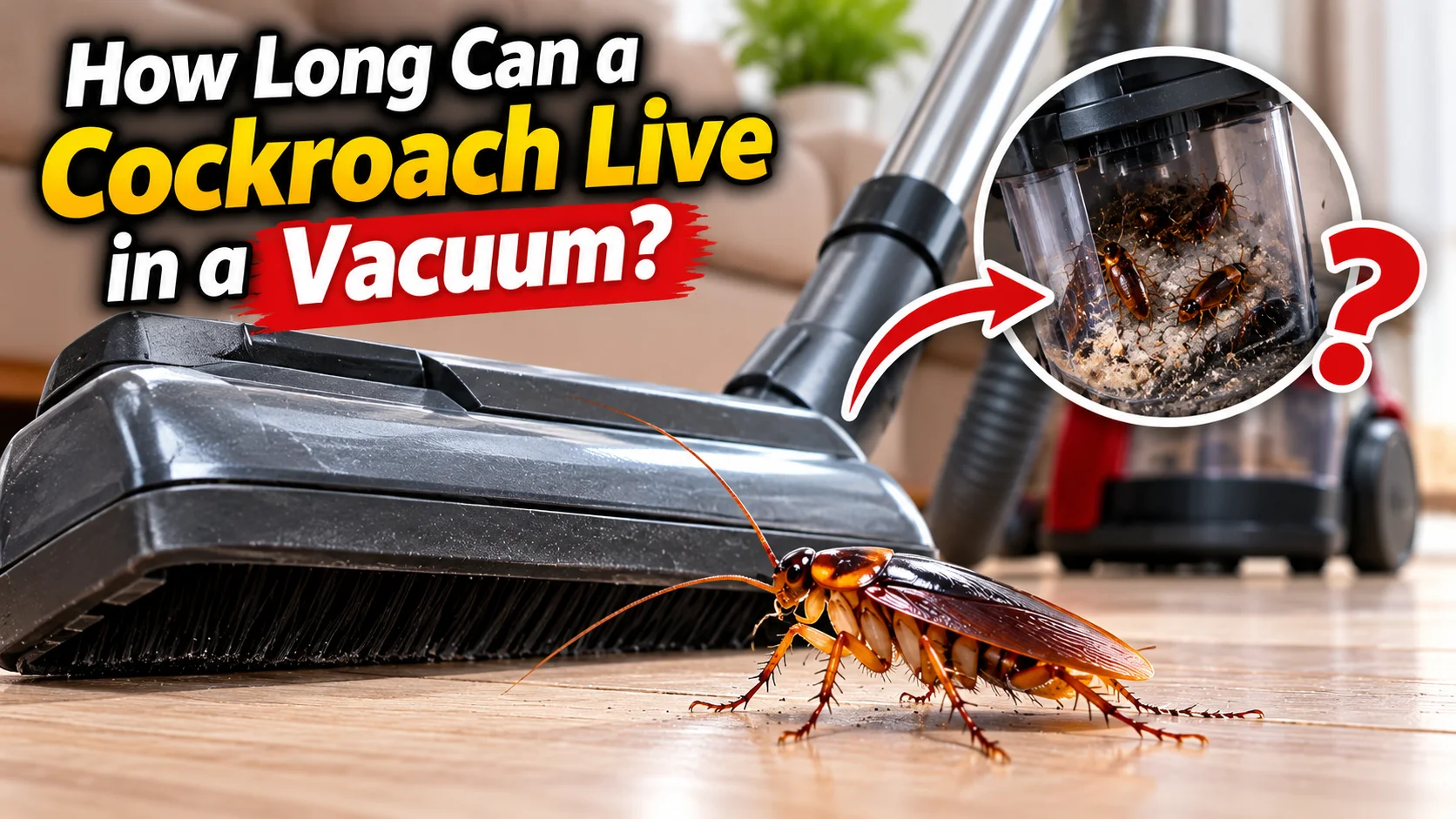
How long can a cockroach live in a vacuum? In many cases, a cockroach that has been sucked into a vacuum cleaner may survive the vacuuming process rather than dying immediately. Vacuuming is a useful way to remove cockroaches, nymphs, egg cases, droppings, and debris, but the captured insects should be disposed of properly because they may remain alive inside the vacuum. University extension resources recommend promptly sealing and disposing of vacuum contents rather than assuming the vacuum has killed the cockroaches.
How Long Can a Cockroach Live in a Vacuum?
There is no single number of minutes, hours, or days that applies to every cockroach inside every vacuum cleaner. Survival depends on the cockroach species, its life stage, the type of vacuum, how much debris is inside the machine, airflow, moisture, temperature, and how quickly the vacuum contents are removed.
The important point is that vacuuming should not be treated as a guaranteed way to kill cockroaches. Cockroach-control manuals from university extension programs specifically warn that vacuuming may remove live cockroaches without killing them. The contents should therefore be sealed and disposed of appropriately after vacuuming.
Can Cockroaches Survive Being Vacuumed?
Yes, some cockroaches can survive being vacuumed. The force of suction can remove them from cracks, crevices, underneath appliances, and other hiding places, but the vacuum itself is not a reliable killing method.
University of Nebraska-Lincoln guidance states that vacuuming does not necessarily kill live cockroaches and recommends placing the vacuum bag in a freezer or sealing it in a cockroach-proof container for disposal. Other extension guidance similarly recommends sealing the vacuum contents immediately after use.
Why Doesn’t Vacuuming Always Kill Cockroaches?
A vacuum cleaner is designed primarily to move air and collect dust, debris, and insects. Although cockroaches may be subjected to strong airflow, impact, and agitation while being sucked through the hose, those conditions do not guarantee that every insect will die.
The interior of a vacuum also contains collected debris that can provide physical protection. For this reason, pest-management guidance treats vacuuming as a mechanical removal method rather than a stand-alone extermination technique.
How Long Can a Cockroach Survive Inside a Vacuum Cleaner?
It is difficult to give an exact survival time for a cockroach inside a vacuum cleaner. A vacuum bag or canister is not a controlled environment, and conditions can vary considerably between machines.
A cockroach may have access to air and organic debris inside the vacuum, while the amount of moisture and food available can vary. Because survival is variable, it is safest to assume that a cockroach sucked into the vacuum could still be alive until the vacuum contents have been properly disposed of.
Does a Vacuum Cleaner Suffocate Cockroaches?
Not necessarily. Cockroaches have a different respiratory system from mammals and exchange gases through openings called spiracles. A vacuum cleaner does not automatically create an environment that instantly deprives a cockroach of oxygen.
More importantly, there is no reliable reason to assume that a cockroach inside a vacuum cleaner has died simply because it has been there for a short period. Proper disposal of the vacuum contents is therefore recommended.
Can Cockroach Eggs Survive Vacuuming?
Cockroach egg cases can also be collected by vacuuming. Extension pest-management guidance recommends vacuuming egg cases as part of cockroach control, but the vacuum contents must then be handled carefully.
The exact number of eggs inside an egg case depends on the cockroach species. For example, German cockroach egg capsules can contain as many as 48 eggs, while other cockroach species produce capsules containing fewer eggs.
This is one reason why simply vacuuming a cockroach and then leaving the vacuum unattended is not a good idea. Properly removing or treating the vacuum contents helps prevent captured pests from escaping or continuing their development.
What Should You Do After Vacuuming a Cockroach?
If you use a vacuum cleaner to remove a cockroach, deal with the vacuum contents immediately rather than assuming the insect is dead.
- For a bagged vacuum: remove the bag carefully and place it inside a sealed plastic bag.
- For a bagless vacuum: empty the canister carefully into a sealed container or bag.
- Dispose of the contents promptly: do not leave captured cockroaches inside the vacuum for an extended period.
- Consider freezing the contents: university pest-management guidance recommends freezing vacuumed cockroaches when appropriate as a way to kill them before disposal.
- Use a HEPA-filter vacuum when possible: this can help reduce the amount of cockroach debris and allergens that become airborne.
Is Vacuuming a Good Way to Get Rid of Cockroaches?
Yes. Vacuuming can be an effective part of a cockroach-control strategy, particularly when cockroaches are concentrated in accessible hiding places. It can physically remove adults, nymphs, egg cases, shed skins, droppings, and food debris.
The University of Minnesota Extension recommends vacuuming as part of cockroach control and notes that a HEPA filter can reduce airborne cockroach debris. Cornell University also recommends using a vacuum with a crack-and-crevice attachment to reach cockroaches hiding in difficult areas.
However, vacuuming works best as one part of an integrated pest management approach rather than as the only treatment.
How to Vacuum Cockroaches Safely
Vacuuming can be particularly useful when cockroaches are hiding under appliances, behind furniture, around cabinets, or inside cracks and crevices.
1. Use a Crevice Attachment
A narrow vacuum attachment can help reach cracks and other areas where cockroaches hide. Cornell University recommends using crack-and-crevice vacuuming as part of cockroach management.
2. Vacuum Egg Cases and Debris
Do not focus only on adult cockroaches. Vacuuming can also remove egg cases, shed skins, fecal material, crumbs, and other debris associated with an infestation.
3. Dispose of the Vacuum Contents Immediately
This is one of the most important steps. Do not assume that cockroaches inside the vacuum have died. Seal the contents and dispose of them according to local waste guidelines, or use an appropriate freezing method when recommended.
What Is the Best Way to Kill Cockroaches After Vacuuming?
Vacuuming removes cockroaches, but long-term control requires addressing the conditions that allow them to survive and reproduce. Integrated pest management combines sanitation, exclusion, monitoring, physical removal, and appropriate control products.
Cockroach Baits
Cockroach baits can be an important part of an integrated pest management program. Cornell University describes baiting as one of the successful techniques for managing cockroach populations when baits are placed correctly.
Sticky Traps
Sticky traps can help identify where cockroaches are most active. They can be placed near appliances, walls, kitchens, bathrooms, and other suspected activity areas. Traps are particularly useful for monitoring an infestation and determining where additional control measures may be needed.
Reduce Food and Water Sources
Cockroaches need food, water, and shelter. Store food in tightly sealed containers, clean crumbs and spills quickly, remove garbage regularly, repair leaks, and avoid leaving pet food or dirty dishes available overnight.
Seal Cracks and Entry Points
Seal cracks and gaps around cabinets, plumbing, windows, doors, walls, and other potential entry points. Reducing hiding places and pathways can make it more difficult for cockroaches to establish or move through a home.
Can Heat or Cold Kill Cockroaches?
Temperature can affect cockroach survival, but casually exposing a room or piece of furniture to outdoor temperatures is not always a reliable treatment.
University extension guidance describes controlled heat and freezing methods for certain situations. For example, Nebraska Extension materials describe specific temperature and exposure conditions for killing cockroaches, while University of Minnesota Extension recommends freezing certain infested small items for several days. These controlled methods are different from simply opening windows or placing furniture outdoors for a short time.
Do Homemade Cockroach Remedies Work?
Home remedies are often promoted online as simple ways to kill cockroaches, but their effectiveness can vary considerably. Some materials used for pest control, such as boric acid, can be effective when correctly applied to appropriate locations, but they should be used according to product directions and kept away from children and pets.
Rather than relying on an untested homemade mixture, homeowners can combine sanitation, vacuuming, monitoring traps, sealing entry points, and appropriately labeled cockroach baits or other pest-control products. For a significant infestation, professional pest management may be appropriate.
How to Prevent Cockroaches From Returning
Removing one cockroach does not necessarily solve an infestation. Long-term prevention focuses on eliminating food, water, and hiding places while reducing opportunities for cockroaches to enter the home.
- Store food in sealed containers.
- Clean crumbs, grease, and spills promptly.
- Take household garbage out regularly.
- Fix leaking faucets and pipes.
- Keep sinks and kitchen surfaces clean and dry.
- Reduce cardboard, paper piles, and clutter.
- Seal cracks around plumbing, cabinets, walls, windows, and doors.
- Use sticky traps to monitor cockroach activity.
- Vacuum cracks, crevices, and areas beneath appliances regularly.
- Address the infestation rather than relying on vacuuming alone.
These measures are consistent with integrated pest management recommendations from university extension programs, which emphasize sanitation, exclusion, moisture reduction, monitoring, and targeted control.
When Should You Call a Pest Control Professional?
If you continue finding cockroaches after cleaning and vacuuming, see cockroaches regularly, discover egg cases, or notice activity in several areas of the home, professional pest management may be worth considering.
Professional control can be especially useful for established infestations because technicians can identify hiding areas, determine the extent of the problem, and use an integrated treatment strategy. University of Florida Extension notes that integrated pest management combines multiple control methods and that professional operators may have specialized equipment, training, and access to products not available to homeowners.
Frequently Asked Questions About Cockroaches in Vacuums
How long can a cockroach live in a vacuum?
There is no reliable universal survival time. A cockroach may survive the vacuuming process, so it is safest to assume it could still be alive until the vacuum contents are properly disposed of or otherwise treated.
Do cockroaches die when you vacuum them?
Not necessarily. Vacuuming can remove cockroaches effectively, but university pest-management guidance warns that it does not reliably kill live cockroaches.
Can cockroaches escape from a vacuum cleaner?
They can potentially remain alive inside the vacuum and may escape if the vacuum contents are not properly contained. This is why extension guidance recommends promptly sealing or otherwise treating the vacuum contents after collecting cockroaches.
Can a vacuum cleaner kill cockroach eggs?
Vacuuming can remove cockroach egg cases from infested areas, but you should not assume that suction alone has killed every egg inside an egg case. Properly dispose of or treat the vacuum contents after cleaning.
What should I do after vacuuming a cockroach?
Remove the vacuum bag or empty the canister carefully, seal the contents, and dispose of them promptly. If appropriate, freezing the collected material can be used as a control method according to extension guidance.
Is vacuuming enough to get rid of a cockroach infestation?
Usually, vacuuming should be considered one part of a broader cockroach-control strategy. Combine it with sanitation, moisture control, sealing entry points, monitoring traps, and appropriate baits or professional treatment when necessary.
Final Thoughts: How Long Can a Cockroach Live in a Vacuum?
So, how long can a cockroach live in a vacuum? There is no dependable fixed survival time, and vacuuming does not guarantee that a cockroach will die immediately. Some cockroaches can survive being sucked into a vacuum, which is why pest-control guidance recommends treating vacuuming as a removal method rather than a guaranteed killing method.
Vacuuming remains a useful tool because it can physically remove cockroaches, nymphs, egg cases, droppings, and food debris. For the best results, dispose of the vacuum contents promptly and combine vacuuming with sanitation, moisture control, sealing cracks and crevices, monitoring traps, and appropriate cockroach-control methods.