

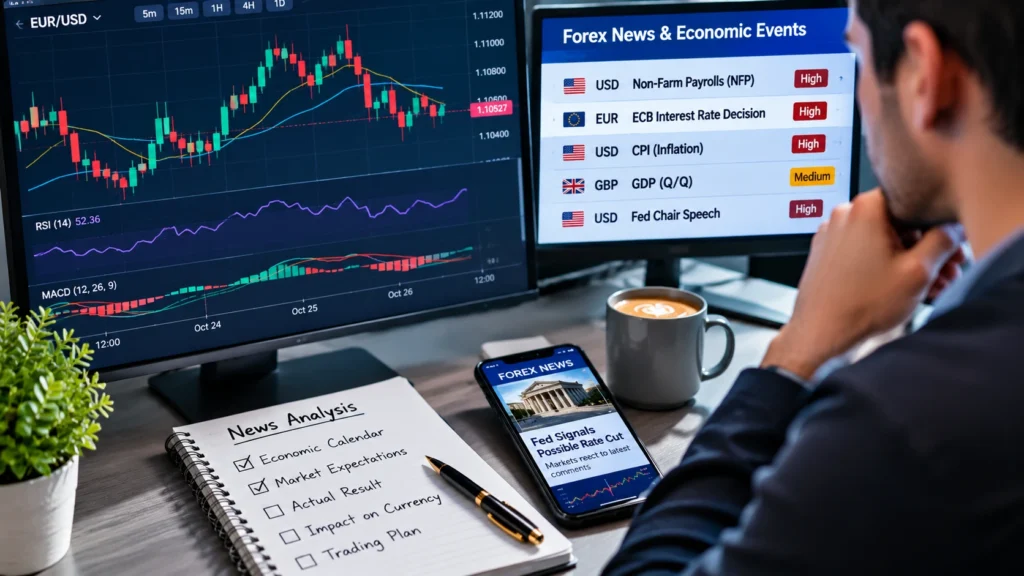
The foreign exchange (Forex) market is influenced by much more than currency charts and technical indicators. Economic reports, central bank announcements, political developments, inflation figures, and global events can all affect currency prices. For traders, understanding these developments is an important part of making informed trading decisions.
Whether you are a beginner or an experienced trader, learning how to analyze news in Forex can help you understand market movements, identify potential trading opportunities, and manage exposure during periods of uncertainty.
For example, an unexpected inflation report may change expectations about future interest rates. Similarly, a central bank announcement can influence investor confidence and demand for a particular currency. However, the market does not always react in the direction traders expect. Actual results, previous expectations, economic conditions, and market sentiment all matter.
Analyzing financial news is also valuable for traders pursuing opportunities like my funded futures, where disciplined execution, informed decisions, and consistent risk management are important.
In this guide, you will learn how to analyze Forex news, interpret important economic indicators, use an economic calendar, understand market sentiment, and combine fundamental analysis with technical trading strategies.
Understanding the Role of News in Forex Trading
Forex trading involves buying one currency while selling another. Currency values fluctuate according to supply and demand, which are influenced by economic performance, monetary policy, political developments, and global financial conditions.
For example, stronger economic growth may increase confidence in a country’s economy and influence demand for its currency. However, economic growth alone does not guarantee currency appreciation. Traders also consider inflation, interest rate expectations, economic risks, and developments in other countries.
This is why news analysis is an important part of Forex fundamental analysis. It helps traders understand the economic factors behind currency movements rather than relying exclusively on chart patterns.
Major News Events That Influence Forex Markets
Several categories of economic and political news can influence currency exchange rates:
- Central bank interest rate decisions: Changes in monetary policy can affect the relative attractiveness of currencies.
- Gross Domestic Product (GDP): Economic growth reports provide information about a country’s economic performance.
- Inflation reports: Consumer Price Index (CPI) and other inflation indicators can influence expectations about monetary policy.
- Employment reports: Employment growth, unemployment rates, and wage increases provide information about labor market conditions.
- Trade balances: Import and export developments can influence currency demand and economic expectations.
- Political developments: Elections, government decisions, and policy changes can create uncertainty.
- Geopolitical events: International conflicts, sanctions, and diplomatic developments can affect investor confidence.
Understanding these events helps traders evaluate why a currency pair is moving and whether the underlying economic conditions support a particular market outlook.
1. Use an Economic Calendar to Plan Your Trades
An economic calendar is one of the most useful tools for analyzing Forex news. It provides a schedule of upcoming economic announcements, central bank meetings, and important financial releases.
Instead of being surprised by sudden market movements, traders can use an economic calendar to prepare for potentially volatile trading sessions.
What Should You Look for in an Economic Calendar?
When reviewing an economic calendar, pay attention to the following information:
- Event name: Identify the economic report or announcement scheduled for release.
- Release date and time: Check when the information will become available. Make sure the calendar uses your local time or adjust the displayed time zone.
- Previous result: Review the most recent reported figure.
- Forecast: Understand what economists and market participants expect.
- Actual result: Compare the published figure with the forecast after the release.
- Expected impact: Identify events commonly associated with higher market volatility.
High-impact announcements deserve additional attention because they can trigger rapid price movements, wider spreads, and changes in market liquidity.
How to Use an Economic Calendar Effectively
Start by identifying the currency pairs you trade. If you regularly analyze EUR/USD, for example, pay attention to important economic announcements from both the United States and the Eurozone.
Before an announcement, record the forecast and previous result. After the release, compare the actual data with expectations and observe how the currency pair responds.
Do not assume that every high-impact announcement will create a profitable trading opportunity. Sometimes the market has already priced in the expected result, while unexpected details can produce a completely different reaction.
2. Get Forex News from Reliable Sources
Accurate information is essential when analyzing financial markets. Online platforms publish thousands of Forex-related updates every day, but not every source provides reliable or complete information.
Traders should prioritize official economic publications, central bank announcements, established financial news organizations, and reputable market data providers.
Recommended Sources for Forex News
Consider using the following types of information sources:
- Central bank websites: Official announcements from institutions such as the Federal Reserve, European Central Bank, and Bank of England.
- Government statistical agencies: Official employment, inflation, GDP, and trade data.
- Financial news organizations: Established publishers that report international economic developments.
- Reputable Forex platforms: Trading platforms and brokers that provide economic calendars, market commentary, and currency analysis.
- Independent economic research: Reports that explain economic trends and their possible implications for currency markets.
For additional market information and Forex-related resources, you can explore Forex trading information from Weltrade.
It is also important to verify major announcements using their original sources. For example, when analyzing US monetary policy, traders can review the Federal Reserve’s official website rather than relying exclusively on social media summaries.
Trading communities and discussion forums can provide different perspectives, but their comments should not replace verified economic information.
3. Focus on High-Impact Forex News Events
Not every economic announcement has the same influence on currency markets. Some reports receive significant attention because they may change expectations about economic growth, inflation, or central bank policy.
Learning to identify important events helps traders organize their research and avoid spending too much time on information that has little relevance to their chosen currency pairs.
Central Bank Announcements and Interest Rate Decisions
Central banks play a major role in determining monetary policy. Their decisions regarding interest rates, inflation targets, and economic conditions can influence currency valuations.
For example, an unexpected interest rate increase may support a currency if it makes investments denominated in that currency more attractive relative to alternatives.
However, a rate increase does not automatically make a currency stronger. If the decision was already expected, its impact may be limited. If traders believe the increase could damage economic growth, the currency might even weaken.
When analyzing central bank news, examine:
- The announced interest rate decision.
- Changes compared with market expectations.
- Statements about future monetary policy.
- Comments about inflation and economic growth.
- Potential differences between the monetary policies of two countries.
Central bank speeches and meeting minutes can also provide useful information about future policy expectations.
Inflation Data and Consumer Price Index Reports
Inflation is another major factor that Forex traders monitor. Rising prices can influence central bank decisions, purchasing power, and expectations about future interest rates.
One commonly followed indicator is the Consumer Price Index (CPI), which measures changes in the prices of a basket of consumer goods and services.
When analyzing inflation reports, consider:
- Whether inflation increased or decreased compared with the previous report.
- Whether actual inflation was above or below expectations.
- Whether core inflation shows a similar trend.
- How inflation developments may influence central bank policy.
For example, higher-than-expected inflation may increase expectations of tighter monetary policy. However, the currency reaction depends on the wider economic outlook and what investors had already anticipated.
Geopolitical Events and Political Developments
Political developments can create uncertainty in the Forex market. Elections, international conflicts, trade restrictions, sanctions, and government policy changes may influence investor confidence and currency demand.
During uncertain periods, investors may change their exposure to currencies and other financial assets. However, the direction of these movements depends on the specific event and the economic relationships involved.
When analyzing geopolitical news, consider:
- Which countries or currencies are directly affected.
- Whether the development is temporary or likely to continue.
- Potential effects on international trade and investment.
- Possible changes in energy and commodity prices.
- How financial markets are responding to the announcement.
Avoid making trading decisions based on dramatic headlines alone. Look for confirmed information and assess the potential economic consequences.
Employment Reports and Labor Market Data
Employment reports provide valuable information about economic conditions. Traders often monitor unemployment rates, job creation, wage growth, and labor force participation.
For the US dollar, one widely followed release is the Nonfarm Payrolls (NFP) report, which measures changes in employment across many sectors of the US economy, excluding certain categories.
When analyzing employment news, consider:
- Whether job creation exceeded or missed expectations.
- Whether the unemployment rate increased or decreased.
- Whether wage growth is accelerating or slowing.
- Whether previous employment figures were revised.
- What the combined data may suggest about economic conditions and monetary policy.
A strong employment report may support a currency under certain conditions, but the complete report and market expectations matter more than one headline figure.
GDP and Economic Growth Reports
Gross Domestic Product measures the value of goods and services produced within an economy over a specific period. It is an important indicator of economic activity.
Forex traders monitor GDP reports to understand whether an economy is expanding, slowing, or contracting.
However, it is important to examine the components of the report rather than focusing only on the headline growth rate. Consumer spending, business investment, government spending, and net exports can provide additional insight.
4. Compare Actual Economic Data with Market Expectations
One of the most important principles of Forex news analysis is understanding the difference between actual results and market expectations.
Currency prices often move in response to unexpected information rather than simply whether an economic report appears positive or negative.
Why Economic Surprises Matter
Before an economic announcement, analysts and market participants usually have expectations about the result. These expectations can already influence currency prices before the official report is released.
When the actual result differs significantly from the forecast, traders may adjust their expectations and positions.
Consider this simplified example:
| Economic indicator | Forecast | Actual result | Interpretation |
|---|---|---|---|
| Inflation | 3.0% | 3.5% | Higher than expected |
| Employment growth | 180,000 | 120,000 | Lower than expected |
| GDP growth | 2.0% | 2.4% | Higher than expected |
These figures are illustrative examples, not current economic data or trading signals.
In the inflation example, higher-than-expected inflation might increase expectations of tighter monetary policy. However, the market reaction will also depend on other economic indicators and the central bank’s priorities.
Comparing actual figures with forecasts provides a more useful starting point than simply labeling economic news as good or bad.
5. Analyze Market Sentiment Carefully
Market sentiment refers to the overall attitude of investors and traders toward a particular currency, asset, or financial market.
It can change quickly following economic announcements, central bank speeches, geopolitical developments, or unexpected financial events.
What Influences Forex Market Sentiment?
Several factors can influence market sentiment:
- Economic growth expectations.
- Central bank policy announcements.
- Political and geopolitical developments.
- Investor confidence and risk appetite.
- Changes in financial market positioning.
- Unexpected economic reports.
How to Evaluate Market Sentiment
Traders can examine currency price movements, market positioning information, financial news, and volatility indicators to understand current sentiment.
For example, the Commitment of Traders (COT) report published by the US Commodity Futures Trading Commission provides information about positions held by different categories of futures market participants.
Although positioning data can provide useful context, it does not guarantee future price direction. Sentiment can change rapidly, particularly when new economic information becomes available.
Avoid following market opinions blindly. Compare different perspectives and use verified information to develop your own analysis.
6. Compare Current News with Previous Economic Events
Historical market behavior can help traders understand how currency pairs have responded to similar economic announcements in the past.
For example, if you are analyzing an upcoming Federal Reserve interest rate announcement, you can examine previous policy decisions and observe how major currency pairs reacted.
However, historical reactions should be treated as reference points rather than reliable predictions.
What Should You Compare?
- Previous interest rate announcements.
- Historical inflation reports.
- Employment data releases.
- Major geopolitical developments.
- Changes in market expectations.
- Price movements before and after important announcements.
Pay attention to whether the economic conditions were similar during previous events. A currency may react differently to the same type of announcement when inflation, growth, and monetary policy expectations have changed.
Keeping a trading journal can help you identify recurring patterns and understand how your own analysis performs over time.
7. Combine Fundamental Analysis with Technical Analysis
Fundamental analysis helps traders understand the economic reasons behind currency movements. Technical analysis focuses on price charts, trends, support and resistance levels, and market indicators.
Using both approaches can provide a broader perspective when evaluating a potential Forex trade.
Important Technical Analysis Tools
Some commonly used technical analysis tools include:
- Trend lines: Help identify the general direction of price movement.
- Support and resistance: Highlight price areas where buying or selling pressure may develop.
- Moving averages: Help traders examine trends and changes in price direction.
- Relative Strength Index (RSI): Measures price momentum and can help identify potentially overbought or oversold conditions.
- Moving Average Convergence Divergence (MACD): Helps evaluate momentum and possible trend changes.
- Candlestick patterns: Provide information about price behavior and potential changes in market sentiment.
Example of Combining News and Technical Analysis
Suppose an economic report creates a positive reaction in a particular currency. Instead of entering a trade immediately, you can examine the relevant currency pair’s chart.
Consider whether:
- The currency pair is already moving in the direction suggested by the news.
- Price is approaching a major resistance or support area.
- Technical indicators support the observed momentum.
- The potential trade offers an acceptable risk-to-reward profile.
- Market volatility makes the proposed entry and stop-loss levels practical.
Combining these factors can help you build a more structured trading plan. However, neither fundamental nor technical analysis can eliminate uncertainty.
For a broader explanation of chart analysis, indicators, and currency market research, read our guide on how to analyze the Forex market.
8. Understand the Risks of Trading During Major News Releases
Forex news trading can involve significant risks. Major economic announcements sometimes cause sudden price movements, increased volatility, and changes in available market liquidity.
Even when your interpretation of an economic report is correct, the trade may still move against you.
Common Risks Associated with Forex News Trading
- Sudden price movements: Currency prices can move sharply within seconds of an announcement.
- Spread widening: The difference between bid and ask prices may increase during volatile conditions.
- Slippage: Your trade may execute at a different price from the one requested.
- Market gaps: Prices may jump between trading periods or during unexpected developments.
- False breakouts: Initial price movements may reverse after traders process the announcement.
- Leverage exposure: High leverage can magnify losses when the market moves against your position.
Use Stop-Loss Orders and Position Sizing
Risk management should be part of every Forex trading strategy, particularly when trading around important economic announcements.
Before entering a trade, determine how much capital you are willing to risk and calculate an appropriate position size.
Consider the following practices:
- Set a predefined risk limit for each trade.
- Calculate position sizes according to your account balance and stop-loss distance.
- Use stop-loss orders where appropriate, while understanding that execution is not guaranteed at the requested price during gaps or extreme volatility.
- Avoid increasing leverage simply because an economic announcement appears favorable.
- Do not risk money you cannot afford to lose.
- Consider staying out of the market when conditions are too unpredictable.
For additional guidance, read our article on why it is necessary to have a stop-loss while trading in Forex.
Forex trading, especially leveraged trading, can result in substantial losses. Review the risks carefully and understand the terms and regulatory protections associated with your broker before trading.
9. Develop a Consistent Forex News Trading Strategy
Having access to economic news is not enough. You also need a structured process for reviewing information and deciding whether market conditions meet your trading criteria.
A consistent news analysis routine can help reduce emotional decisions and make it easier to evaluate your trading performance.
Create a Daily Forex News Routine
Consider following these steps:
- Review the economic calendar: Identify important announcements scheduled for the trading day.
- Select relevant currency pairs: Focus on the currencies directly affected by upcoming events.
- Check market expectations: Record forecasts and previous economic results.
- Read official announcements: Use reliable sources to understand the economic background.
- Monitor market reactions: Observe how currency prices respond to new information.
- Perform technical analysis: Examine trends, support, resistance, and momentum.
- Calculate trading risk: Determine position size and potential losses before entering a trade.
- Record your results: Maintain a trading journal to review your decisions and identify mistakes.
Use Technology to Monitor Forex News
Modern trading platforms and financial applications provide tools that make market research easier. Traders can use economic calendar alerts, real-time price notifications, financial news feeds, and charting software to monitor developments.
Some tools also offer automated news sentiment analysis and event notifications. Although these features can help organize information, automated signals should not replace independent research and risk management.
Be careful when relying on social media trading accounts, influencers, or unverified market predictions. Always confirm important information using credible sources.
10. Maintain a Forex Trading Journal
A trading journal is a useful resource for reviewing how economic news influences your trading decisions.
Instead of relying on memory, record the information that influenced each trade and compare your expectations with the actual market outcome.
Your journal can include:
- The date and time of the economic announcement.
- The currency pair being analyzed.
- The previous, forecast, and actual economic figures.
- Your interpretation of the announcement.
- The technical conditions before entering the trade.
- Your entry price, exit price, and stop-loss level.
- The final trading result.
- Lessons learned from the decision.
Reviewing these records can help you identify whether your news analysis is consistent and where your strategy may need improvement.
Common Mistakes to Avoid When Analyzing Forex News
Even experienced traders can make mistakes when interpreting financial news. Recognizing common problems can help you develop a more disciplined approach.
1. Trading Immediately After Every Announcement
Not every economic release creates a suitable trading opportunity. Entering positions without understanding the report or evaluating market conditions can expose you to unnecessary risk.
2. Ignoring Market Expectations
A positive economic report may not strengthen a currency if the market expected an even better result. Always compare actual figures with forecasts and consider what has already been priced into the market.
3. Relying on Unverified Headlines
Social media posts and incomplete news summaries can create misleading impressions. Confirm important information through official publications and established financial news sources.
4. Ignoring Risk Management
Correctly predicting the direction of a currency pair does not guarantee a profitable trade. Spreads, slippage, execution costs, and unexpected price reversals can affect trading results.
5. Using Too Many Indicators
Adding more technical indicators does not automatically improve your analysis. Focus on tools that support a clearly defined strategy and avoid making decisions based on conflicting signals.
Conclusion
Learning how to analyze news in Forex is an important skill for traders who want to understand the economic and political developments influencing currency markets.
Economic calendars, central bank announcements, inflation reports, employment figures, GDP releases, and geopolitical developments can all provide useful information. However, their impact depends on market expectations, existing economic conditions, and the relationship between the currencies in a trading pair.
For a more complete approach, combine fundamental analysis with technical indicators, monitor market sentiment, review historical data, and maintain a consistent trading journal.
Most importantly, never overlook risk management. Forex markets can be unpredictable, and leveraged trading can result in substantial financial losses. Use reliable information, develop a clear trading plan, and avoid making impulsive decisions based on individual headlines.
By developing a disciplined approach to news analysis, you can improve your understanding of the Forex market and make more informed trading decisions.
Frequently Asked Questions About Forex News Analysis
What is Forex news analysis?
Forex news analysis is the process of examining economic reports, central bank announcements, political developments, and other financial news to understand their potential influence on currency exchange rates. It is an important part of fundamental analysis.
Which news events have the biggest impact on Forex markets?
Major central bank interest rate decisions, inflation reports, employment data, GDP releases, and significant geopolitical developments can influence Forex markets. Their actual impact depends on market expectations and the economic conditions at the time of the announcement.
How do I use an economic calendar for Forex trading?
An economic calendar helps traders identify upcoming financial announcements. Review the event name, release time, previous result, forecast, and actual result. Pay particular attention to high-impact events that may create increased market volatility.
Does good economic news always strengthen a currency?
No. A positive economic report does not automatically strengthen a currency. Market expectations, monetary policy outlook, economic conditions, and developments in other countries can influence the reaction. Sometimes positive news has already been reflected in currency prices.
How do interest rate decisions affect Forex prices?
Interest rate decisions can influence currency demand by changing the relative attractiveness of investments in different countries. However, currency movements depend on whether the decision was expected, future policy guidance, inflation, and other economic factors.
What is the difference between fundamental and technical analysis in Forex?
Fundamental analysis examines economic indicators, interest rates, political developments, and financial news to understand currency values. Technical analysis studies price charts, trends, support and resistance levels, and indicators to evaluate potential market movements.
Should beginners trade Forex during major news releases?
Major news releases can create unpredictable price movements, wider spreads, and slippage. Beginners should first understand how economic announcements affect currency pairs and practice their strategies in a demo account before considering live trading. Avoid risking money you cannot afford to lose.
How can I identify reliable Forex news sources?
Use official central bank websites, government statistical agencies, established financial news organizations, and reputable market data providers. Verify important announcements using original sources instead of relying entirely on social media posts or unconfirmed reports.
Can technical indicators help analyze Forex news?
Yes. Tools such as moving averages, RSI, MACD, trend lines, and support and resistance levels can help traders examine how currency prices respond to economic announcements. However, technical indicators cannot guarantee future market movements.
Why is risk management important when trading Forex news?
Major announcements can cause rapid price movements, spread widening, and slippage. Risk management helps traders define potential losses through appropriate position sizing, predefined risk limits, and stop-loss planning. It is particularly important when using leverage.