
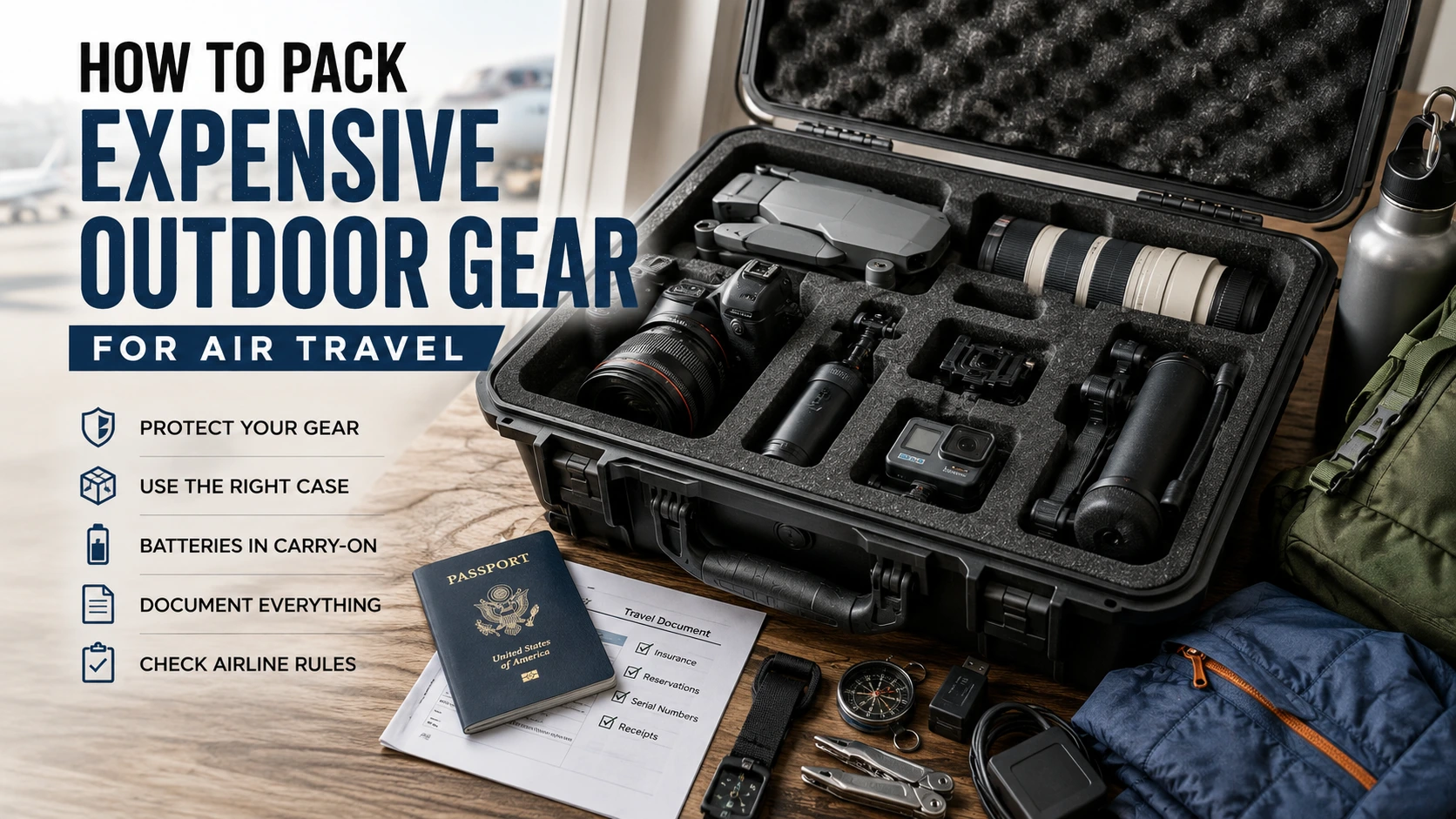
Traveling with expensive outdoor equipment requires more planning than throwing everything into a suitcase and hoping for the best.
A camera, spotting scope, drone, GPS device, diving computer, climbing equipment, specialized electronics, or other high-value gear can represent thousands of dollars. The problem is that airport baggage systems are designed to move bags quickly, not necessarily to handle every piece of equipment as carefully as you would.
That doesn’t mean you shouldn’t fly with expensive gear.
It means you need to pack it differently.
A good packing system protects equipment from impacts, movement, moisture and pressure while also making it easier to deal with airline security and baggage handling.
Here’s how to pack expensive outdoor equipment for air travel without making the process unnecessarily complicated.
1. Start by Separating Your Equipment
Before choosing a case, divide your equipment into three groups:
- Fragile and essential
- Expensive but durable
- Replaceable accessories
This simple step can make a huge difference.
Your most fragile equipment should generally stay with you whenever airline and security rules allow it. Cameras, sensitive electronics, memory cards, important data and other small high-value items are often easier to protect in a suitable carry-on bag.
Larger equipment may need to travel as checked baggage.
The goal isn’t necessarily to carry everything into the cabin. It’s to avoid putting all of your valuable equipment in one place.
For example, if your checked case is delayed, you don’t want to discover that your entire trip depends on one piece of equipment sitting inside that missing case.
A simple rule
Don’t put everything you need in one bag.
Create some separation between your essential equipment, accessories and backup items.
2. Choose a Real Protective Case
One of the biggest packing mistakes is using a normal suitcase or the original cardboard shipping box.
Those options may be fine for short-distance transportation, but expensive outdoor equipment needs protection against impacts and movement.
For valuable equipment going into the aircraft hold, look for a rigid protective case with features such as:
- Strong exterior construction
- Secure latches
- Water or weather resistance
- Appropriate interior padding
- Enough room for the equipment
- Handles that can withstand repeated use
- Wheels if the case is particularly heavy
A hard case isn’t automatically a good case, however.
The interior is just as important as the exterior.
Your equipment shouldn’t be bouncing around inside a large empty box.
3. Don’t Leave Empty Space Around Your Gear
Imagine placing an expensive camera inside a large case with several inches of empty space around it.
Even if the case itself is extremely strong, the equipment can still move every time the case is dropped, turned or pushed.
That’s why interior fit matters.
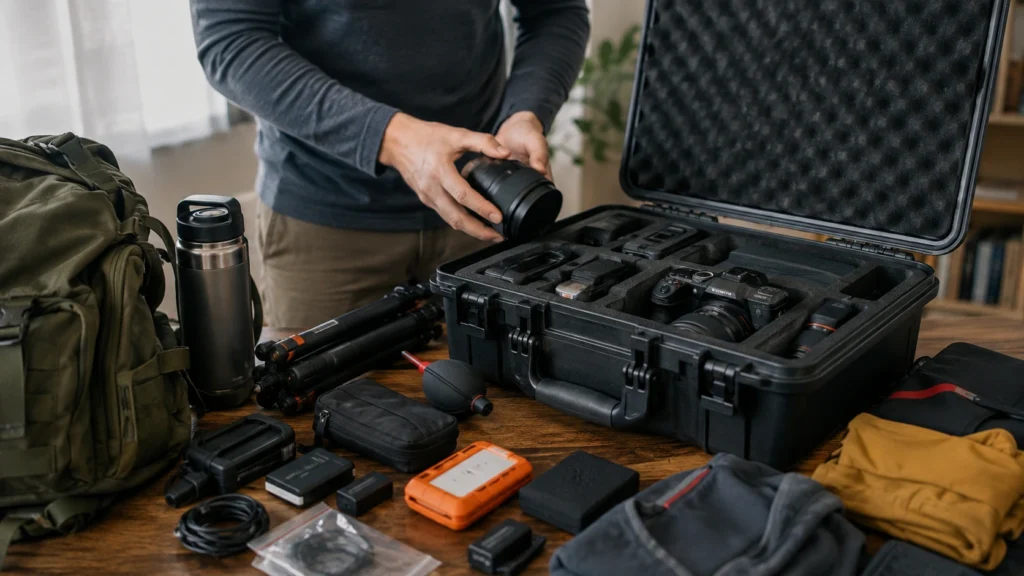
Foam inserts are one of the most practical solutions for expensive equipment. The foam should hold each item securely without putting excessive pressure on delicate components.
For irregularly shaped equipment, custom-cut foam can be particularly useful.
You want the equipment to remain in approximately the same position throughout the journey.
Check the fit before traveling
Close the case and gently move it from side to side.
If you can hear equipment moving inside, stop and fix the problem before traveling.
That small test can prevent a surprisingly expensive repair.
4. Protect Equipment From Direct Impact
Don’t allow delicate parts to sit directly against the walls of the case.
Depending on the equipment, vulnerable areas may include:
- Lenses
- Screens
- Adjustment knobs
- Connectors
- Tripod mounts
- Handles
- Dials
- Sensors
- Battery compartments
- Small mechanical components
Use appropriate padding between these areas and the exterior of the case.
Also avoid placing heavy objects directly on top of fragile equipment.
A common mistake is putting accessories into the same compartment simply because they fit.
If two pieces can hit each other, they probably shouldn’t share an unprotected space.
5. Secure Anything That Moves
Expensive outdoor equipment often contains adjustable or removable components.
These can include:
- Tripod heads
- Camera cages
- Adjustable mounts
- Handles
- Straps
- Filters
- Battery doors
- Lens accessories
- GPS mounts
- Small tools
Before packing, check every component that can rotate, slide, fold or detach.
If something can move during transportation, either secure it or remove it and pack it separately.
For equipment with important adjustable settings, take a photograph before packing.
This gives you a visual reference if something moves during the journey.
6. Remove Unnecessary Accessories
More equipment isn’t always better.
Every extra item inside a case increases weight, clutter and the possibility of something hitting something else.
Before packing, ask:
“Do I actually need this for this trip?”
Remove items that are:
- Easily replaceable
- Unnecessary for the activity
- Bulky
- Heavy
- Poorly protected
- Available at your destination
For example, you might not need three different mounting accessories when one will do the job.
A lighter, more organized case is usually easier to manage.
7. Pay Special Attention to Batteries
This is one area where you should never rely on general packing assumptions.
Many outdoor devices use lithium batteries, including cameras, drones, GPS equipment, lights and other electronics.
Under current U.S. FAA guidance, spare lithium batteries and power banks must be carried in carry-on baggage rather than checked baggage. Batteries also need protection against short circuits and physical damage. Battery-powered devices placed in checked baggage have additional requirements, including being completely switched off and protected from accidental activation or damage.
Battery size matters too. For example, rechargeable lithium-ion batteries up to 100 Wh are generally permitted under U.S. passenger rules, while batteries in the 101–160 Wh range generally require airline approval; batteries over 160 Wh are not permitted on passenger aircraft under those rules. Airlines and international regulations can impose additional restrictions.
Before your flight:
- Check the Wh rating of your batteries
- Keep spare batteries in your carry-on
- Protect exposed terminals
- Use battery cases or protective pouches
- Don’t travel with damaged or recalled batteries
- Check your airline’s current requirements
If your carry-on is unexpectedly gate-checked, remember to remove spare batteries and other items that aren’t permitted in the hold.
Never assume that the rules for one airline or country automatically apply to another.
8. Keep Small, Critical Items With You
Some inexpensive-looking items can become extremely valuable when you’re far from home.
A small memory card, specialized charging cable or unusual adapter may cost very little but be difficult to replace during a remote trip.
Consider keeping important small items in your carry-on when permitted.
Examples include:
- Memory cards
- Essential charging cables
- Batteries
- Data storage devices
- Small electronics
- Specialized adapters
- Important tools where permitted
- Critical documentation
The idea is simple:
Don’t let one delayed checked bag stop your entire trip.
9. Protect Against Moisture
Outdoor equipment doesn’t always travel through a dry environment.
Your case could encounter:
- Rain
- Humidity
- Wet baggage carts
- Condensation
- Snow
- Damp storage areas
Water-resistant or waterproof cases can provide another layer of protection, but don’t rely entirely on the case.
For sensitive electronics, consider appropriate moisture protection such as sealed bags or desiccant packs where suitable.
However, avoid creating a sealed environment around equipment that is still wet.
If you have just finished a wet outdoor activity, allow equipment to dry properly before packing it for the return flight.
10. Photograph Everything Before Closing the Case
Take photographs of your equipment before you travel.
This takes only a few minutes and can be extremely useful later.
Photograph:
- The equipment itself
- Serial numbers
- Special configurations
- Accessories
- The inside of the case
- The equipment inside the foam
- The closed case
- Any existing scratches or damage
For particularly valuable equipment, keep receipts and serial numbers in a secure digital location.
This creates a record of what you actually packed.
It can also make an insurance claim or baggage-damage report easier if something goes wrong.
11. Create a Simple Gear Inventory
Don’t rely on memory when you’re traveling with a lot of expensive equipment.
Create a simple inventory containing:
| Item | Serial Number | Packed Location |
|---|---|---|
| Camera body | Record number | Carry-on |
| Lens | Record number | Carry-on |
| GPS device | Record number | Protective case |
| Outdoor electronics | Record number | Protective case |
| Batteries | Record details | Carry-on |
You don’t need an elaborate system.
A spreadsheet or secure note can be enough.
Keep a copy somewhere you can access while traveling.
12. Don’t Overpack the Case
A protective case isn’t stronger because you have squeezed 30 items into it.
Overpacking can create unnecessary pressure on equipment and make it harder to close the case properly.
Leave enough room for the foam and protective material to do its job.
You should be able to close the case without forcing the lid down.
If you have to sit on the case to close it, you probably have too much inside.
13. Check the Weight Before Going to the Airport
This is one of the easiest problems to prevent.
A protective case can be surprisingly heavy even before equipment is added.
Then add cameras, optics, batteries, tools and accessories, and the total can quickly become uncomfortable.
Weigh your case at home.
If it is close to your airline’s baggage limit, don’t wait until check-in to discover the problem.
You may have time to move nonessential items into another permitted bag.
Also remember that baggage allowances and excess-baggage fees vary between airlines, fare types and routes. IATA notes that baggage rules are determined by individual airlines and can differ based on the route and product purchased.
14. Check Your Airline’s Rules Before Packing
This step should happen before you finish packing—not at the airport.
Airline policies can differ, and international trips may involve additional national or destination-specific requirements.
IATA specifically recommends checking directly with your airline because baggage and dangerous-goods requirements can vary.
Pay particular attention to:
- Baggage dimensions
- Weight limits
- Special equipment policies
- Battery restrictions
- Carry-on dimensions
- Oversized equipment
- Sporting equipment
- Drones and electronics
- Restricted items
- Connecting-country requirements
Save a copy or screenshot of relevant rules before leaving home.
15. Don’t Hide Unusual Equipment
If you’re carrying equipment that could raise questions during security screening, don’t try to make it look like something else.
Pack it neatly and follow the applicable airline, airport and government requirements.
Some equipment may require additional screening or special handling.
Giving yourself extra time at the airport is much better than discovering a problem when you’re already rushing toward the gate.
16. Use a Final Packing Checklist
The night before your flight, run through the same checklist every time.
Expensive Outdoor Equipment Travel Checklist
Equipment
- Inspect equipment for existing damage
- Clean equipment appropriately
- Remove unnecessary accessories
- Secure adjustable components
- Remove detachable parts where appropriate
Protective case
- Use a suitable hard case
- Check foam fit
- Eliminate unnecessary empty space
- Protect fragile components
- Check latches and hinges
- Confirm the case isn’t overloaded
Electronics
- Check battery condition
- Check battery Wh ratings
- Pack spare batteries correctly
- Protect battery terminals
- Back up important data
- Charge essential equipment
Documentation
- Photograph equipment
- Record serial numbers
- Save receipts
- Save insurance information
- Save airline rules
- Check destination requirements
Before leaving
- Weigh the case
- Check baggage allowance
- Check carry-on restrictions
- Confirm special equipment rules
- Keep essential items accessible
What Should Go in Your Carry-On?
The answer depends on the equipment and applicable airline/security rules, but a useful principle is to keep small, fragile and difficult-to-replace items with you when permitted.
For example:
- Camera bodies
- Memory cards
- Essential electronics
- Spare lithium batteries
- Power banks
- Important documents
- Small fragile accessories
The FAA and IATA both emphasize keeping spare lithium batteries in carry-on baggage rather than checked baggage.
For larger equipment, check the airline’s specific policy before deciding how to transport it.
What Should Go in a Checked Case?
Large or bulky equipment may need to travel in checked baggage.
This can include equipment that:
- Exceeds carry-on dimensions
- Is too heavy for comfortable cabin transport
- Is specifically handled as sporting/outdoor equipment
- Requires a protective hard case
- Cannot reasonably fit in your cabin baggage
The important point is that checked baggage doesn’t mean unprotected baggage.
Use a properly fitted protective case and assume that the case will experience movement during transportation.
What to Do When You Arrive
Don’t wait until you reach your hotel or trailhead to inspect expensive equipment.
If your checked case shows obvious damage, inspect it as soon as practical and follow the airline’s baggage-claim process.
Then check:
- Case corners
- Latches
- Hinges
- Foam
- Equipment mounts
- Screens
- Lenses
- Adjustment points
- Batteries
- Cables and connectors
Turn on electronic equipment when appropriate.
For equipment where performance matters, give yourself enough time to test it before the activity begins.
Discovering a problem at the trailhead is much worse than discovering it at the airport.
Final Thoughts
Packing expensive outdoor equipment for air travel isn’t about making the biggest possible case. It’s about controlling movement, protecting fragile components and planning for the things that can go wrong.
Use a proper protective case, fit the interior carefully, separate fragile equipment, secure adjustable parts and pay close attention to batteries and airline restrictions.
Most importantly, don’t wait until you’re standing at the check-in counter to discover that something isn’t allowed or that your case is overweight.
A few minutes of preparation at home can save you hours of frustration—and potentially thousands of dollars in damage.
Before your next trip, use a repeatable checklist:
Inspect → Protect → Separate → Document → Check the rules → Weigh → Travel → Inspect again.
That’s a much better way to make sure your expensive outdoor equipment arrives ready for the adventure.
FAQ
How should I pack expensive outdoor equipment for a flight?
Use a durable protective case with properly fitted foam, secure moving components, separate fragile items, protect electronics and batteries, and follow your airline’s current baggage requirements.
Is a hard case better for expensive outdoor equipment?
For valuable equipment traveling in checked baggage, a well-designed hard protective case can provide substantially better physical protection than a standard soft suitcase. The interior padding and fit are just as important as the case exterior.
Can I put spare batteries in checked luggage?
Under U.S. FAA passenger rules, spare lithium batteries and power banks must be carried in carry-on baggage, not checked baggage. Airline and international requirements can vary, so verify the rules for your specific trip.
Should I photograph my equipment before traveling?
Yes. Photographing your equipment, serial numbers, accessories and packed case creates a useful record of what you took with you and its condition before travel.
How can I stop outdoor equipment from moving inside a case?
Use appropriately fitted foam or dividers to create individual spaces for each item. Test the closed case before traveling and make sure nothing rattles or shifts when it is gently moved.
Should expensive outdoor equipment go in carry-on or checked baggage?
It depends on the size, type of equipment and applicable airline/security rules. Small fragile items that are permitted in the cabin are often easier to protect with you, while larger equipment may need to travel in a checked protective case.