
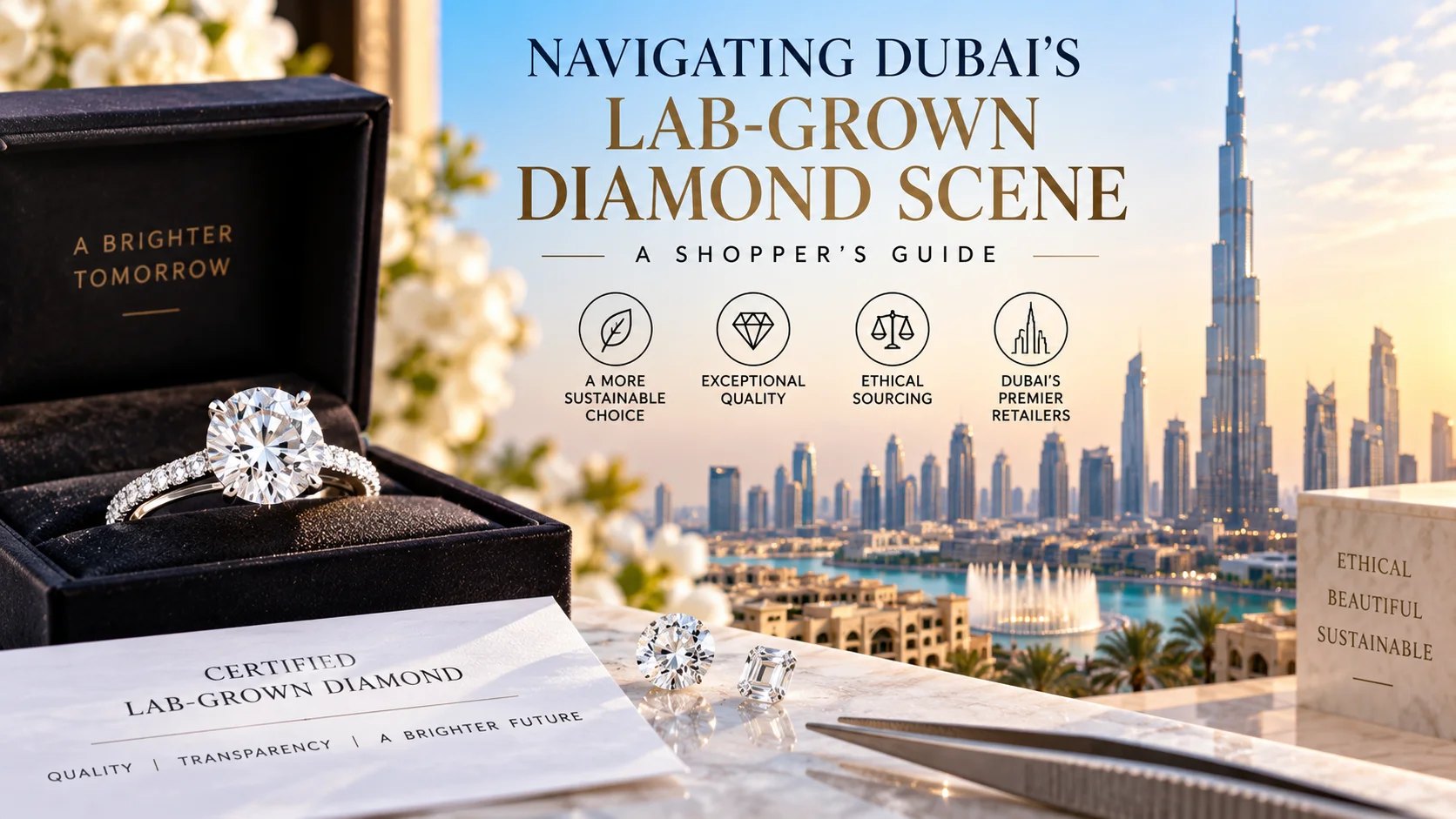
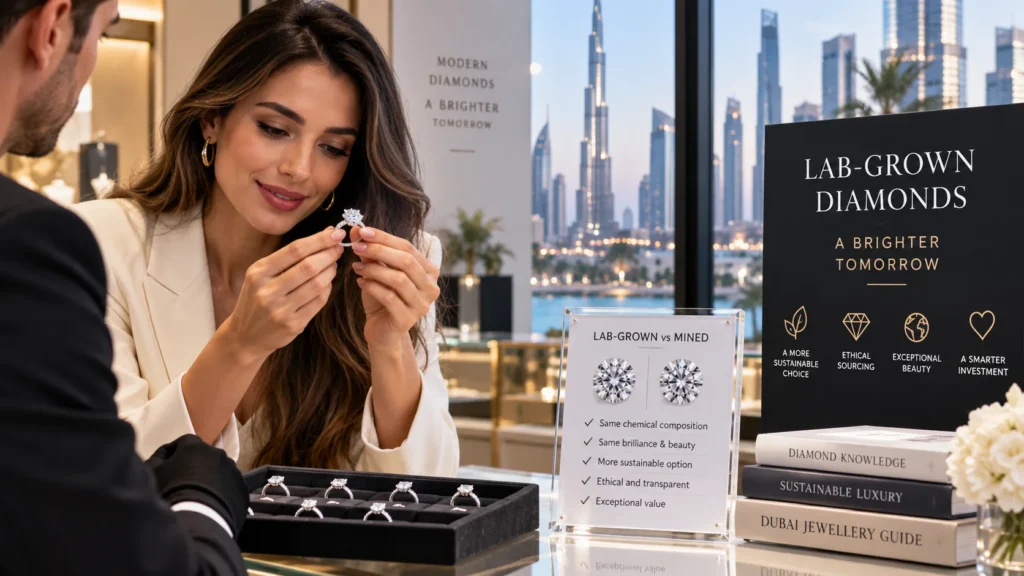
Shopping for lab-grown diamonds in Dubai can be an exciting experience, but it is important to know what you are buying before choosing a stone or piece of jewellery. From understanding how laboratory-grown diamonds are made to checking certification, comparing the 4Cs and evaluating environmental claims, a little research can make the buying process much easier.
Dubai has a well-established jewellery and diamond market, giving shoppers access to a wide range of styles and retailers. If you are considering a lab-grown diamond ring, engagement ring or another piece of jewellery, understanding the differences between laboratory-grown and mined diamonds can help you ask better questions and compare products more confidently.
This guide explains lab-grown diamonds in Dubai, how they are produced, what to look for when shopping, how certification works, and which questions to ask before making a purchase.
What Are Lab-Grown Diamonds?
Lab-grown diamonds, also called laboratory-grown or laboratory-created diamonds, are diamonds produced in a controlled technological environment rather than formed naturally beneath the Earth’s surface. They are not the same as diamond simulants such as cubic zirconia because laboratory-grown diamonds have essentially the same chemical, physical and optical properties as natural diamonds.
According to the Gemological Institute of America (GIA), laboratory-grown diamonds can be produced using two main methods: High Pressure High Temperature (HPHT) and Chemical Vapor Deposition (CVD). GIA also notes that advanced gemological testing can distinguish laboratory-grown diamonds from natural diamonds. :contentReference[oaicite:0]{index=0}
For shoppers, the most important distinction is therefore the diamond’s origin. A laboratory-grown diamond is a real diamond, but it is not a mined diamond. This distinction should be clearly disclosed when the stone is sold or advertised.
The U.S. Federal Trade Commission’s jewelry advertising guidance similarly recommends that laboratory-grown diamonds be clearly described as laboratory-grown, laboratory-created or an equivalent term so consumers understand that they are not mined diamonds. :contentReference[oaicite:1]{index=1}
How Are Lab-Grown Diamonds Made?
Understanding the production method can help you make sense of the information provided on a diamond report. The two major laboratory-growth technologies are HPHT and CVD.
HPHT Diamonds
HPHT stands for High Pressure High Temperature. This method recreates extremely high-pressure and high-temperature conditions that encourage carbon to crystallise around a diamond seed.
HPHT-grown diamonds can have different colours and identifying characteristics depending on their growth conditions and any treatment performed after growth. Gemological laboratories can use these characteristics as part of the identification process. :contentReference[oaicite:2]{index=2}
CVD Diamonds
CVD stands for Chemical Vapor Deposition. In this process, diamond material grows from a seed inside a controlled chamber containing carbon-rich gases. Energy is used to create a plasma that enables carbon to deposit onto the diamond seed layer by layer.
GIA research notes that CVD has become a major source of laboratory-grown diamonds submitted for grading and that some CVD diamonds undergo post-growth HPHT treatment to modify colour. :contentReference[oaicite:3]{index=3}
Are Lab-Grown Diamonds Real Diamonds?
Yes. A laboratory-grown diamond is not simply a look-alike gemstone. Gemological sources describe laboratory-grown diamonds as having essentially the same chemical, physical and optical properties as natural diamonds.
The important difference is how the diamond was formed. Natural diamonds develop through geological processes, while laboratory-grown diamonds are produced using controlled technology.
This distinction also explains why shoppers should not confuse lab-grown diamonds with diamond simulants. A simulant is another material designed to resemble a diamond, whereas a laboratory-grown diamond is diamond material produced in a laboratory environment.
Lab-Grown Diamonds vs. Mined Diamonds
The choice between a laboratory-grown and mined diamond ultimately depends on what matters most to the individual buyer. The two options differ primarily in origin, while laboratory-grown diamonds share many of the fundamental material properties of natural diamonds.
| Factor | Lab-Grown Diamond | Mined Diamond |
|---|---|---|
| Origin | Produced in a controlled laboratory or manufacturing environment | Formed naturally through geological processes |
| Material | Diamond | Diamond |
| Common production method | HPHT or CVD | Natural geological formation |
| Can it be identified? | Yes, using specialised gemological testing | Yes, through gemological examination and testing |
| 4Cs | Colour, clarity, cut and carat can be evaluated | Colour, clarity, cut and carat can be evaluated |
| Environmental considerations | Depend on production technology and energy sources | Depend on mining methods, location and supply chain |
The table highlights why it is useful to look beyond general labels such as “eco-friendly” or “ethical.” The environmental and social characteristics of a particular diamond depend on its production or mining practices and the evidence provided by the seller.
The Sustainability Question: Look Beyond the Marketing
Environmental considerations are one reason some consumers investigate laboratory-grown diamonds. However, it is too broad to describe every lab-grown diamond as automatically “environmentally friendly” or “sustainable.”
Laboratory production requires energy, and the environmental impact can vary according to the technology used, the efficiency of the facility and the source of the electricity. Therefore, shoppers interested in sustainability should ask the retailer for specific information rather than relying only on general marketing language.
The U.S. Federal Trade Commission advises businesses to have a reasonable basis for environmental benefit claims and warns against broad, unqualified claims such as “environmentally friendly” when they cannot be substantiated. :contentReference[oaicite:4]{index=4}
Instead of simply asking whether a diamond is sustainable, consider asking: Where was it produced? What growth method was used? What information is available about the energy used? Can the retailer substantiate its environmental claims?
What About Ethical Sourcing?
Lab-grown diamonds can appeal to consumers who want an alternative to mined stones, but it is still important to examine the specific company and supply chain. The fact that a diamond is laboratory-grown does not, by itself, provide a complete picture of every social or environmental characteristic associated with the business producing or selling it.
Rather than assuming that every laboratory-grown diamond automatically meets a particular ethical standard, ask retailers about manufacturing, labour practices, sourcing policies and documentation where those factors are important to you.
Debunking Common Lab-Grown Diamond Myths
Myth 1: Lab-Grown Diamonds Are Fake
This is one of the most common misconceptions. Laboratory-grown diamonds are diamond material and have essentially the same chemical, physical and optical properties as natural diamonds. They are different from diamond simulants.
Myth 2: You Can Easily Tell a Lab-Grown Diamond by Looking at It
In many cases, visual inspection alone is not enough to reliably determine whether a diamond is laboratory-grown or natural. GIA explains that specialised equipment and advanced testing are used to make reliable identifications. :contentReference[oaicite:5]{index=5}
Myth 3: Every Lab-Grown Diamond Has the Same Quality
Laboratory-grown diamonds can vary considerably in colour, clarity, cut, carat weight and other characteristics. GIA evaluates laboratory-grown diamonds using established gemological criteria, and the quality of an individual stone still matters when comparing products. :contentReference[oaicite:6]{index=6}
Myth 4: A Lab-Grown Diamond Is Automatically a Better Investment
A purchase decision should not be based on an assumption that a laboratory-grown diamond will appreciate in value. Jewellery pricing, resale demand, retailer margins and market conditions can all affect what a buyer may recover when reselling a diamond.
If resale matters to you, ask the retailer about its current buyback or upgrade policies and research the terms carefully before purchasing.
Where to Find Lab-Grown Diamonds in Dubai
Dubai shoppers can find laboratory-grown diamond jewellery through specialist jewellers and other retailers. However, availability, collections, showroom locations and appointment requirements can change, so it is worth checking the retailer’s current information before visiting.
For example, Fergus James currently advertises laboratory-grown diamonds in the UAE and lists a Dubai location in Jumeirah Lake Towers where visits are available by appointment. :contentReference[oaicite:7]{index=7}
The original article also mentioned Brilliant Earth as a source of laboratory-grown diamonds. Before presenting any retailer as a current Dubai showroom or local retailer, verify its present Dubai availability, because an international retailer’s online availability does not necessarily mean it operates a physical Dubai store.
How to Choose a Lab-Grown Diamond in Dubai
Once you have found a retailer, the next step is comparing individual stones rather than choosing solely by appearance or carat weight.
1. Start With the 4Cs
The 4Cs—Cut, Color, Clarity and Carat Weight—are the standard framework used to describe diamond quality. GIA describes the 4Cs as the international language of diamond quality. :contentReference[oaicite:8]{index=8}
Cut
Cut affects how a diamond interacts with light and can have a major influence on its appearance. Do not assume that a higher carat weight automatically means a more attractive stone.
Color
Diamond colour is graded according to recognised systems. Depending on the stone and setting, small differences in colour may be more or less noticeable to the eye.
Clarity
Clarity describes internal and external characteristics of a diamond. Laboratory-grown diamonds can have their own identifying clarity characteristics, which are evaluated using recognised terminology and scales. :contentReference[oaicite:9]{index=9}
Carat Weight
Carat refers to weight, not simply visual size. Two diamonds with the same carat weight can appear different depending on their proportions, cut and shape.
Check the Diamond Report
A laboratory report can provide important information about the stone you are considering. GIA has graded laboratory-grown diamonds since 2007, and its laboratory-grown diamond reports identify the growth method, such as CVD or HPHT, and may note evidence of post-growth colour treatment. :contentReference[oaicite:10]{index=10}
When shopping, check that the report corresponds to the exact stone being offered. Compare the report number, measurements, carat weight, colour, clarity, cut information and any relevant treatment details with the retailer’s product description.
GIA also provides verification tools for its reports, allowing consumers to check report information against its database. :contentReference[oaicite:11]{index=11}
Can a Jeweller Tell if a Diamond Is Lab-Grown?
Identifying laboratory-grown diamonds can require specialised equipment. GIA explains that traditional visual observations and basic diamond detectors may not reliably distinguish laboratory-grown diamonds from natural diamonds because of their similar chemical and optical properties.
Advanced gemological laboratories use specialised instruments and analytical methods to identify growth-related characteristics. :contentReference[oaicite:12]{index=12}
This is another reason why an independent laboratory report can be useful when purchasing a higher-value diamond.
Questions to Ask a Dubai Diamond Retailer
Before purchasing a lab-grown diamond in Dubai, consider asking the retailer the following questions:
- Is the diamond laboratory-grown or mined?
- Was the diamond produced using HPHT or CVD?
- Does the diamond have an independent grading or identification report?
- Which laboratory issued the report?
- Can I verify the report number?
- Has the diamond received any post-growth treatment?
- What are the exact 4Cs?
- What is the return or exchange policy?
- Does the retailer offer an upgrade or buyback programme?
- Are there additional charges for the setting, resizing or delivery?
- Can you provide documentation supporting any environmental claims?
- What warranty is included with the jewellery?
Check the Return, Warranty and Upgrade Policies
A diamond may look different in person than it does in photographs or online videos. Before completing your purchase, read the retailer’s return and exchange conditions carefully.
Also ask whether the jewellery comes with a warranty and whether resizing is included. If you are buying an engagement ring, find out whether the retailer offers future upgrades or trade-in options and understand the conditions attached to those programmes.
Consider the Ring Setting and Metal
The diamond is only one part of a finished piece of jewellery. The setting, metal, craftsmanship and overall design can significantly influence the appearance and long-term practicality of a ring.
Popular choices include solitaire, halo, three-stone and bezel settings, while metals may include platinum, white gold, yellow gold and rose gold. Choose a setting based on personal style, lifestyle and how much protection the stone needs.
Compare Diamonds by Overall Value, Not Just Carat
One of the easiest mistakes when shopping for diamonds is focusing almost entirely on carat weight. A larger stone is not necessarily the best match for your budget or preferences.
Instead, compare the complete specification: cut, colour, clarity, carat weight, shape, fluorescence where relevant, report information, treatments, setting and total price.
Two diamonds with similar carat weights can have noticeably different prices because their quality characteristics and market positioning differ.
Lab-Grown Diamond Pricing in Dubai
The price of a laboratory-grown diamond depends on several factors, including carat weight, cut, colour, clarity, shape, certification, brand, setting and current market conditions.
Rather than relying on a single price-per-carat figure, compare diamonds with similar specifications and documentation. Make sure you are comparing like-for-like products and that the quoted price includes the same components.
Common Mistakes to Avoid When Buying Lab-Grown Diamonds
- Buying based only on carat weight: Consider all of the 4Cs and the overall appearance.
- Ignoring the grading report: Ask for documentation that identifies the individual stone.
- Assuming every environmental claim is equivalent: Ask for evidence behind sustainability statements.
- Confusing lab-grown diamonds with simulants: Confirm what material you are actually purchasing.
- Skipping the return policy: Understand the retailer’s conditions before paying.
- Not checking the report: Verify the report number when an independent report is provided.
- Assuming all retailers have physical Dubai stores: Confirm the current showroom location and appointment requirements.
- Choosing a setting without considering lifestyle: Think about durability, comfort and everyday wear.
A Simple Dubai Lab-Grown Diamond Shopping Checklist
Before you make your purchase, use this quick checklist:
- ☐ Confirm that the stone is laboratory-grown.
- ☐ Ask whether it was produced using HPHT or CVD.
- ☐ Review the 4Cs.
- ☐ Request the laboratory report.
- ☐ Verify the report information.
- ☐ Ask about post-growth treatments.
- ☐ Compare the complete price, not just the carat price.
- ☐ Check the return and warranty policies.
- ☐ Ask about resizing and future upgrades.
- ☐ Research any sustainability claims that influence your decision.
- ☐ Check the retailer’s current Dubai location and appointment requirements.
Frequently Asked Questions About Lab-Grown Diamonds in Dubai
Are lab-grown diamonds real diamonds?
Yes. Laboratory-grown diamonds are diamond material with essentially the same chemical, physical and optical properties as natural diamonds. Their key difference is their origin: they are produced in a controlled laboratory environment rather than formed naturally underground. :contentReference[oaicite:13]{index=13}
What are the two main types of lab-grown diamonds?
The two main growth methods are HPHT, or High Pressure High Temperature, and CVD, or Chemical Vapor Deposition. Both methods can produce gem-quality diamonds. :contentReference[oaicite:14]{index=14}
Can you tell a lab-grown diamond from a natural diamond by looking at it?
Not reliably in many cases. Because laboratory-grown diamonds share many of the same physical and optical properties as natural diamonds, specialised gemological testing may be required to identify their origin. :contentReference[oaicite:15]{index=15}
Do lab-grown diamonds have the 4Cs?
Yes. Colour, clarity, cut and carat weight are important quality characteristics for laboratory-grown diamonds as well as natural diamonds. GIA reports for laboratory-grown diamonds provide information about these characteristics. :contentReference[oaicite:16]{index=16}
Are lab-grown diamonds more sustainable?
There is no single answer that applies equally to every laboratory-grown diamond. Environmental impact depends on factors such as production technology, energy sources and manufacturing practices. If sustainability is important to you, ask the retailer for specific evidence supporting its environmental claims rather than relying on broad marketing language. :contentReference[oaicite:17]{index=17}
Should I buy a certified lab-grown diamond?
An independent laboratory report can make it easier to verify the identity and quality characteristics of a diamond. When a report is supplied, check that it corresponds to the exact stone and verify the report information through the issuing laboratory where possible.
Are lab-grown diamonds available in Dubai?
Yes, laboratory-grown diamond jewellery is available through retailers serving the Dubai market. Availability and showroom arrangements can change, so confirm current stock and appointment requirements directly with the retailer before visiting.
Can I buy a lab-grown engagement ring in Dubai?
Yes. Lab-grown diamonds can be used in engagement rings and other jewellery designs. When comparing rings, consider the diamond’s 4Cs, report, setting, metal, warranty, return policy and overall price.
Final Thoughts: Shopping for Lab-Grown Diamonds in Dubai
Navigating the lab-grown diamond Dubai market becomes much easier when you know what to check. Start by understanding the difference between laboratory-grown diamonds, natural diamonds and simulants. Then compare the 4Cs, review the diamond report, ask about the growth method and investigate any claims that are important to you.
Most importantly, look beyond the sparkle. A well-informed purchase involves understanding the stone’s origin, quality characteristics, documentation, setting, retailer policies and total cost.
Whether you are shopping for an engagement ring, wedding jewellery or a special gift, taking the time to compare individual stones and ask detailed questions can help you make a purchase that fits your preferences and budget.