
Stone Plastic Composite flooring didn’t stay a niche product for long. Southeast Asia’s flooring market was valued at roughly USD 29 billion in 2024 and is on track to approach USD 50 billion by 2033, and SPC is one of the categories pulling that growth global SPC flooring demand is projected to grow at close to 17% a year through the next decade, with Asia-Pacific expanding even faster than the global average. Every brand riding that wave eventually hits the same wall: the flooring is only as good as the adhesive holding it down, and building an in-house adhesive line from scratch is rarely worth it for a flooring or panel brand whose core business is the panel, not the chemistry.
That’s where OEM manufacturing comes in and where the search for the right Thai partner usually gets harder than expected.
Why “wood substitute” adhesive is its own category
SPC, WPC, and other wood-substitute panel materials don’t behave exactly like solid timber or like ceramic tile. They expand and contract differently, they’re often installed over subfloors that aren’t perfectly flat, and the bonding agent needs to handle both structural hold and a certain amount of movement without cracking. A generic construction adhesive formulated for concrete-to-concrete bonding isn’t automatically the right fit.
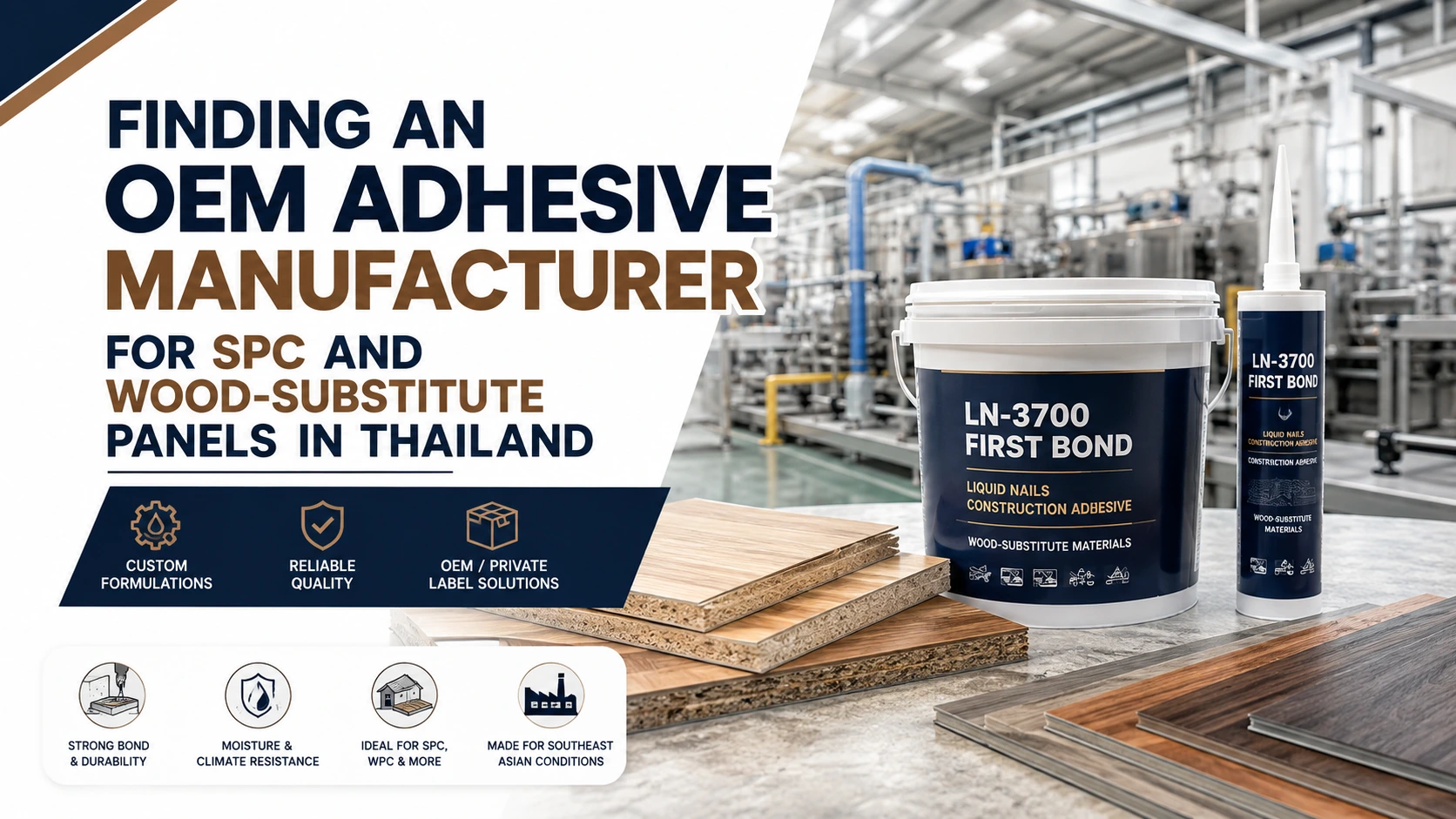
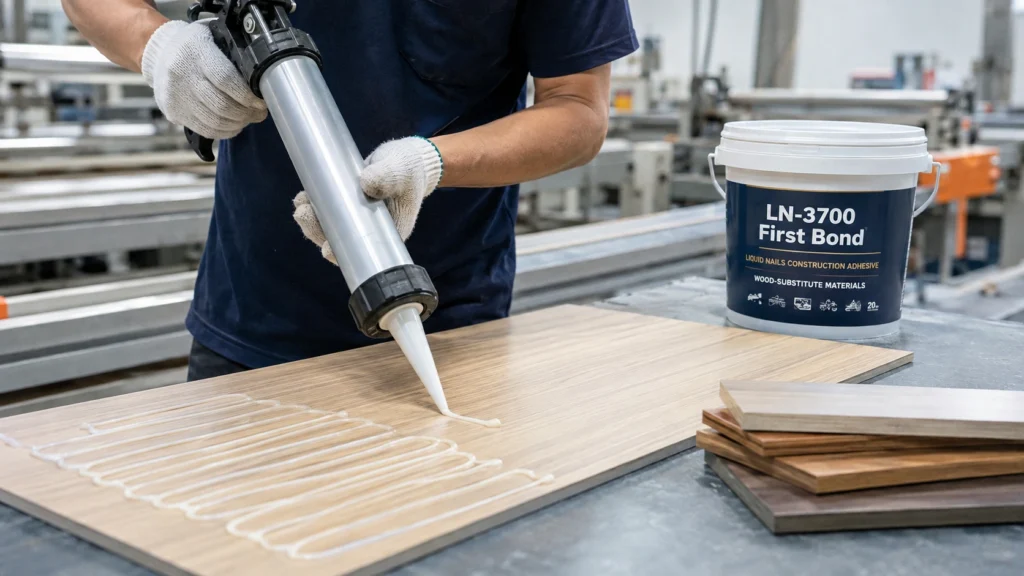
This is a niche First Sealant Technology already produces into, even if it isn’t labeled “SPC glue” on the shelf. Their LN-3700 First Bond Liquid Nails Construction Adhesive is formulated specifically for mirror work, moulding, wood stairs, furniture assembly, and notably “wood-substitute materials,” which is exactly the category SPC and WPC panels fall under, alongside tile and small-format marble work. It’s a real product line, not a hypothetical one, which matters when you’re evaluating whether a factory can actually deliver what an OEM brief asks for versus just agreeing to try.
What to actually vet before signing an OEM agreement
Manufacturing footprint, not just a sales office. First Sealant operates production in Thailand and Singapore, with an in-house R&D laboratory and automated production lines, the kind of setup that supports both consistency at scale and the ability to adjust a formulation for a specific OEM brief, rather than reselling a fixed catalog under someone else’s label.
Where the raw materials come from. Formulation quality in adhesives traces back almost entirely to input chemistry. First Sealant sources raw materials from the UK, Japan, and the US established supply chains for polymer and resin inputs rather than relying on a single, harder-to-verify local source.
Export and cross-border track record. A factory that has never shipped outside its home country is a bigger unknown for an OEM relationship than one that already has. First Sealant’s products currently reach Laos, Myanmar, Indonesia, and Malaysia, which means the documentation, packaging durability, and consistency needed for export orders aren’t being built from zero.
What “adjustable formulation” means in practice
An OEM brief rarely arrives as a blank slate; it usually starts with an existing product the brand likes, plus a list of things they’d change. Faster tack time so installers can walk on the floor sooner. A slightly different odor profile because a retail partner complained. Cold-weather cure performance for a market outside Southeast Asia. Whether a factory can absorb that kind of request without restarting the whole formulation process depends entirely on whether the R&D work happens in-house or gets outsourced to a chemical supplier upstream.
That distinction rarely shows up on a factory’s website. It shows how specific and how fast the technical team’s answers are during the first real conversation whether “let us check with our chemist” takes a day or three weeks.
A realistic scenario
Consider a mid-sized flooring importer in Vietnam or Indonesia that currently private-labels its SPC planks from a Chinese factory but wants to bundle a matching installation adhesive under its own brand for the regional market. Sourcing that adhesive from the same flooring factory is often the easy default but it’s rarely their core competency, and quality on the bonding side can be inconsistent compared to a supplier that specializes in sealants and adhesives specifically.
A dedicated adhesive manufacturer in Thailand, with its own chemistry R&D and a facility built for this category, is frequently the stronger technical fit even if it means managing one additional supplier relationship. The tradeoff usually pays for itself the first time a customer complaint about adhesive failure doesn’t land on the importer’s desk.
Why climate tolerance deserves more attention than it gets
An adhesive formulated and tested in a temperate market doesn’t automatically perform the same way in Bangkok’s humidity or a coastal Indonesian warehouse with no climate control. Moisture-related bond failure is one of the more common and more preventable complaints in SPC panel installation, and it traces back more often to the adhesive’s humidity tolerance than to the panel itself. A Thailand-based manufacturer that formulates and tests under the exact conditions the finished product will be installed in has a practical advantage here that’s easy to overlook when comparing spec sheets side by side.
Questions worth putting to any OEM candidate
Before committing to a private-label adhesive run, ask:
- What’s the minimum order quantity, and does it scale with panel volume or run independently?
- Can the formulation be adjusted for local climate humidity tolerance matters more in Southeast Asia than in temperate export markets?
- What packaging and labeling flexibility exists for private-label runs?
- Is there a sample or small-batch trial process before committing to a full production order?
These aren’t questions a catalog page answers. They’re questions for a direct conversation with the factory’s technical team.
Starting that conversation
First Sealant Technology’s covers the production footprint and materials sourcing referenced above includes OEM wood SPC glue Thailand and SPC glue OEM manufacturer Thailand. For OEM terms, minimum order quantities, and formulation specifics for SPC or wood-substitute panel adhesive, the most reliable next step is contacting their team directly at 096-818-9168, 097-959-5111, or 097-959-1222 during business hours (Monday–Saturday, 08:30–17:30).
Market figures cited above are drawn from published industry research (IMARC Group, Southeast Asia flooring market; global SPC flooring market growth estimates) and are provided for general context, not as a guarantee of any specific outcome. Confirm OEM capacity, pricing, and formulation details directly with the manufacturer.