
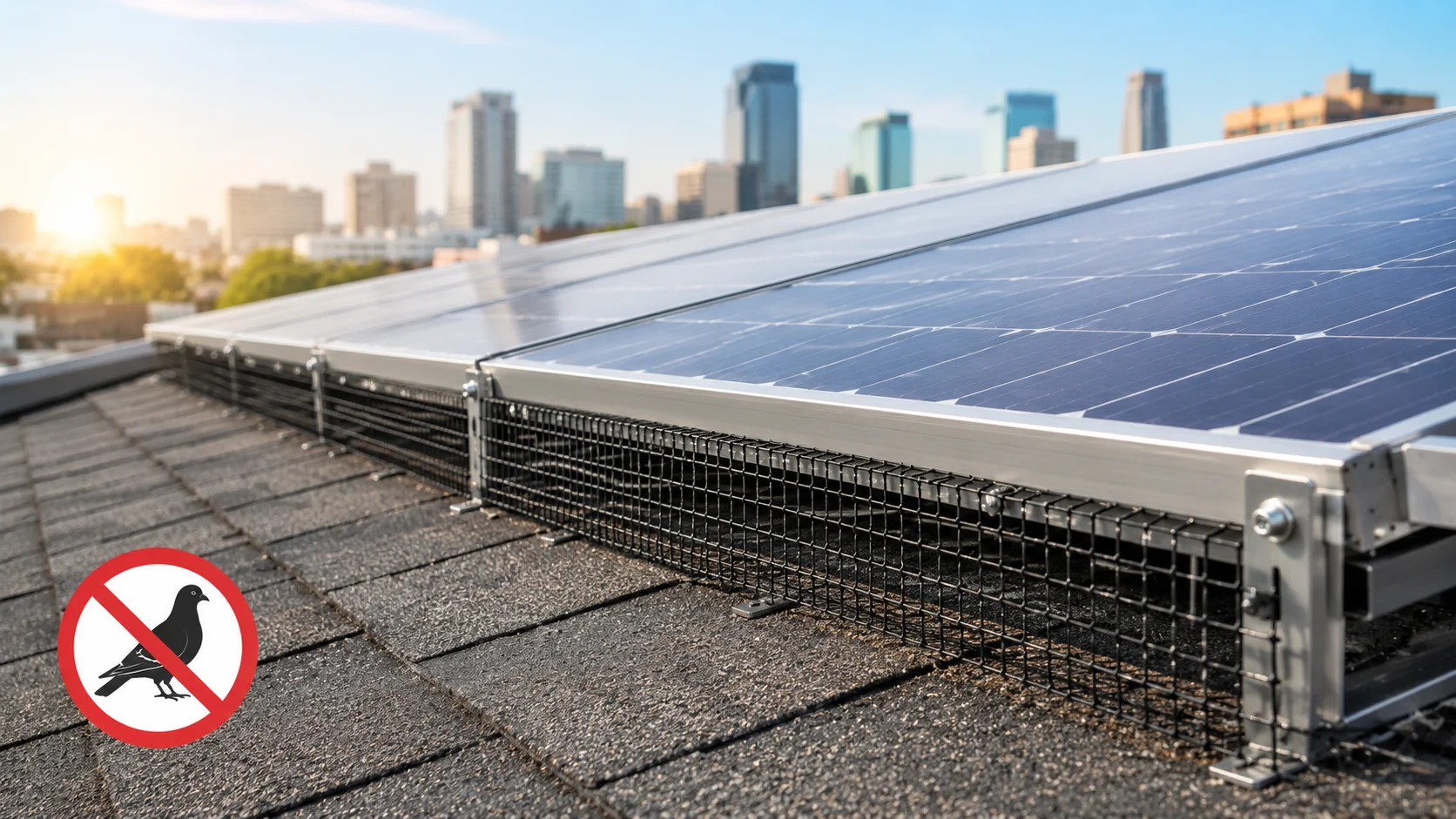
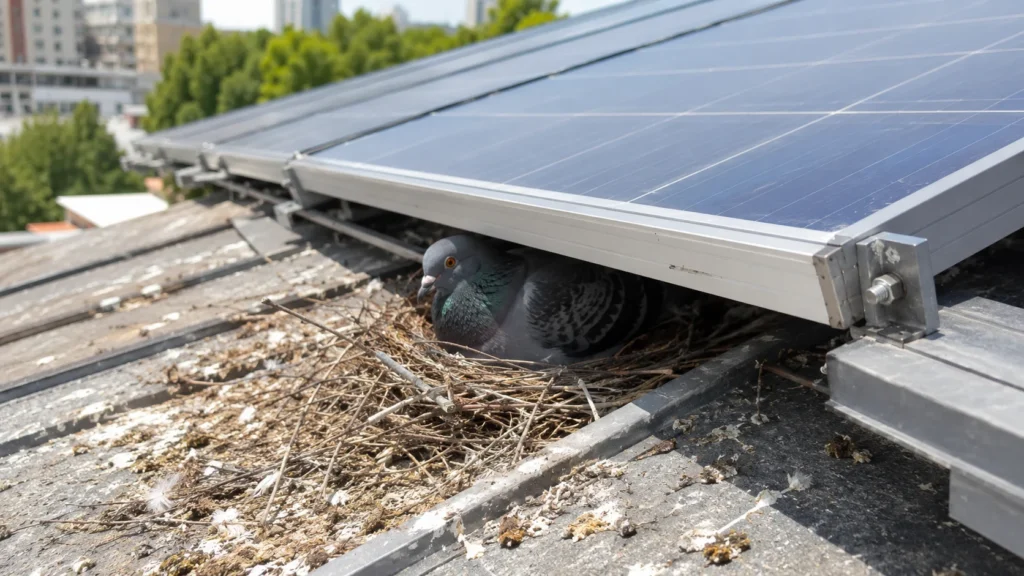
Solar panels are expensive and feral pigeons like to nest underneath them. Knowing why they nest there and what it does to your system, is the first step in protecting your investment before the damage adds up. Left unchecked, a nesting problem can quietly chip away at both the performance of your system and the lifespan of your roof. The good news is that once you understand the risk, it’s a straightforward one to prevent.
The Gap Under Your Panels Is Prime Real Estate
The space between PV panels and your roof deck isn’t wasted space – from a bird’s perspective, it’s ideal. The panels radiate warmth from the underside, the roof surface holds heat, and the gap stays shaded during the hottest part of the day. For feral pigeons, that microclimate checks every box: warmth, shelter from rain, and physical protection from aerial predators like hawks that can’t maneuver in a tight space.
Once a pair establishes a nest, others follow. Pigeons are colonial birds, and an occupied array signals to others that the location is safe. Within a season, what started as one nest can become a full colony, and the damage scales with the population.
How Guano Degrades Your Panels And Your Roof
Bird droppings are not only unattractive, but they contain high levels of acid. When droppings land on a solar system, they can hit anodized aluminum frames, cell covers, junction boxes, cables, mounting hardware, and other surfaces. Eventually, the acid in the droppings will eat through any protective coatings and begin to cause even more damage.
The even more costly damage is what droppings do to a panel’s power generation output. When droppings are present on a solar panel’s surface, they create tiny points of shade. Photovoltaic cells generate electricity based on whole, direct exposure to photons, so shading doesn’t merely cause a cell to underperform. It forces other cells to work against the current, as a shaded cell becomes a consumer of energy instead of a producer. These shaded cells become thermal hotspots as they overheat, which will eventually cause microcracks and permanent damage to the entire cell. Soiling from organic matter – birds, insects, etc. – can reduce a solar panel’s power output by as much as 25% or more in high-soiling areas.
That’s not a minor hit. On a system you paid tens of thousands to install, a sustained 20-25% efficiency loss means years of delayed payback. Getting ahead of the problem often starts with a professional pigeon control service that can assess the damage and clean things up safely before exclusion work begins.
Nesting Debris Is A Fire Hazard
Bird nesting debris is highly flammable and a serious fire risk. Fires spread rapidly under a solar array where they are difficult to detect and can damage associated structural components and leave monitoring systems inoperable.
Dry nesting material within an array heats up, and the accumulated debris decreases airflow, which raises panel operating temperature and decreases efficiency. The drier the nesting material, the more potential fuel there is, and temperatures may also run high enough to ignite plastic components, which can further fuel a fire.
Buildup of organic nesting material stores moisture against your roof and provides a breeding ground for mold and mildew. Wet insulation performs poorly and also invites pests looking to establish their nest in a cozy spot. Wet nesting material and pests cause mechanical and electrical issues and invite bacterial growth that can further deteriorate your assets.
Why You Shouldn’t Clean This Up Yourself
When guano dries, it becomes friable – it crumbles and releases fine particles into the air. Those particles can carry Histoplasma capsulatum, the fungal spores responsible for histoplasmosis, a respiratory infection that ranges from flu-like symptoms to serious lung involvement. Scraping or brushing dried droppings without proper respiratory protection and containment puts you at a real risk.
There’s also a warranty issue. Most solar panel manufacturers include language that voids the warranty if the anti-reflective coating is scratched or the frame is damaged during improper cleaning. Pressure washing seems like the obvious solution, but the pressure required to remove dried guano is often enough to scratch that coating or force water into junction boxes. It’s the kind of mistake that costs more than hiring someone to do it correctly.
Before any physical exclusion work can happen, the existing nests have to be removed, and the area needs to be properly sanitized.
Also worth knowing: bird nests are home to secondary pests – mites, ticks, and beetles that live in the nesting material. Once a nest is disturbed or abandoned, those parasites look for new hosts and often migrate through roof vents into the attic and interior spaces.
Physical Exclusion Is The Only Permanent Fix
Plastic owls, reflecting tapes, audio repellents – pigeons will habituate in weeks. They’ve learned to live around humans their entire lives. A fake predator that never moves isn’t a threat; it’s furniture. Tightly applied solar bird mesh doesn’t let them physically access the gap, so they move on quickly.
Bird spikes have some use on roof ridges and ledges to prevent landing near the panels, but as an exclusion tool on the edges of the array, they don’t work. Spikes only work on the lead-offs and their protrusion depth tends to be unattractive to installers and isn’t needed if the mesh is already tightly sealed to the surface.
Protecting The Investment You’ve Already Made
Installing solar panels requires a long-term financial commitment. However, the return on investment depends on the performance of these panels as they need to operate at their rated output capacity for several decades. Pigeon nesting can be detrimental to the efficiency of the panels in many ways. It can lead to loss of efficiency, structural damage, fire, and roof degradation. These issues might not be immediately noticeable but can compound over the years.
Therefore, after investing in a professional cleanup, installing critter guards isn’t an additional expense, it’s a necessity to ensure the longevity of the system and its performance.