
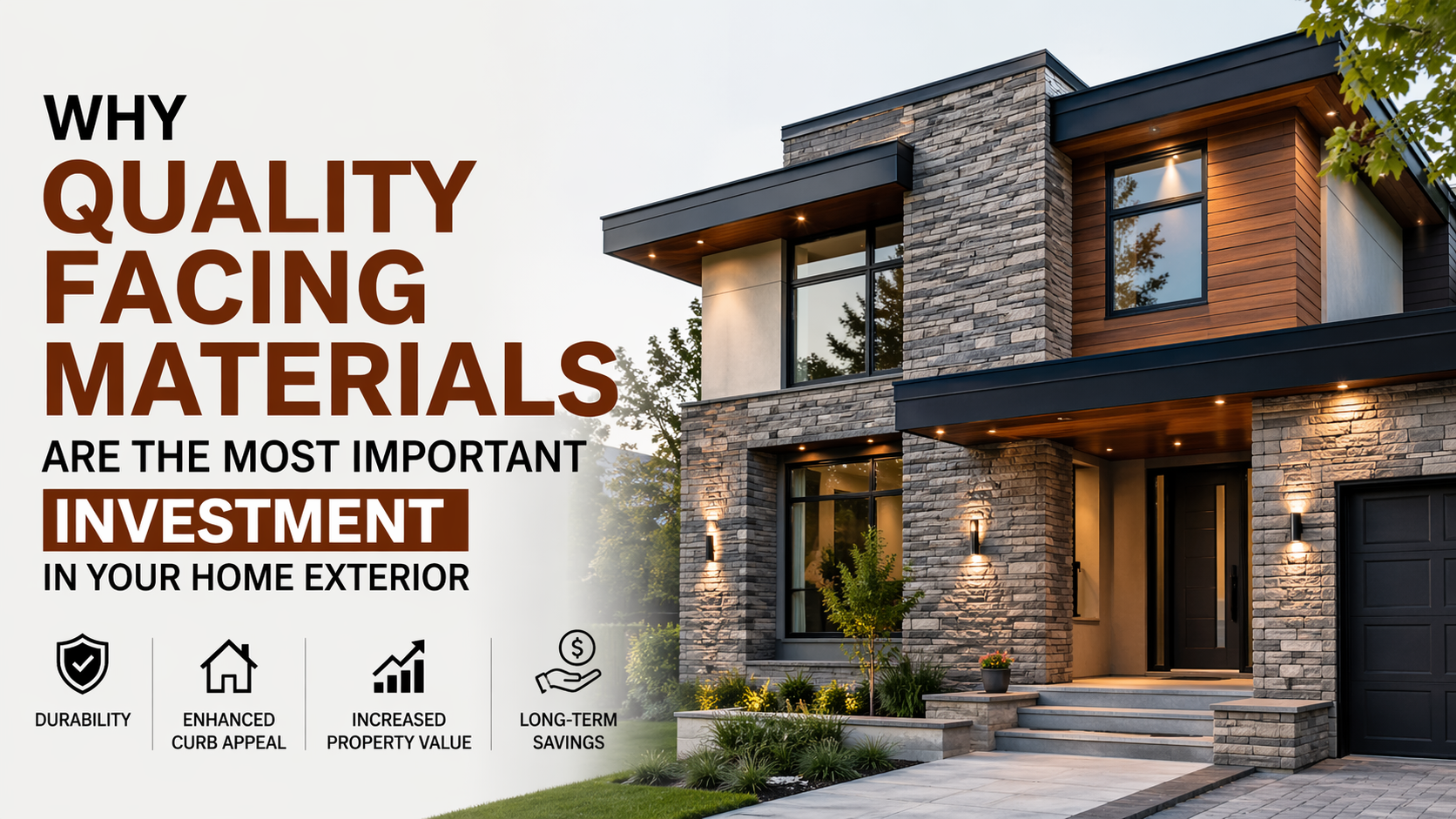
The front of a house has a tougher job than all the rest of the building, it has to safeguard everything inside, a huge and expensive task. All the choices you make about kitchens, floors, and insulation are parked right on the other side of that skin, which is why the decision on what material to use for your façade isn’t an aesthetic one, it’s a structural and financial one. Viewing it as something to skimp on is up there with grafting a swimming pool onto a terraced house on the list of most expensive mistakes a homeowner can make.
The Real Cost of Cheap Cladding
Artificial renders and substandard facing materials do have one benefit: a lower figure on the estimate. But it’s a very short-term gain.
Look at the annualized cost of a clay brick front over its life, 50 to 100 years, no repaint, no re-render, and minimal maintenance, and the cost per square meter per year will hardly register. A cheaper alternative that needs recoating every 8 to 10 years, or shows cracking within a decade, doesn’t just cost money to fix. It costs time, disruption, and often scaffolding fees that dwarf the original saving. The “cost per year” framing is the honest one. A premium material that lasts 75 years without intervention is almost always cheaper than a budget material that needs attention every decade, even if the upfront price is double.
How Clay Bricks Handle Moisture – and Why it Matters
Moisture is one of the durable problems of modern housing, the kind that over time destroys the plaster, the timber, and the insulation. Look behind the damage and more often than not you’ll find an exterior material that doesn’t breathe.
Genuine fired clay facing bricks from Southern Brick are by contrast naturally porous. A brick manageably absorbs a tiny quantity of the water from rain, and as conditions change, it releases that moisture again. The mortar between the bricks acts as a buffer, too, absorbing its own share of the moisture that’s under absorption pressure. The wall is breathing, as builders put it, and the process of capillary suction as water is drawn out of the mortar joints and face of the brick spreads the moisture relatively quickly and evenly across the wall.
This can only happen effectively because the clay body of the brick has a specific, correctly engineered porosity. An efficient level of incoming water is released quickly and without stress to the fabric. Bricks with this level of porosity achieve it by design, firing the clay body in such a way as to produce an open internal system of microscopic voids. This porosity is measured according to precise international standards and, unlike a claim of being sustainable or natural, tells you something real about the quality and longevity of the material: high-fired, correctly engineered porosity, low porous absorption, and low transfer of water. This is a brick that is low maintenance over its lifetime.
What Surveyors Actually See
Potential buyers and surveyors form an impression of a building long before they walk through the front door. The appearance of a property’s exterior immediately communicates the likely quality of what’s inside, and that estimation has a financial impact.
Research by the Royal Institution of Chartered Surveyors (RICS) has shown that high-quality external finishing and facades, and good “curb appeal” contribute up to 10% of a property’s total residential value. This is not simply an issue of form over function. A well-specified, efficient façade indicates to a surveyor that good material choices have been made throughout, while poor cladding suggests the reverse.
So, the exterior is not just a building’s outer coat, it’s a marketing tool. It establishes expectations, which influence potential sale and rental values for the whole building.
Material Selection and Architectural Character
The aesthetic choices in facing bricks go beyond the mortar joint colour, too. The format of the brick will determine the scale of the build, from traditional through to ultra-modular and oversized one-piece or even thin bricks that can be front fixed or even be used as a tile. Again, creativity can be king here, with feature walls or incredible patterns achievable if the right format of facing brick is used in the hands of a skilled bricklayer.
Then there is the general performance of the material to be considered. Even though the thermal performance of a single brick is not going to alter a lot between strong, engineering, and other types, any external insulation will depend on the width and porosity, as will issues like resistance to frost and exposure grading. Formulations now exist that provide the aesthetics but with an extraordinarily low absorbance rate.
The Environmental Case For Quality Materials
Selecting materials from well-known manufacturers reduces the overall carbon footprint more than you think. For example, a clay brick made in an energy-efficient kiln from locally sourced clay, especially engineered to last 100 years without failure and replacement, has a far better lifecycle performance than a synthetic that frequently contributes to landfill and replacement over time.
Then there is the reclamation side. Fired clay bricks have resale value as long as they can be cleaned and reused after removal. The material, thus, remains in a cyclical mode rather than in the waste cycle. This aspect of sustainable argument also often gets missed when comparing first costs.
Good brick manufacturers are also serious about mortar compatibility as well, and the fact that a spent material like brick can be crushed, integrated as pozzolanic material and broken aggregate, or simply made a fill material for a future land reclamation emphasizes just how important these seemingly minor factors can be in application.
The exterior is the only part of your home that every other investment depends on. It’s not where you cut the budget.