
E Find Anything
Saturday, April 18, 2026
  • Home
  • Health & Fitness
  • Technology
  • Pets
  • Business
  • Financial Services
  • Home Products & Services
  • Other Categories
    • Cars & Other Vehicles
    • E Money
    • Education
    • Entertainment
    • Foods
    • Games
    • Lifestyle
    • Other
    • People and Society
    • Relationships
    • Spirituality
    • Travel
  • About Us
  • Contact Us
No Result
View All Result
  • Home
  • Health & Fitness
  • Technology
  • Pets
  • Business
  • Financial Services
  • Home Products & Services
  • Other Categories
    • Cars & Other Vehicles
    • E Money
    • Education
    • Entertainment
    • Foods
    • Games
    • Lifestyle
    • Other
    • People and Society
    • Relationships
    • Spirituality
    • Travel
  • About Us
  • Contact Us
No Result
View All Result
E Find Anything
No Result
View All Result
Home Technology

The Role of Internet Providers in Your Online Privacy

Bryan Davis by Bryan Davis
March 26, 2026
in Technology
Reading Time: 5 mins read
0
0
SHARES
12
VIEWS
Share on FacebookShare on Twitter
internet providers and online privacy

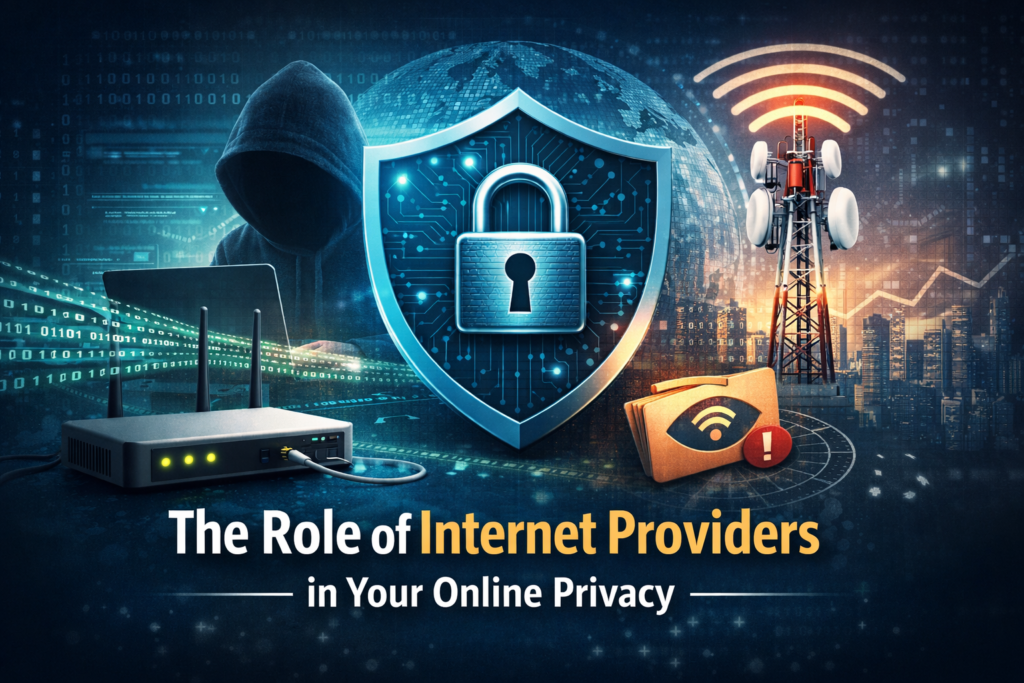
Most of us feel as though we are in our own digital world when we open our laptops, sitting in our favorite corner, far away from prying eyes. But as we’re typing away, the reality is that we’re never alone—our Internet Service Provider (ISP) is always present. 

Most of us treat our ISP as we do any other utility—pay the bill, get the service, and don’t think much about it. However, when every piece of data is worth money, we have to ask ourselves: What is the role of our internet provider?

Let’s dive deeper into that.

Table of Contents

Toggle
  • Can Your ISP Watch What You Do Online? 
  • Who Meddles in Your Browsing History?
  • Throttling: When Your Provider Plays Favorites
  • How to Reclaim Your Digital Space
    • Moving Under the Radar
  • The Rise of the “Supercookie”
  • How to Spot a “Good” Provider

Can Your ISP Watch What You Do Online? 

If you aren’t doing anything “wrong” online, you have nothing to worry about. Wrong! 

Privacy is not about how well you’re hiding your secrets but rather who has access to the data you send or receive. All of this has to pass through your ISP’s servers, so they can see the “address” of every digital destination you visit. 

Nowadays, we have encryption protocols that “mask” the data and make it unreadable to third parties, so that part is secured. However, your ISP can still see the metadata—which sites you visited, when you visited them, and sometimes, your behavior on those websites.

Individually, these pieces of information don’t reveal much, but when you combine them over time, they paint a startlingly accurate picture of your health, your finances, and even your personality.

Who Meddles in Your Browsing History?

In the United States, the rules of the road for ISPs have changed quite a bit over the years. Currently, many providers are legally allowed to collect and even monetize the data they gather. While they usually strip your name and social security number, they can sell “segments” of user behavior to advertisers.

Essentially, your browsing habits help companies build a “digital twin” of you to figure out exactly what you might buy next. According to insights from digital civil liberties advocates, the lack of strict data privacy laws means that in many states, your provider has a fairly long leash when it comes to how they handle (and profit from) your digital footprint.

Throttling: When Your Provider Plays Favorites

Aside from how your data is being handled, privacy is also about how you’re allowed to use the service you pay for. What does this mean? Well, if you’ve noticed your download speed slowing or your video quality suddenly dropping, you might be experiencing “traffic shaping,” or throttling.

By analyzing the type of data traveling through their lines (even if they can’t see the specific file), ISPs can slow down high-bandwidth activities to manage their network load. While they claim it’s for “network health,” it raises a bigger question: Should a company be allowed to decide which parts of the internet work better than others?

How to Reclaim Your Digital Space

If you don’t like the idea of your ISP keeping a log of your midnight searches, you’ll be happy to know that there are solutions. You can start addressing your privacy by adding a few layers of protection to your setup.

  • Ditch the default DNS: Your router typically uses the ISP’s “address book” (DNS) to find websites. Switching to a free, privacy-focused DNS like Cloudflare (1.1.1.1) or Quad9 stops your provider from being the primary logger of your requests.
  • Encrypt everything: Stick to apps that offer end-to-end encryption. This ensures that even if the ISP sees you’re sending data, they have no way to unscramble the contents.
  • Check your hardware: If you’re using the router the cable company gave you, check the privacy settings. Often, “diagnostic” features are just fancy names for data collection.

Moving Under the Radar

Using a VPN as a service is one of the best ways to make your online activity virtually invisible for those who want to take it a step further. When you click “connect,” your computer makes a secure tunnel to a remote server. Your ISP sees your traffic as one big stream of gibberish.

They can only see that you’re connected to a secure node; they can’t see what apps you’re using or what sites you’re visiting. This takes the trust away from a provider that might want to sell your data and gives you back control over who can see what you do online.

The Rise of the “Supercookie”

One of the more clever and controversial ways providers have tracked users is through Unique Identifier Headers, or what we now call supercookies.

What is a supercookie? Well, a normal cookie lives in your browser, but a supercookie is attached to your data directly in the network.

You can’t delete them by clearing your cache or using an “Incognito” window. They follow you across devices, allowing advertisers to recognize you even if you’ve tried to reset your identity. As experts in web privacy and security point out, as long as there is a financial incentive to track users, these “stealth” methods are projected to evolve.

How to Spot a “Good” Provider

Don’t think that every ISP is after your history. Some providers build their reputation on “privacy-first” ethics. You can check how they handle user data by going through their annual Transparency Report.

This process will allow you to see what data is being shared and how, but also understand the provider’s role in the data journey and which technical steps you can take to protect your online world.

After all, surfing the web can be a lot more fun when you aren’t being followed.

Tags: digital privacy guidehow ISPs track usersinternet providers and privacyinternet security tipsISP data collectionISP privacy risksonline privacy protectionprotect browsing data
ShareTweetPin
Previous Post

When Buildings Tell a Story: Architecture That Inspires

Next Post

Richard Harris Car Accident Lawyer in Las Vegas vs Other Legal Options: Key Decision Factors

Bryan Davis

Bryan Davis

Bryan Davis is a professional writer and researcher specializing in health, wellness, pets, and technology. With years of experience producing accurate, evidence-based content, he combines thorough research with practical knowledge to provide readers with reliable guidance. Bryan is dedicated to creating trustworthy content that empowers individuals to make informed decisions about their health, lifestyle, and pets.

Related Posts

what to check before buying a refurbished high-end smartphone

What to Check Before Buying a Refurbished High-End Smartphone

by Bryan Davis
April 14, 2026
0

Saving hundreds on a premium device is genuinely possible, but only if you know exactly what to look for before...

enterprise cybersecurity framework

Beyond Basic Antivirus: Building a Holistic Cybersecurity Framework for Growing Enterprises

by Bryan Davis
April 14, 2026
0

Antivirus software made sense when the biggest threat was a bad file on a floppy disk. That world is long...

advanced cable certification for enterprise IT

Beyond the Blink: Why Advanced Cable Certification is the Foundation of Enterprise IT

by Bryan Davis
April 9, 2026
0

Introduction It usually starts with small, frustrating issues. A call drops mid-conversation, a cloud app suddenly slows down, or a...

continuous NIST re-evaluation

Moving Beyond Static Security: How Continuous NIST Re-Evaluation Drives Measurable ROI

by Bryan Davis
April 9, 2026
0

Introduction For many businesses, cybersecurity spending feels like a constant expense with unclear returns. You invest in tools, platforms, and...

Warehouse Management Software

How Implementing Warehouse Management Software Streamlines Operations

by Bryan Davis
April 9, 2026
0

Integrating sophisticated warehouse management software (WMS) can be transformative for businesses, optimizing inventory control and response times significantly. Studies show...

Next Post
Richard Harris Car Accident Lawyer in Las Vegas

Richard Harris Car Accident Lawyer in Las Vegas vs Other Legal Options: Key Decision Factors

Why Can’t I Run My Genboostermark Code

Why Can’t I Run My Genboostermark Code? Fix Errors Quickly With These Proven Solutions

Leave a Reply

Your email address will not be published. Required fields are marked *

RECOMMENDED

first guided UTV adventure tour tips

Helpful Tips to Prepare for Your First Guided UTV Adventure Tour

April 17, 2026
kayaking trip on the Shenandoah River

How to Prepare for a Fun and Comfortable Kayaking Trip on the Shenandoah River

April 17, 2026

MOST VIEWED

  • What Is VACP Treas 310

    VACP Treas 310 Meaning: VA Payment Code Explained (2026 Guide)

    0 shares
    Share 0 Tweet 0
  • Babata Namak Sinhala – Babata Lassana Namak

    7361 shares
    Share 0 Tweet 0
  • 15 Best Sites to Download Paid Android Apps for Free

    1 shares
    Share 0 Tweet 0
  • Top 5 Trends in Sunglasses for 2026

    0 shares
    Share 0 Tweet 0
  • 42 Dugg Height Life, Career, Net Worth, and More

    0 shares
    Share 0 Tweet 0

Follow Us on Social Media

efindanything-logo

This is a lifestyle blog offering an everything about Health & Fitness,Financial Services,Insurance,Travelling and more.Join us. Dive in. Improve your Life

CATEGORY

  • Art & Design (1)
  • Business (300)
  • Careers (9)
  • Cars & Other Vehicles (136)
  • Construction (5)
  • Digital Marketing (6)
  • E Money (26)
  • Education (70)
  • Engineering (1)
  • Entertainment (17)
  • Environment (1)
  • Fashion (49)
  • Financial Services (160)
  • Foods (48)
  • Games (49)
  • Gear & Equipment (2)
  • Health & Fitness (454)
  • History (3)
  • Home Products & Services (384)
  • Insurance (16)
  • Law (153)
  • Lifestyle (40)
  • Other (24)
  • Parenting (3)
  • People and Society (34)
  • Pets (1,228)
  • Political (1)
  • Psychology (2)
  • Real Estate (62)
  • Relationships (48)
  • Safety (17)
  • Spirituality (51)
  • Sports (22)
  • Technology (240)
  • Travel (65)
  • Wishes (1)

RECENT POSTS

  • Helpful Tips to Prepare for Your First Guided UTV Adventure Tour April 17, 2026
  • How to Prepare for a Fun and Comfortable Kayaking Trip on the Shenandoah River April 17, 2026
  • Jaynike vs YouTubeStorm: Which YouTube Growth Service Is Best in 2026? April 17, 2026
  • How Can You Make Your Moving Day More Organized and Stress-Free? April 17, 2026
  • TikTok Views Providers Compared: Which Platform Delivers Real Tiktok Engagement? April 16, 2026
  • Home
  • About Us
  • Contact Us
  • Privacy Policy
  • Terms & Conditions
  • Disclaimer
  • Sitemap

© 2018- 2026 E Find Anything

No Result
View All Result
  • Home
  • Health & Fitness
  • Technology
  • Pets
  • Business
  • Financial Services
  • Home Products & Services
  • Other Categories
    • Cars & Other Vehicles
    • E Money
    • Education
    • Entertainment
    • Foods
    • Games
    • Lifestyle
    • Other
    • People and Society
    • Relationships
    • Spirituality
    • Travel
  • About Us
  • Contact Us

© 2018- 2026 E Find Anything

Go to mobile version