
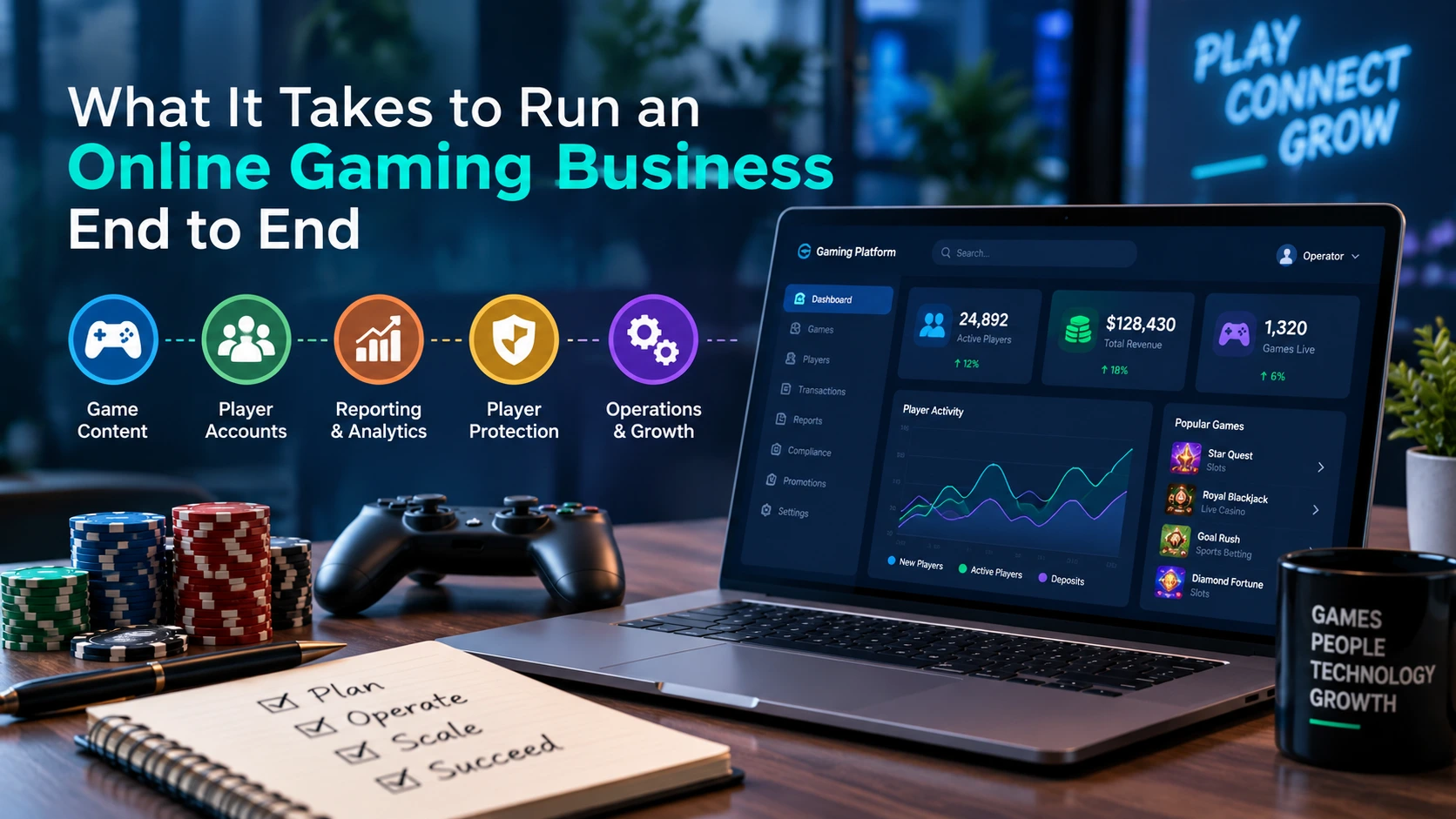
From the outside, an online gaming business looks like a website with games and betting markets. From the inside, it is a long chain of moving parts that all have to work at once: content, accounts, reporting, protection, and the daily operations holding everything together. Understanding that chain is the first step to running it well, because a weakness anywhere in it eventually surfaces as a problem players can feel.
Every link in that chain runs on online gaming software of one kind or another, and how well those pieces fit together decides how the whole business performs. Soft2Bet, a leading iGaming turnkey solutions provider delivering high-quality products and services for online gambling operators, builds its platform so operators get that chain as one connected system rather than a set of parts to assemble.

The Front of House and Everything Behind It
Players interact with a small visible slice of the operation: the lobby, the games, the markets, the account screen. Behind that slice sits the majority of the business. Content has to be sourced and kept fresh, accounts have to be managed accurately, activity has to be reported, and player protection has to run continuously in the background.
The visible layer is only as good as what supports it. A beautiful front end on top of shaky infrastructure produces an experience that looks right and behaves wrong, and players judge behaviour far more than looks. Getting the invisible layers right is what makes the visible one dependable.
The Daily Work of an Operator
Running the business day to day means keeping many small processes moving at once. None of them is dramatic on its own, but together they decide whether the operation feels sharp or sloppy.
A typical operating day involves keeping on top of:
- content updates across the catalogue
- account activity and player queries
- operational reporting and performance review
- player protection checks running as designed
- the technical health of the platform itself
Why the Pieces Have to Talk to Each Other
Each part of the chain can be competent in isolation and still produce a clumsy business if the parts do not connect. When accounts, content, and reporting live in separate systems, someone has to bridge the gaps by hand, and every bridge is a place where time is lost and mistakes creep in.
A connected platform removes those bridges. One player record, one operational view, one place where the day’s work happens. The difference is hard to show on a feature list and impossible to miss in daily use: the connected operation simply moves faster with less effort. Over months, that saved effort is not a marginal gain, it is the difference between an operation that keeps up and one that pulls ahead, using the same people and the same hours.
Growing Without Rebuilding
A business that starts well soon wants more: more content, more players, eventually more markets. The end-to-end chain has to stretch to fit, and how gracefully it stretches depends on choices made long before growth arrived. Infrastructure built with headroom turns expansion into an adjustment, infrastructure built for day one turns it into a rebuild. Few operators regret buying room they did not yet need, many regret discovering, mid-growth, that the room was never there.
This is where the choice of foundation quietly pays off or quietly costs. Soft2Bet operates under 23 licenses across 12 jurisdictions, which reflects a platform built with multi-market growth in mind rather than adapted to it after the fact.
Conclusion
Seen end to end, an online gaming business is less a website and more a system, and the operators who thrive are the ones whose system runs as a single connected whole. Every gap between parts costs time, and every connection saves it, day after day.
That connected foundation is also what engagement tools need underneath them. Soft2Bet completes the chain with MEGA (Motivational Engineering Gaming Application), its gamification engine, so the system that runs the business also helps keep players genuinely interested in it.