The problem of the “shrinking world” is not an uncommon one. For many seniors living on their own, the social calendar doesn’t vanish overnight – it very slowly shrinks over the course of many years until a week can go by with barely a good conversation happening that wasn’t with family. Independent living communities are one of the most direct ways to break that cycle, but the discussion about them seems perpetually mired in what’s being left behind rather than what’s being added on.
Passive isolation is the real threat
Most elderly people who live alone are not passively “withdrawing”; they’re actively looking for opportunities to connect. The difference is the effort it takes to find or create those opportunities is much greater when you’re on your own. Stressful nighttime driving to get to a book club can become a dealbreaker. Organizing a trip to a museum requires multiple people to show interest and pick a date. All it takes is one rainy day and a reschedule to stop trying as hard.
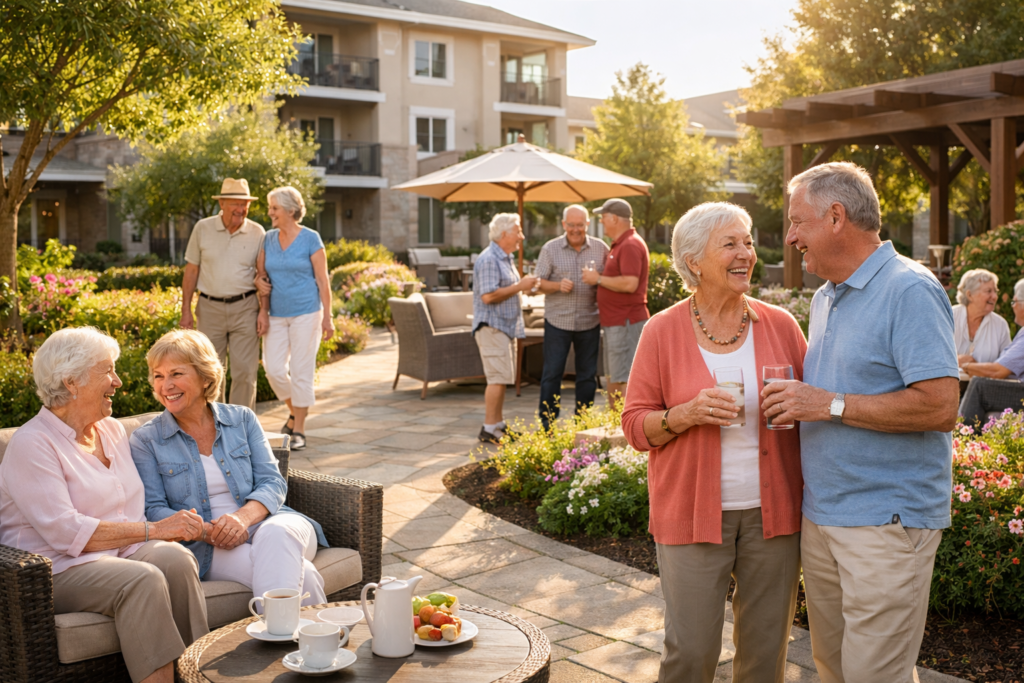
An independent living community removes most of those barriers by, literally, design. That book club is downstairs. There is a bus leaving for the museum next week. Did you want to join the afternoon game of bridge and grab a sandwich? It’s an order of magnitude easier for residents to connect, from which flow all manner of health and wellness benefits.
Shared experience creates real support
There is a specific type of emotional support that people in the same season of life can offer. Surely, talking to your adult children about aging is rich and rewarding, but it’s not the same as just not having a stressful conversation and letting the problem get bigger to the point where that conversation becomes necessary. Many older adults deliberately avoid specific topics to prevent any worry in family members or the tendency to feel like a burden to them. Peers have no such interpersonal minefield.
Their neighbors might stop driving, too. Likewise, worrying about small things in the house, managing medications, or considering what’s coming up next in life. Peers understand these references. They relate to these experiences. They trust them, and take care of them. This is communities building social capital, that protective, informal safety net that you enjoy when you actually know your neighbors. And that’s definitely different than the usual neighborhood friendliness. It’s knowing that you didn’t make it to Tuesday lunch.
Reclaiming identity beyond the family home
Many people feel that moving out of the family home they’ve lived in for decades would be abandoning a crucial part of their identity. But here’s another perspective on that life phase: the family home can eventually take over as a full-time job. And when that ‘job’ finally ends, it can be a relief, not a loss.
Going, maintaining, fixing, planning; a house and yard require a huge mental and physical outlay that could better be spent elsewhere. What do you fill that vacuum with, when suddenly there’s no house and yard to worry about anymore? For many residents, it’s a chance to rediscover hobbies and aspects of themselves that fell by the wayside in the demands of career and raising a family.
Book clubs, gardening groups, art classes, these are more than just ways to kill the day – they’re opportunities to build a new self that has never been tied to a job title, or a parental role that’s inevitably at the tail-end of its lifecycle. Good activities coordinators and directors at facilities understand this. They’re not just scheduling token events for the day, but giving residents a reason to engage with their surroundings.
Location still matters
The community itself sets the daily social rhythm, but the surrounding city shapes the broader lifestyle. Transportation services that remove the stress of driving give residents access to cultural events, restaurants, and landmarks they might otherwise stop visiting. That access isn’t trivial – it’s the difference between feeling like you live in a community and feeling like you live in a bubble.
For families exploring independent living in St. Louis, the combination of on-campus programming and access to the city’s museums, parks, and performing arts venues creates a genuinely full social life rather than an insular one. What the community provides daily and what the city provides occasionally work together.
The informal health benefit people don’t talk about enough
Routine social interaction in a community environment serves almost as continuous casual health checking. Neighbors observe. Staff observe. If someone is having a bad day, or not there anymore, or becomes more isolated than normal, you have people in proximity to react.
This doesn’t replace medical care. But it does fill an important gap – the gap between quarterly doctor visits for a person truly living alone and out of sight. Small early alterations in behavior or mood are much more likely to be recognized and dealt with when that person is part of a community than when their only regular interaction is a phone call once a week.
The decision to move into independent living isn’t a capitulation. It’s a choice to stay in touch, stay involved, and stay recognizable to those around you. For seniors seeing their social circle slowly but surely diminish, that’s something to take very seriously – and to begin to think about sooner rather than later.