
Unplugged camping is not to get away from the systems, it’s about creating good systems. It’s whether you had self-contained machine mentality in your set-up before you even hit the road that will determine whether or not your weekend goes exactly to plan or you return home with a flat battery and a belly full of bad memories.
Build Your Power Budget in Watt-Hours, Not Gut Feel
Most people estimate the size of their battery bank based on a rough guess. They purchase a 100Ah battery, install a solar panel or two, and cross their fingers. This method falls flat as soon as you realize you’re three days away from the nearest resupply stop.
The right way to size a battery bank is to perform a watt-hour audit on every single appliance you intend to operate while away from mains power. Log each appliance, its wattage, and the average number of hours it runs per day. A 12V compressor fridge consuming 45W for 12 hours needs 540Wh. Add 20W of LED lighting for 5 hours (100Wh), a 60W water pump running for 0.5 hours (30Wh), a 30W fan for 8 hours (240Wh), and 60Wh for device charging. That’s roughly 1,030Wh per day before you even consider the electric grinder or CPAP.
Now add a 20% safety margin to cover unanticipated use and inefficiencies. You now need 1,240Wh per day. A 100Ah lead-acid battery nominally contains 1,200Wh, but you should not discharge it past 50%, leaving you with 600Wh, not even enough to run the refrigerator. In moderate conditions, a 12V compressor fridge can consume between 40 and 60Ah per day, and this usage can increase by up to 50% when the outside temperature exceeds 35°C (RV Industry Energy Consumption Study). This means that with high temperatures, your fridge will flatten a single lead-acid battery before your morning coffee on the first day.
Choose a Rig Built For Where You’re Actually Going
Standard caravans are designed for sealed roads and powered sites. Try driving one on a bumpy road to a remote waterhole and you will experience what it means to be “not built for that” with cabinetry cracking, cupboard latches blowing out, and dust coming in through every crevice.
On a true remote journey, the engineering and structure of the suspension and chassis are not about comfort alone. They are what stands between your home away from home falling apart over rough tracks, or through water crossings, and the relentless pounding of thousands of kilometers of cross-country travel.
Heavy-duty independent coil suspension absorbs the lateral and vertical shock that rigid axle setups transmit directly into the frame and fittings. A hybrid caravan bridges the gap between a traditional caravan and an off-road camper trailer, offering a dust-sealed aluminum frame and independent suspension without giving up the creature comforts of a hard-roof ensuite and internal kitchen. That combination matters when you want to access genuinely remote sites but don’t want to spend every night in a swag. A high-clearance chassis keeps the drawbar, where your gas bottles, stone guards, and jerry cans are stowed, from dragging on steep entry angles.
Dust ingress is a separate problem from suspension, and it’s worth addressing deliberately. Dust-reduction systems, positive pressure ventilation, sealed cabinetry, proper door and window gaskets, keep fine particles out of electronics, bedding, and food storage. After a week on red dirt roads, a rig without proper dust sealing looks and feels exactly like what it is.
Switch to LiFePO4 and Recover Real Capacity
Switching to LiFePO4 (Lithium Iron Phosphate) batteries is not a luxury expense over AGMs; for overlanders doing more than weekend trips, it’s an essential cost.
Lithium batteries can safely discharge to 80-90% of their rated capacity instead of the 50% that keeps AGMs healthy, so a 100Ah LiFePO4 battery really nets you around 90Ah of usable power vs. the 50Ah you’d get from that size AGM one. That’s not a marginal improvement, it nearly doubles your effective storage in the exact same space.
Weight is also a critical factor. Water and fuel are already heavy. Carrying two AGM batteries to achieve the same power output of one lithium bank is a bunch of mass you simply don’t need to waste.
Pair your lithium bank with a State of Charge (SoC) monitor, a digital shunt-based gauge that reads actual amperage flow in and out of the battery. Voltage-based guesses are useless with lithium because their voltage profile is extremely flat across most of their discharge range. Without a proper SoC monitor, you won’t know you’re at 10% until the fridge shuts off.
Build a Solar System That Works When You’re Parked in the Shade
Fixed rooftop panels charge the battery while you’re driving and while you’re set up under direct sun. But most good campsites have trees, and trees mean shade. That’s where the strategy breaks down if rooftop panels are your only source.
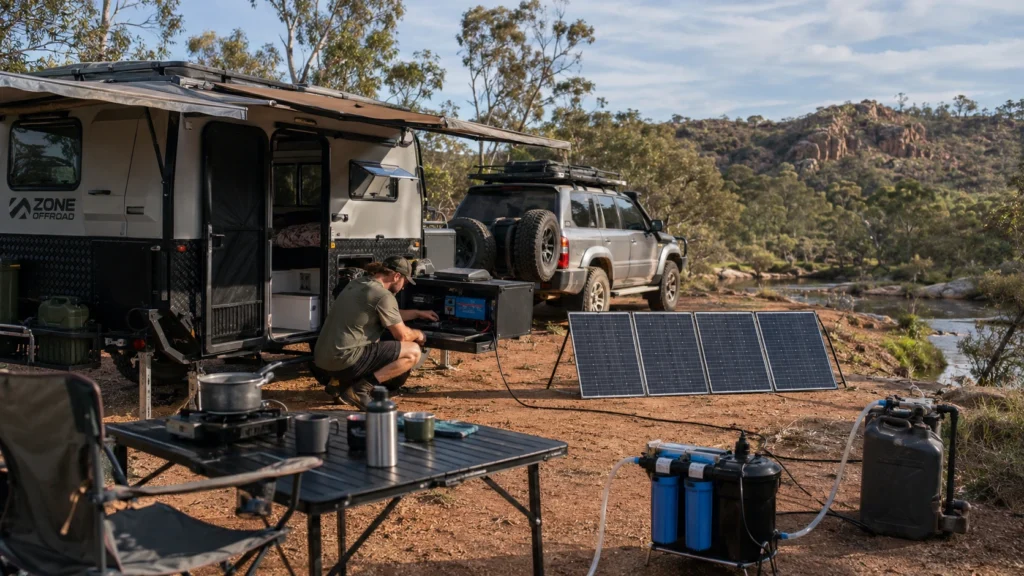
Portable solar blankets, folded monocrystalline panels that deploy on the ground or against a fence, let you run an extension lead from the shaded camp spot to a patch of open sunlight 10 or 15 meters away. A 200W rooftop array plus a 160W solar blanket gives you 360W of potential generation, and you get to keep the awning down and the camp comfortable.
Whatever panels you’re running, they need to feed through an MPPT (Maximum Power Point Tracking) solar controller rather than a basic PWM unit. An MPPT controller continuously adjusts the electrical operating point to match the battery’s current state of charge, recovering significantly more energy, particularly during low-light morning hours and on partly cloudy days.
While you’re driving, a DC-to-DC charger pulls power from the tow vehicle’s alternator and feeds it into your house batteries at a controlled, battery-appropriate charge rate. Modern lithium batteries require a tailored charge profile that a direct alternator connection won’t provide. A DC-to-DC charger handles that correctly and keeps both the vehicle’s electrical system and your house bank safe.
Run a Three-Tier Water Strategy
Managing water at the system level involves dividing the supply into three categories: potable water, utility water, and an emergency reserve that should not be used under regular circumstances.
This can be easily achieved with different colored water bladders or cisterns. Not only does this make it easy to see how much of each water type you have left, but it also ensures that people or gear drawing utility water in one direction cannot spread contaminants to the potable water located in another, cross-contaminating your drinking supply. Utility water can be replenished from natural sources and requires less effort to be potable, as it is only used for washing and bathing.
A 12-volt inline pump assembly can be used as a simple way to draw water from a creek or lake with a two-stage filtration system between the water source and your low-pressure storage cistern. A 5-micron sediment filter will reduce dirt and rust, followed by a 0.5-micron carbon block that can take out bacteria, protozoa, and chemical contamination. This refills your low-pressure utility tanks with the convenience of a tap and hose but does not waste your drinkable potable water.
For drinking water, gravity-fed filtration using hollow fiber membrane filters provides a non-electric backup method that works even when the pump system is down. These passive filters are light, reliable, and don’t require power, making them a sensible redundancy layer rather than a primary system.
Cut Water Consumption Before You Even Start Filtering
The quickest way to increase your available supply of water is not to lug around more water, but to reduce your water usage. A couple of simple changes will provide substantial benefits.
For instance, scraping your plates with a silicone spatula before washing can reduce the amount of water you need for cleaning, and it decreases the amount of grease that enters your greywater system. Similarly, using a spray bottle to wash your hands instead of running a tap at your sink will require far less water to get the job done. In fact, these two changes alone will see your water usage cut by up to 60% per day compared to the sort of practices most campers would be familiar with from home.
Greywater management is becoming more regulated in ecologically sensitive areas. A greywater tank (with its biodegradable, leave-no-trace soaps) rather than simply emptying wash water straight onto the ground is becoming a legal requirement rather than an alternative in more and more remote places. If you’ve got a tank, you’re the one who gets to decide if greywater ever comes into contact with soil, and how it’s disposed of.
A water bypass valve in the plumbing can isolate your hot water tank on those short trips or when winterizing. It’s a simple little fitting, but it saves you from having to run a full tank cycle with every pack-up of an evening or winterizing if the forecast predicts frost.
Handle Blackwater Without Destroying Your Timeline
Traditional chemical cassette toilets need to be emptied every two to three days, based on group size, which dictates your itinerary around dump stations. In truly remote areas, there simply aren’t any.
A composting toilet separates liquid and solid waste at source. Liquids go to a small contained tank. Solids are treated in an aerobic environment with the addition of a carbon-based medium to remove any scent and reduce the volume of output. The result is a system that can be left for weeks at a time, requires no water, and produces a product with much less contact with hazardous waste products than chemically treated ones.
The waterless component is also important when you consider off-grid longevity. Every flush from a water-based system is a mouthful of your potable supply gone. On a week-long journey with two people, we’re talking tens of liters here; wouldn’t you rather drink and cook with that?
Weight Distribution is a Safety Calculation, Not an Afterthought
Taking 300 liters of water with you will add approx. 300kg to your rig. That 300kg has to be incorporated low in the chassis, over the axles, not perched in high external jerry cans at the rear. High, rearward weight shifts the center of the trailer backwards, reducing the towball download and seriously increasing the risk of sway at highway speeds.
Then there’s the Aggregate Trailer Mass (ATM) which is the combined legal and structural weight limit of the trailer fully loaded. Exceeding it affects braking distances, tyre load ratings, and the mechanical stress on the coupling. Check your water, fuel, gear, and battery weight against the ATM before every long trip, not just the first one.
Self-sufficiency in the bush comes down to how well you’ve engineered the inputs against the outputs. Get the numbers right, and the remote stuff takes care of itself.