
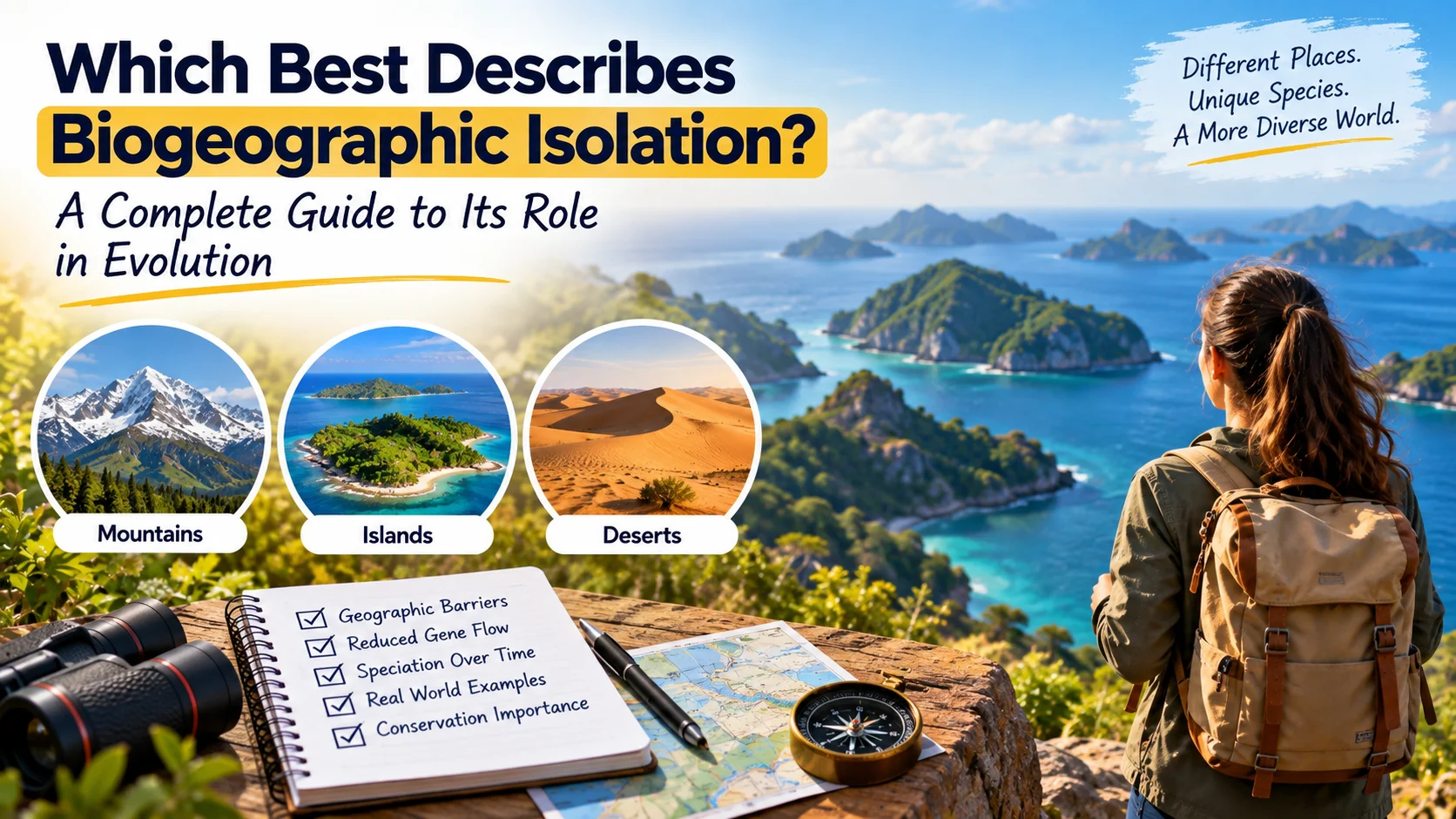
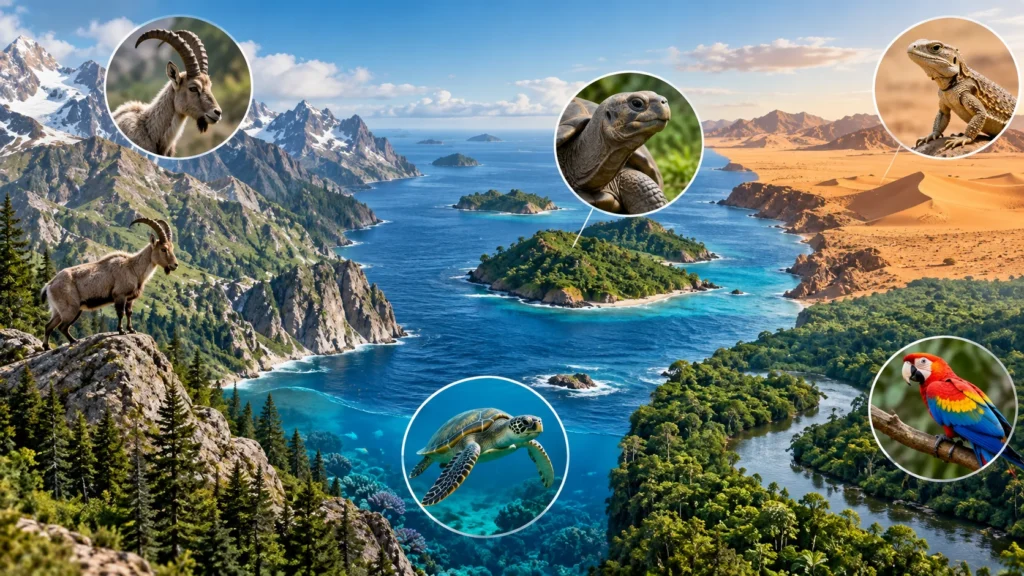
Biogeographic isolation describes the separation of populations or species across geographic areas. Physical features such as mountains, oceans, rivers, deserts, and islands can limit movement and reduce opportunities for populations to interact and exchange genes.
This concept is important in evolutionary biology because geographic separation can influence how populations change over time. When gene flow between separated populations is reduced for many generations, the populations may accumulate genetic differences. In some circumstances, these differences can contribute to the formation of new species.
The correct answer is: it is a mechanism that can contribute to evolution and speciation.
Understanding biogeographic isolation is important for studying how organisms are distributed across Earth and how populations can diverge. Geographic separation can arise when new landforms develop, sea levels change, rivers alter their courses, or populations become separated on islands or other isolated habitats.
Once populations are separated, differences in their environments, mutations, natural selection, genetic drift, and other evolutionary processes can cause them to become increasingly different. The longer separation continues, the greater the potential for genetic divergence.
Key Takeaways
- Biogeographic isolation involves the geographic separation of populations or species.
- Geographic barriers can reduce or prevent gene flow between populations.
- Reduced gene flow can allow separated populations to accumulate genetic differences.
- Over many generations, genetic divergence can contribute to speciation in some populations.
- Mountains, oceans, rivers, deserts, islands, and large distances can contribute to geographic isolation.
- Island populations provide important examples for studying biogeography and evolution.
Understanding the Fundamentals of Biogeographic Isolation
Biogeographic isolation is closely connected to evolutionary biology because geography can influence the movement of organisms and the exchange of genes between populations. When populations become separated, they may experience different environmental conditions and evolutionary pressures.
Over time, isolated populations can become genetically different. Mutation introduces genetic variation, natural selection can favor traits that are useful in particular environments, and genetic drift can change allele frequencies through chance. Together, these processes can contribute to divergence between populations.
Definition and Basic Concepts
Biogeographic isolation occurs when populations occupy separate geographic areas and have limited opportunities to interact. Mountains, oceans, rivers, deserts, changing coastlines, and islands can all create or maintain geographic separation.
Geographic isolation is especially important when it reduces gene flow. If individuals from separated populations rarely reproduce with one another, genetic differences can accumulate independently over generations. This can eventually contribute to allopatric speciation, where new species arise following geographic separation.
The Role of Geographic Barriers
Geographic barriers can prevent or greatly reduce movement between populations. Mountains, oceans, rivers, deserts, and islands are common examples. The effect of a barrier depends on the organism involved; a barrier that is difficult for one species to cross may be relatively easy for another.
Islands are particularly useful for studying biogeography because populations that become established there may experience limited gene flow with mainland populations. Over time, differences in environment and evolutionary history can contribute to distinctive populations and species.
Historical Context in Evolutionary Biology
The geographic distribution of organisms has played an important role in the development of evolutionary biology. Charles Darwin’s observations during his travels, including his studies of organisms on the Galápagos Islands, contributed to the development of ideas about adaptation and evolution.
Today, scientists combine information about fossils, genetics, geography, ecology, and species distributions to investigate how populations have changed and diversified over time.
| Geographic Barrier | Example | Possible Evolutionary Effect |
|---|---|---|
| Mountains | Major mountain ranges | Can separate populations and reduce gene flow |
| Oceans | Island populations | Can isolate populations from mainland relatives |
| Rivers | Large river systems | Can restrict movement in some terrestrial or aquatic species |
Which Best Describes Biogeographic Isolation in Nature?
In nature, biogeographic isolation refers to geographic separation that influences how populations interact and exchange genes. The separation does not automatically create a new species. Instead, it can create conditions in which populations experience different evolutionary histories.
Several factors can contribute to geographic isolation:
- Geographic barriers: Mountains, rivers, oceans, deserts, and other physical features can restrict movement.
- Climate differences: Different environmental conditions can limit where populations can survive and reproduce.
- Distance: Populations separated by large distances may have fewer opportunities for interaction and reproduction.
- Habitat fragmentation: Changes to landscapes can divide previously connected populations.
Island biogeography provides a useful example. When a population reaches an island and becomes separated from its original population, gene flow may be reduced. Natural selection, genetic drift, mutation, and other evolutionary processes can then shape the isolated population over time.
The relationship between geography and evolution is complex. Geography can influence where organisms live, how easily they move, and how often populations exchange genes. These factors can influence patterns of genetic divergence and biodiversity.
| Factor | Description |
|---|---|
| Geographic Barriers | Physical features that can separate populations and reduce movement or gene flow |
| Climate-Based Separation | Differences in environmental conditions that can restrict where populations live and reproduce |
| Distance-Based Separation | Large geographic distances that reduce opportunities for populations to interact |
Types of Geographic Barriers Leading to Isolation
Different types of geographic barriers can separate populations. Two important processes discussed in biogeography are vicariance and dispersal. They describe different ways geographic distributions can develop and change.
Vicariance occurs when a previously connected population becomes divided by a newly formed geographic barrier. Dispersal occurs when organisms move from one area to another and establish populations in new locations.
Physical Barriers: Mountains and Oceans
Physical barriers such as mountains and oceans can strongly influence the distribution of species. For example, the formation of the Isthmus of Panama changed connections between marine environments and contributed to major changes in the distributions of marine organisms.
Mountains can also separate populations by creating difficult terrain or different environmental zones. The effects vary depending on the species and its ability to move through or around the barrier.
Climate-Based Isolation
Climate can influence geographic distributions because organisms often have specific environmental requirements. Differences in temperature, rainfall, seasonal conditions, and other environmental factors can restrict where populations can survive.
Climate change can also alter species distributions. As environmental conditions change, populations may shift their ranges, become fragmented, or encounter new opportunities for movement and interaction.
Distance-Based Separation
Distance can act as an important form of separation. Populations that live far apart may have fewer opportunities to exchange individuals and genes, particularly when additional environmental or physical barriers exist between them.
Dispersal can occur through many pathways, including wind, water, animal movement, and natural range expansion. Whether a population successfully establishes itself in a new area depends on environmental conditions and the species’ biological characteristics.
| Type of Barrier | Description |
|---|---|
| Physical Barriers | Mountains, oceans, rivers, deserts, and other physical features that can restrict movement |
| Climate-Based Separation | Environmental differences that limit where populations can survive and reproduce |
| Distance-Based Separation | Large distances that reduce opportunities for populations to interact |
The Process of Species Separation Through Isolation
Species separation through geographic isolation is a gradual evolutionary process. It begins when populations become separated and experience reduced gene flow. The separated populations can then follow different evolutionary paths.
Over generations, genetic differences can accumulate through mutation, genetic drift, and natural selection. Different environmental conditions can favor different characteristics in each population.
If genetic differences become sufficiently large, reproductive barriers may eventually develop. At that point, populations may no longer successfully interbreed even if geographic separation is later reduced. This is one possible pathway to speciation.
Understanding this process helps explain why closely related populations can eventually become quite different. It also helps scientists investigate the evolutionary history of species and the origins of biodiversity.
Island Biogeography: A Useful Example of Isolation
Island biogeography examines how species are distributed on islands and how factors such as isolation, immigration, extinction, habitat size, and evolution influence island biodiversity.
Islands such as the Galápagos, Hawaii, and Madagascar have provided important examples for understanding how geographic isolation and environmental conditions can influence evolution. Their unique communities include species that are not naturally found in many other parts of the world.
The Galápagos Islands Case Study
The Galápagos Islands are a well-known example in evolutionary biology. The islands contain distinctive species and populations that have evolved in different environments. Charles Darwin’s observations of Galápagos organisms helped contribute to the development of evolutionary theory.
Species such as giant tortoises and marine iguanas demonstrate how island environments can shape biological characteristics over long periods. Geographic isolation can reduce gene flow, while natural selection and other evolutionary processes contribute to changes within populations.
Hawaii’s Unique Species Development
Hawaii provides another important example of island evolution. Because the Hawaiian Islands are geographically isolated, many organisms have evolved distinctive populations and species. Hawaiian honeycreepers, for example, are well known for their diversification into different ecological niches.
The Hawaiian Islands demonstrate how colonization, isolation, environmental differences, natural selection, and other evolutionary mechanisms can interact to produce biodiversity.
| Island Region | Examples | Important Factors |
|---|---|---|
| Galápagos Islands | Giant tortoises, marine iguanas, Darwin’s finches | Isolation, natural selection, environmental differences |
| Hawaii | Hawaiian honeycreepers and other endemic species | Isolation, diversification, ecological opportunities |
| Madagascar | Lemurs and fossa | Long-term geographic isolation and environmental diversification |
Madagascar’s Isolated Evolution
Madagascar is another important example of geographic isolation and biodiversity. Its long geographic separation from mainland Africa has contributed to the development of distinctive plant and animal communities.
Lemurs are among Madagascar’s best-known endemic mammals. Their diversity illustrates how isolated environments can support evolutionary diversification over long periods when populations follow different evolutionary paths.
The Role of Vicariance in Biogeographic Isolation
Vicariance is a process in which a geographic barrier divides the range of a population or species. The barrier can result from geological, environmental, or other large-scale changes that separate previously connected populations.
Once separated, the populations may experience reduced gene flow. Over time, differences can accumulate through mutation, genetic drift, natural selection, and other evolutionary processes. In some cases, prolonged separation can contribute to allopatric speciation.
Several factors can contribute to geographic separation:
- Geographic barriers, such as mountains, oceans, and rivers
- Changes in climate or environmental conditions
- Changes in landscapes and habitats
- Large distances between populations
It is important to distinguish geographic isolation from reproductive isolation. Geographic separation initially reduces opportunities for gene flow, while reproductive isolation involves biological differences that prevent populations from successfully exchanging genes through reproduction.
Vicariance has contributed to many patterns of biodiversity seen around the world. Studying these patterns helps scientists understand how geographic history and evolutionary processes have influenced the distribution of organisms.
| Example | Geographic Separation | Possible Evolutionary Outcome |
|---|---|---|
| Island populations | Ocean separating islands from mainland areas | Reduced gene flow and population divergence |
| Mountain populations | Mountain ranges separating habitats | Genetic differentiation between populations |
| River-separated populations | Large rivers restricting movement | Reduced interaction in species with limited crossing ability |
How Dispersal Affects Isolated Populations
Dispersal is the movement of organisms from one location to another. It is an important process in biogeography because it can allow species to colonize new environments and establish populations in areas outside their original range.
Dispersal can reduce isolation when organisms move between previously separated populations. On the other hand, when a small group disperses to a new location and becomes separated from its source population, the new population may eventually experience geographic isolation.
Methods of Species Dispersal
- Wind dispersal: Seeds, spores, and other small biological materials can be carried by air currents.
- Water dispersal: Organisms or reproductive structures can travel through rivers, lakes, oceans, and other waterways.
- Animal-assisted dispersal: Animals can transport seeds and other organisms either intentionally or accidentally.
- Active movement: Many animals can move into new habitats through their own locomotion.
Success Rates in New Environments
Dispersing into a new environment does not guarantee that a population will survive. Success can depend on food availability, climate, habitat, competition, predators, disease, and the organism’s ability to reproduce in the new environment.
If a population successfully becomes established and remains separated from its original population, genetic differences can accumulate over time. This may contribute to genetic divergence and, in some circumstances, eventual speciation.
| Factor | Effect on Dispersal |
|---|---|
| Geographic features | Can make movement into new areas easier or more difficult |
| Climate | Can determine whether a dispersed population can survive and reproduce |
| Available resources | Food, water, shelter, and habitat affect establishment success |
| Human activities | Can unintentionally transport organisms or alter natural movement patterns |
Genetic Consequences of Biogeographic Isolation
Geographic isolation can have important genetic consequences because it can reduce gene flow between populations. Once populations are separated, their genetic compositions can change independently of one another.
Different evolutionary forces can affect isolated populations. Natural selection may favor different traits in different environments, genetic drift can change allele frequencies through chance, and mutation introduces new genetic variation.
- Genetic drift: Random changes in allele frequencies, which can be especially influential in small populations.
- Natural selection: Differences in survival or reproduction associated with inherited traits in particular environments.
- Mutation: A change in DNA that can introduce new genetic variation.
- Reduced gene flow: Limited exchange of genes can allow separated populations to become increasingly genetically different.
These processes do not all have the same effect in every population. Their combined influence depends on population size, environmental conditions, migration, reproduction, and other biological factors.
Over long periods, genetic divergence can become substantial. If reproductive barriers eventually develop, the separated populations may become distinct species.
Modern Implications of Biogeographic Isolation
Biogeographic isolation remains important in modern biology, particularly in conservation. Many species live in fragmented or isolated habitats, and understanding their geographic distribution can help scientists identify populations that may be vulnerable to environmental change.
Climate change can alter habitats and species ranges. A population that becomes isolated in a shrinking habitat may have fewer opportunities to exchange genes with other populations. This can increase vulnerability, particularly when populations are already small.
Important conservation considerations include:
- Protecting important habitats and maintaining ecological connections where appropriate
- Reducing habitat fragmentation where possible
- Monitoring isolated and vulnerable populations
- Understanding how climate and environmental changes affect species distributions
Human activities such as deforestation, urban development, pollution, and habitat conversion can alter natural patterns of species movement. Studying biogeography helps researchers understand these changes and develop more informed conservation strategies.
Conservation Considerations
Conservation planning needs to consider the geographic structure of populations. Protecting only a single location may not be enough when a species consists of multiple populations with different genetic histories.
Maintaining suitable habitat and, where appropriate, ecological connectivity can help populations remain connected. At the same time, conservation strategies need to consider the biology and specific needs of each species.
Climate Change Effects
Climate change can shift the geographic ranges of species and change the environments in which populations live. Some populations may be able to move into suitable habitats, while others may become increasingly restricted by geographic or environmental barriers.
Understanding these changes can help researchers identify populations at greater risk and determine where conservation efforts may be most useful.
Human Impact on Isolated Populations
Human activities can create or strengthen barriers between populations. Roads, cities, agriculture, deforestation, and other forms of development can fragment habitats and make movement more difficult for some species.
Reducing habitat destruction and protecting important ecosystems can help maintain biodiversity. Biogeographic knowledge provides valuable context for understanding how these changes affect populations and species.
Conclusion: The Continuing Importance of Biogeographic Isolation
So, which best describes biogeographic isolation? It is the geographic separation of populations or species that can reduce gene flow and influence evolutionary change. Geographic isolation does not automatically produce a new species, but prolonged separation can allow populations to accumulate genetic differences.
Mountains, oceans, rivers, deserts, islands, climate differences, and large geographic distances can all influence where organisms live and how populations interact. Examples from the Galápagos, Hawaii, and Madagascar demonstrate how geographic history can contribute to distinctive patterns of biodiversity.
By studying geographic isolation alongside natural selection, genetic drift, mutation, dispersal, and other evolutionary processes, scientists can better understand how populations diverge and how new species can arise.
Biogeographic isolation is therefore an important concept in evolutionary biology, biogeography, and conservation. It helps explain both the distribution of life on Earth and the evolutionary processes that have shaped biodiversity over time.
FAQ
What is biogeographic isolation?
Biogeographic isolation describes the geographic separation of populations or species. Mountains, oceans, rivers, deserts, islands, and large distances can limit movement and reduce gene flow between populations.
How does biogeographic isolation contribute to speciation?
Geographic isolation can reduce gene flow between populations. Over many generations, mutation, genetic drift, natural selection, and other evolutionary processes can cause the populations to become genetically different. In some cases, these differences can eventually contribute to reproductive isolation and speciation.
What are examples of biogeographic isolation?
Examples include populations separated by mountain ranges, oceanic islands, large rivers, deserts, or other geographic features. The Galápagos Islands, Hawaii, and Madagascar are well-known examples for studying geographic isolation and biodiversity.
What types of geographic barriers can cause isolation?
Geographic barriers can include mountains, oceans, rivers, deserts, glaciers, changing coastlines, and fragmented habitats. The importance of each barrier depends on the species and its ability to move through or around it.
What is vicariance in biogeography?
Vicariance occurs when a geographic barrier divides a population or species’ former geographic range. The resulting populations may experience reduced gene flow and can follow different evolutionary paths over time.
What is the role of dispersal in biogeographic isolation?
Dispersal is the movement of organisms into new areas. It can connect populations when individuals move between them, but it can also establish a new population in a distant location. If that population later becomes isolated from its source, genetic divergence may occur.
How does biogeographic isolation affect genetic diversity?
Isolation reduces or limits gene flow between populations, allowing their genetic compositions to change independently. Genetic drift, natural selection, mutation, and other processes can produce genetic differences between isolated populations. Small isolated populations may also be particularly vulnerable to loss of genetic variation through genetic drift.
Why is biogeographic isolation important for conservation?
Understanding geographic isolation helps scientists identify how populations are distributed and connected. This information can be important when studying habitat fragmentation, climate change, population vulnerability, and strategies for protecting biodiversity.