

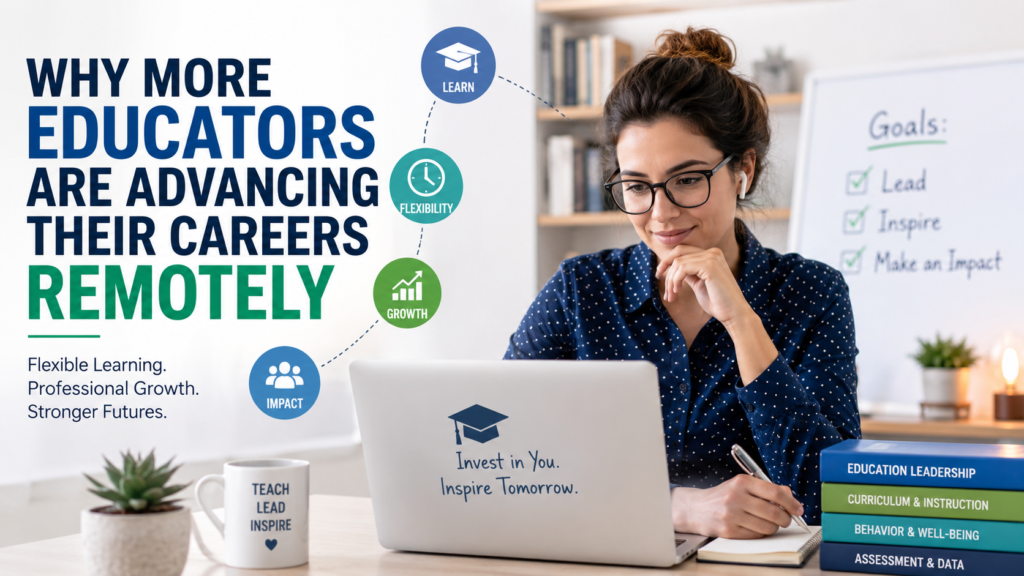
A lot of teachers end up researching graduate programs late at night after finishing lesson plans and grading, then immediately wonder how they would possibly fit school back into an already overloaded schedule. Full-time teaching already stretches most people thin. That is probably why remote learning became much more appealing recently.
Flexible programs fit more naturally around real life instead of forcing educators to rearrange everything just to continue advancing professionally. Teachers can keep working, manage family responsibilities, and slowly build new skills or credentials without stepping away from classrooms completely. For many educators, that flexibility made graduate education finally feel realistic again instead of impossible.
Flexible Learning Changed Professional Growth
Professional development used to follow a fairly rigid structure. Educators either attended evening classes in person or postponed graduate education entirely because balancing everything at once felt unrealistic. Remote learning changed that calculation for many people.
Flexibility matters more than people sometimes realize. Teachers already carry unpredictable schedules through grading, parent communication, meetings, extracurricular activities, and classroom preparation. Fixed campus schedules often created more stress instead of helping educators move forward professionally.
Masters of Education online programs removed some of those barriers. Educators can now study after work, during weekends, or whenever small windows of time become available between responsibilities. That flexibility probably explains why more teachers are willing to continue their education now instead of delaying professional goals indefinitely.
The interesting part is that many educators entering remote programs are not necessarily looking to leave teaching entirely. Some want leadership opportunities. Others want specialized knowledge, curriculum development experience, or stronger credentials for long-term stability within education itself.
Teachers Are Already Used to Adapting
One reason educators adjusted to remote graduate learning fairly quickly is that teaching itself already requires constant adaptation. Teachers manage technology problems, schedule changes, classroom behavior, curriculum updates, and communication challenges almost daily.
Remote education demands similar skills. Time management matters. Organization matters. Self-discipline matters. Educators already practice those habits professionally, even if they do not always think about it that way.
There is also a practical side to this shift. Many teachers became more comfortable with digital platforms after schools relied heavily on remote systems during recent years. Virtual meetings, online assignments, collaborative software, and digital communication tools stopped feeling unfamiliar. That experience lowered some of the hesitation around pursuing remote graduate degrees afterward.
Online learning still requires effort, obviously. Nobody casually earns a graduate degree between random free moments. But remote programs tend to fit more naturally into working adult schedules compared to traditional campus expectations.
Career Growth Feels More Necessary Now
A lot of educators pursue graduate education because the profession itself has changed significantly. Expectations continue to increase while classroom challenges become more complicated every year. Teachers are handling academic instruction alongside emotional support, technology integration, behavioral concerns, and communication demands that barely existed decades ago.
Because of that, many educators feel pressure to strengthen their skills continuously just to keep pace with changing expectations inside schools. Graduate education often becomes connected not only to salary advancement but also to long-term career stability and confidence.
Leadership opportunities matter too. Some educators eventually move toward instructional coaching, curriculum planning, administration, or specialized support roles after spending years inside classrooms. Remote graduate programs allow teachers to prepare for those transitions gradually while still working full-time. That flexibility changes career planning entirely. Educators no longer need to pause income or relocate physically to pursue advanced degrees in many situations.
Work-Life Balance Still Matters
One thing remote education changed is how educators think about balance generally. Teachers already spend large amounts of personal time working outside contract hours. Lesson planning, grading, emails, and preparation rarely stay confined neatly inside school buildings. Traditional graduate programs sometimes added even more exhaustion because commuting and fixed schedules removed whatever flexibility remained in the week. Remote learning reduced part of that pressure.
People still get overwhelmed sometimes. Graduate work layered onto full-time teaching is difficult, no matter where classes happen. But online programs often allow educators to organize coursework around actual life responsibilities instead of constantly reorganizing life around campus schedules.
That difference matters more as educators age, too. Many graduate students now balance children, caregiving responsibilities, mortgages, or second jobs alongside teaching careers. Flexible learning environments fit those realities more realistically.
Technology Changed Expectations Around Education
Technology shifted expectations for higher education overall. Students increasingly expect learning systems to reflect how modern professionals actually live and work. Education stopped feeling tied completely to physical classrooms once digital communication became integrated into everyday life.
Educators understand this shift firsthand because schools themselves have changed rapidly around technology integration. Teachers regularly use online tools inside classrooms now, communicate digitally with families, and manage coursework through learning platforms almost constantly. Remote graduate education feels like an extension of that broader transition rather than a completely separate concept anymore. Learning online stopped feeling experimental. For many professionals, it simply became another normal educational format.
That normalization matters because earlier generations sometimes viewed online degrees skeptically. Those perceptions changed considerably once universities improved digital learning systems and remote education became more common across industries generally.
Educators Want Practical Learning
Another reason remote graduate education appeals to teachers is that many programs focus heavily on practical application instead of abstract theory disconnected from classroom realities. Working professionals often apply concepts immediately while still teaching full-time. Classroom management ideas, instructional strategies, assessment methods, or leadership approaches get tested directly inside real professional environments instead of remaining purely academic discussions.
That immediate connection helps graduate learning feel more useful. Educators can evaluate what works, what does not, and how theories translate into actual classrooms filled with real students and unpredictable daily situations. Teachers tend to appreciate education that respects practical realities. Probably because teaching itself rarely operates under ideal conditions for very long.
Remote Learning Feels Less Disruptive
The biggest reason many professionals continue advancing careers remotely is fairly simple. Online learning feels less disruptive to existing life structures. Teachers can maintain jobs, continue supporting families, stay connected to professional communities, and pursue advanced education simultaneously instead of choosing one responsibility over another temporarily.
That flexibility does not make graduate school easy. It just makes it possible for more people who otherwise might never return to higher education at all. Modern education careers increasingly require ongoing development, but educators also live busy, complicated lives outside classrooms. Remote graduate programs grew because they acknowledge both realities honestly instead of pretending professional adults have unlimited time, energy, and flexibility available every week.